A scorching summer
Link

What are the key takeaways from the market news on August 27, 2026? Sebastian Paris Horvitz provides some insights.
Overview
►This summer’s heatwaves in Europe came close to breaking all-time temperature records, but their most devastating impact was felt through wildfires. As climatologists had predicted, the El Niño phenomenon, which was particularly strong this year, appears to have played a significant role in the high temperatures experienced in Europe and the torrential rainfall seen in South America. At this stage, the economic consequences, particularly for agricultural production, remain difficult to assess.
►Meanwhile, the heat was also spreading through the markets, with major equity indices reaching record highs in mid-August, still driven by expectations of rising corporate earnings. At the same time, long-term interest rates were also hitting new highs. This increase can be attributed to a rise in term premiums, reflecting uncertainty surrounding monetary and fiscal policies, as well as higher inflation expectations, partly driven by the rebound in energy prices.
►Energy prices remain under pressure as the conflict between the United States and Iran continues. Indeed, the Strait of Hormuz remains almost completely closed. Brent crude oil prices have climbed back above $90 per barrel, while European natural gas prices have reached a record high, exceeding €68 per MWh. These increases are obviously bad news for both inflation and growth momentum, particularly in Europe.
►At this stage, there is still little visibility on a path out of the crisis, with both the United States and Iran showing little willingness to resume dialogue. In fact, the United States, through Treasury Secretary S. Bessent, has indicated that economic sanctions against Iran will be stepped up, particularly by targeting countries that are seen as “financing” the Iranian regime. Given that China is the largest purchaser of Iranian oil, it is difficult to view this threat as highly credible.
►Adding to geopolitical tensions, the United States and Canada have entered into a tariff escalation after failing to reach an agreement on the new duties that the U.S. authorities sought to impose on their Canadian neighbour.
►Despite an environment dominated by geopolitical uncertainty, affecting energy prices, and by persistently high interest rates, it is almost surprising to see that the global economy continues to demonstrate resilience. This is the message conveyed by S&P’s preliminary PMI business activity surveys for August across the major economies. Indeed, whether in the euro area, Japan, the United Kingdom, or the United States, composite PMI indices (covering both services and manufacturing) all posted increases.
►In the United States, economic activity rebounded sharply in August according to S&P’s PMI index, driven primarily by the services sector, whose index returned to its highest level since 2024. Although activity in manufacturing continued to slow, the composite index (combining services and manufacturing) reached its highest level since 2026. It therefore appears that the cyclical recovery, supported by fiscal stimulus and investment in artificial intelligence, is still driving the U.S. economy forward.
►However, this momentum could slow once again, weighed down by the latest rise in energy prices. The price of gasoline remains above USD 4 per gallon, while diesel, the dominant fuel in transportation, is trading above USD 5 per gallon. Apart from the brief period in late March and early April, these are the highest levels seen since mid-2022. If such levels persist, they are likely to weigh on consumer spending and could keep inflationary pressures elevated.
►In addition, interest rates remain very high. U.S. 10-year Treasury yields are fluctuating around 4.70%, their highest level in nearly 20 years. This is clearly putting pressure on many sectors of the economy, with the exception, for now, of those that continue to invest heavily in the development of artificial intelligence.
►Above all, these elevated levels are increasing the cost of government borrowing. Treasury Secretary S. Bessent has already made several statements suggesting that the government could intervene in the bond market to prevent further increases in yields. However, with the budget deficit continuing to widen and the debt burden remaining on an upward trajectory, it will be difficult to sustainably calm the market through bond purchases, which can only be limited in scale. This would be even more challenging if, as we expect, the Federal Reserve is forced to move toward a tightening of monetary policy, even a moderate one, by the end of the year.
►In the euro area, economic activity, as measured by S&P’s PMI survey, continued to expand in August and even gained some additional momentum. However, unlike in the United States, manufacturing was the main driver of this strength, supported in part by increased public spending in Germany. The services sector remained resilient, but this was largely thanks to the smaller economies within the region. Indeed, services activity declined in both Germany and France. To some extent, this weakness in the services sector reflects the persistence of high energy costs, particularly for natural gas, as well as interest rates that remain elevated. Political uncertainty, especially in France, also appears to be weighing on confidence.
Going Further
Ormuz : la fermeture maintient des prix de l’énergie élevés
Shipping traffic has remained severely restricted for nearly six months
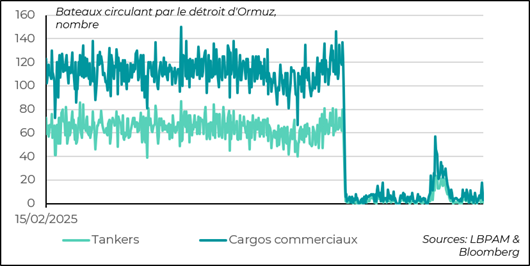
The summer has brought no resolution to the conflict between Iran and the United States, which has now been ongoing for nearly six months. On the contrary, negotiations have stalled, and the prospects for a short-term agreement appear, to say the least, very limited.
In this context, the Strait of Hormuz remains closed, with shipping traffic still heavily restricted. As is well known, without at least a gradual reopening of this strategic artery, there is little hope of a normalization of conditions in energy markets.
The negotiations are therefore at a complete standstill. Nevertheless, it appears, at least from the U.S. side, that a purely military strategy has been set aside for the time being. This can be seen as a relief, insofar as it reduces the risk of disrupting the region’s oil and gas production capacity.
However, the United States has announced a new wave of economic sanctions against the Iranian regime. In an article published by the Financial Times, Treasury Secretary S. Bessent stated that the United States would impose severe sanctions on countries that continue to provide financial support to Iran.
It is difficult to see how this threat could further weaken the Iranian economy in the short term sufficiently to push the regime back to the negotiating table. In particular, China remains Iran’s largest trading partner and purchases a significant share of the country’s remaining oil exports. It is therefore hard to imagine the U.S. government imposing severe sanctions on China.
Overall, and unfortunately for the global economy, we remain at an impasse.
Energy Prices Remain Very Elevated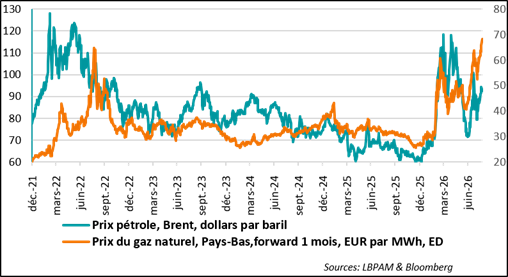
It therefore comes as no surprise that energy prices have started rising again. However, the increase in oil prices has remained relatively moderate. This partly reflects demand that has already adjusted significantly downward, notably through the continued use of existing inventories. China has played a major role in this adjustment. Overall, the price of Brent crude remains just above $90 per barrel, representing only a moderate increase.
However, this drawdown in inventories will soon begin to reach its limits. This could lead to further price increases, with physical constraints also expected to intensify across a number of refined products. We are already seeing refining margins widen.
While the rise in oil prices has remained moderate, the increase in gas prices has been much more significant. In Europe, the price per MWh has reached its highest level since Russia’s invasion of Ukraine. Gas prices currently stand at €68 per MWh.
As Europe must accelerate the rebuilding of its gas reserves ahead of winter, these tensions may persist. This will continue to weigh on Europe’s economic expansion, as higher energy costs erode households’ purchasing power and increase costs for businesses.
United States: Growth Amid Constraints
Activity
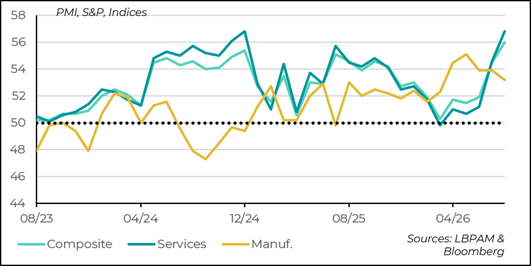
Across the Atlantic, the preliminary PMI business activity surveys once again delivered encouraging news. Indeed, the composite index rose sharply during the month, reaching its highest level since 2022. The services sector was the main driver of this improvement in activity, while manufacturing continued to slow following the strong rebound seen in the spring.
Overall, these figures point to an economy that remains highly resilient and consistent with solid GDP growth in the third quarter of 2026.
According to S&P’s survey, the rebound in services reflects, in particular, a strong increase in demand across the sector. More importantly, this appears to be accompanied by stronger hiring activity, based on company responses. It remains to be seen whether these trends will be confirmed by the next employment report, which is due to be released at the end of next week.
As for manufacturing, activity, although moderating, remains robust and appears to continue benefiting from investment linked to the development of artificial intelligence. The significant increase in corporate bond issuance to finance such investments has been notable. This trend is also reflected in the latest bank lending survey for the second quarter of 2026, which showed rising demand for credit facilities among larger companies.
Credit demand for investment from large corporations
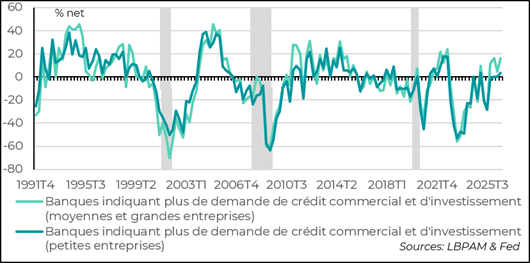
These very strong economic indicators continue to point to a cyclical acceleration in activity, driven by fiscal support measures and spending in the AI sector.
At the same time, it is important to emphasize that there are constraints on the continued expansion of the U.S. economy. The first is, of course, the rise in energy prices. After falling sharply on expectations that the conflict with Iran might come to an end, gasoline prices have moved higher again, returning to elevated levels. Gasoline prices are once again above $4 per gallon.
In addition, concerns over potential supply shortages have continued to drive up refining margins, putting further upward pressure on prices. As a result, the price of diesel, which is used primarily for road transportation, has risen sharply again, exceeding $5 per gallon once more.
Fuel prices are weighing heavily on transportation costs
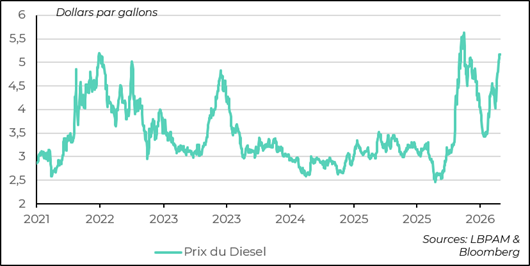
If these increases in energy prices persist, they will obviously have an impact on purchasing power and could slow economic activity more than currently anticipated. More importantly, they risk sustaining inflationary pressures and pushing the Federal Reserve to raise interest rates further.
We continue to expect an increase in policy rates before the end of the year, most likely after the midterm congressional elections.
Interest Rate Pressures Remain Elevated
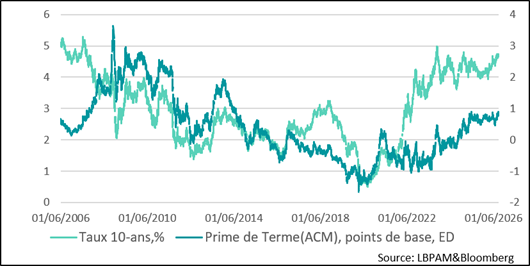
In this respect, another factor that could prove restrictive for economic expansion is the rise in interest rates. Indeed, the latest increase in energy prices has already pushed short-term rates higher, while pressures on longer-term maturities have also intensified.
The yield on 10-year U.S. Treasury bonds remains close to 4.7%, near its highest level in a decade.
This rise in long-term yields reflects, in part, higher inflation expectations, but above all a significant increase in term premiums.
This sudden decline in core inflation appears somewhat surprising, particularly in an economy where domestic demand remains resilient. There were some one-off factors, such as the exceptionally aggressive discounting campaigns conducted by Amazon during the month. However, it will take another month or two to determine whether this marks the beginning of a new trend, although the recent rise in energy prices could alter the outlook.
In any case, this development is noteworthy in an economy where domestic demand, and consumer spending in particular, continues to hold up well.
The Deterioration of Public Finances Continues
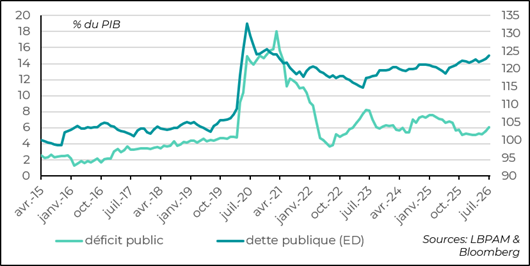
This increase largely reflects the uncertainty surrounding both monetary and fiscal policy. On the fiscal side, despite the revenues generated by the import tariffs introduced by President Trump, U.S. public finances continue to deteriorate. The budget deficit has started to widen again as a percentage of GDP, exceeding 6% over the twelve months to July, while public debt continues to climb.
Statements by S. Bessent regarding possible intervention in the bond market through the purchase of long-dated Treasury securities illustrate the concerns within the U.S. administration. According to Bessent, the aim would be to improve market liquidity and ease upward pressure on interest rates. Although these announcements have helped bring yields down somewhat, it is unlikely that U.S. Treasury interventions alone can resolve the tensions arising from the ongoing deterioration of public finances.
Euro area: Activity Holds Up in August
Industry Maintains Its Momentum in August
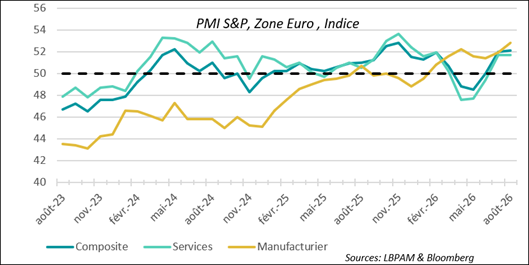
S&P’s preliminary PMI survey remained relatively robust in August, with the composite index (covering both services and manufacturing) edging higher to reach its highest level in nine months. The continued strength of the economy was driven primarily by the manufacturing sector. By contrast, activity in the services sector remained unchanged, likely weighed down by elevated energy costs and ongoing political uncertainties.
Industry Is Driving Growth... Particularly Thanks to Germany
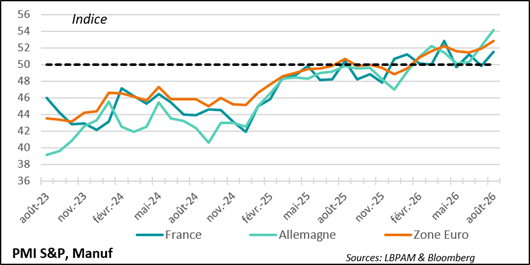
The increase in industrial activity can be linked to the continued boost provided by German public spending. In addition, investment in the AI sector, while less significant than in the United States, has also supported economic activity.
This momentum is expected to continue unless a new shock disrupts the outlook.
Services Lag Behind, Especially in France and Germany
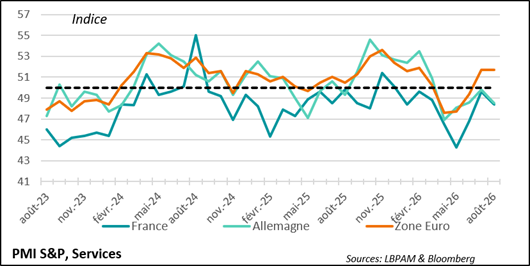
France and Germany were the main drags on services growth, according to S&P’s survey. Both countries saw their services PMI indices decline further and remain in contraction territory. Rising energy prices, together with ongoing political uncertainty, are likely the primary factors weighing on activity in the sector.
By contrast, Southern European economies appear to have maintained much stronger levels of activity, supported in particular by the tourism sector.
Overall, the resilience of the PMI survey is consistent with solid economic growth in the euro area during the third quarter of 2026, with GDP growth expected to be around 0.3%, an improvement compared with the second quarter of 2026 (excluding Ireland).
INSEE Offers a Somewhat More Positive Assessment of the French Economic Outlook
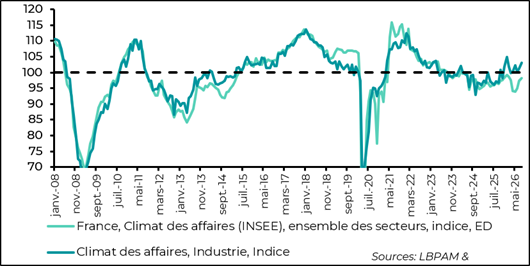
INSEE’s business climate survey indicated a further improvement in business confidence in August, once again driven primarily by the manufacturing sector. However, with regard to services, the survey painted a somewhat different picture from S&P’s PMI, suggesting a stabilization rather than a deterioration in activity.
At the same time, the launch of the campaign for next spring’s presidential election could become an increasing source of uncertainty, potentially weighing on business and consumer confidence.

Sebastian Paris Horvitz
Director of Research