And Yet It Turns: The Global Economy Keeps Moving
Link

PMIs at Multi-Year Highs, a More Resilient Global Economy Than Expected, Reaccelerating Activity in the United States, Improving Momentum in the Euro Area, and Persistent Pressure on Long-Term Interest Rates... Xavier Chapard reviews the key takeaways from September’s business surveys and their implications for the economy and financial markets.
Overview
►Bad news for the economic outlook has been piling up in recent months: the energy shock linked to the situation in the Middle East is increasing in both magnitude and duration, central banks are tightening monetary policy into restrictive territory, long-term interest rates are rising, and political and geopolitical uncertainties are mounting. Under these circumstances, one would normally expect at least a modest deterioration in the economic outlook for the next few months.
►Yet the global economy continues to grow above its long-term trend (around 3%), supporting our constructive medium-term outlook for risk assets. However, contrary to expectations, preliminary September PMIs rose sharply across developed economies, reaching their highest level since the start of the war in Ukraine. At nearly 56 points in aggregate, PMIs are in the upper end of their historical range (excluding the post-Covid rebound). And while they are being driven by the United States, they suggest that growth is fairly broad-based across both sectors and regions.
►Indeed, despite the energy shock, the ECB’s rate hikes and numerous political uncertainties, the Euro Area PMI continued to improve, pointing to growth above potential. The improvement is visible in both Germany and France, where activity has returned to expansion territory. Services are now playing a larger role in the recovery, suggesting that domestic demand is holding up better than expected. Germany’s IFO survey confirms that the recovery is continuing after two years of stagnation. By contrast, France’s INSEE business survey paints a more mixed picture of economic conditions than the PMI data.
►Combined with the rebound in oil prices at the end of the week, driven by uncertainty surrounding U.S.-Iran negotiations, the strength of the global economy is pushing interest rates to new highs. Markets are now pricing in nearly four additional rate hikes from both the Fed and the ECB by next year, while long-term yields have reached their highest levels since the global financial crisis.
►Indeed, the rise in inflation through early next year and growth that is likely to be stronger than we had anticipated in the coming months would justify a somewhat larger recalibration of policy rates than what we currently incorporate into our baseline scenario. Moreover, the accumulation of positive economic surprises and still-accommodative financial conditions suggest that long-term interest rates could remain higher for longer.
►That said, we continue to believe that central banks are likely to remain more cautious than investors currently expect, at least as long as there are no signs of a renewed acceleration in underlying inflationary pressures. Indeed, the impact of higher interest rates on economic activity could become more pronounced next year, as the acceleration in technology-related capital expenditure (CAPEX) and fiscal support measures begin to fade. In addition, a faster-than-expected decline in energy prices would significantly reduce the risk of persistent inflation. This is why we remain constructive on fixed income despite the increase in risks.
►On the political front, the meeting between Trump and Xi did not deliver any significant breakthroughs on the many points of contention between the world’s two largest powers, but it did allow the trade truce to be extended until next year. For markets, this reduces the risk of an escalation in the coming months.
To go further
World: Against All Odds, Growth Accelerates in September
Preliminary PMIs Reached Their Highest Level in Five Years in September
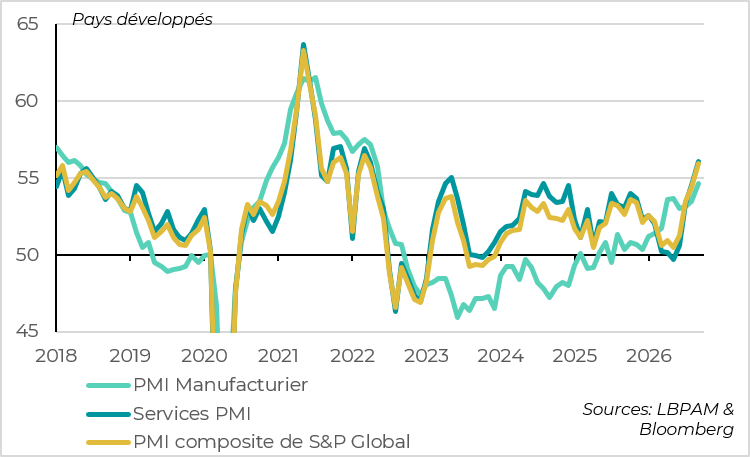
According to S&P Global’s preliminary estimates, the composite PMI for developed economies rose by 1.5 points in September, approaching 56, its highest level since the start of the war in Ukraine in 2022. This came as a major surprise, as PMIs had been expected to decline this month given the rebound in energy prices following the respite seen in early summer and the rise in interest rates over the past month. At this level, this leading indicator is consistent with GDP growth above 2.5% in the third quarter. That would mark an acceleration after growth slowed to 1.5% in 2025 and 1.3% in the first half of the year.
Moreover, the details clearly suggest that a fairly broad-based cyclical improvement has been underway this summer, even if business confidence for the months ahead remains relatively subdued.
Indeed, the increase in PMIs is equally strong in both manufacturing and services, with both sectors reaching their highest levels in four years. Manufacturing continues to follow the upward trend observed since the beginning of the year, while services remain highly dynamic despite their strong inverse correlation with oil prices this year.
Looking at the components, new orders remain strong and employment has reached its highest level in three years, which is reassuring after the marked slowdown in labour market momentum observed across most countries over the past year. This suggests that consumption and investment are holding up despite declining real wages and higher financing costs.
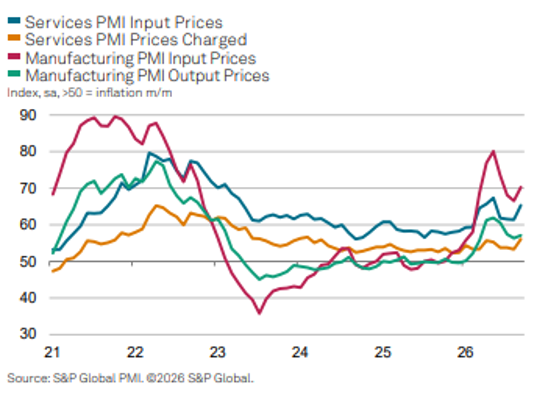
On the price front, input costs are rising sharply, particularly in services, where they now stand above first-half levels. This is not surprising given the persistence of the energy shock. Companies’ selling prices are also increasing rapidly, raising concerns that inflation could remain persistent beyond the energy sector. However, the pace of increase remains more moderate than that of input costs and significantly lower than the levels experienced during 2021-2023.
Growth Is Being Driven by the United States, but Remains Broad-Based
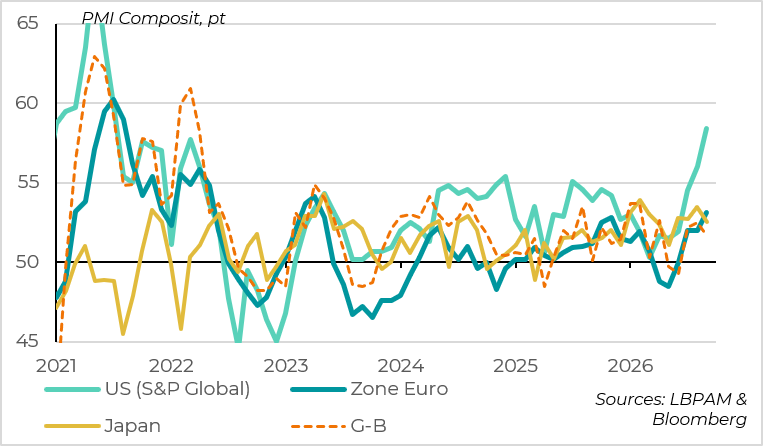
The sharp and unexpected rise in PMIs in September was primarily driven by the United States (+2.4 points to 58.4), which is less surprising given the country’s lower exposure to the energy shock, the resilience of consumer spending over the summer, and the ongoing investment boom. Nevertheless, we did not expect U.S. PMIs to post another increase this month.
However, the Euro Area PMI also rose significantly (+1.1 points to 53.1), which is far more surprising given the current economic and political environment. Meanwhile, PMIs in the United Kingdom and Japan declined as expected, but only modestly, and both remained in expansion territory (51.7 and 52.5, respectively).
Economic Activity Has Been Positively Surprising for Several Quarters Despite Repeated Shocks
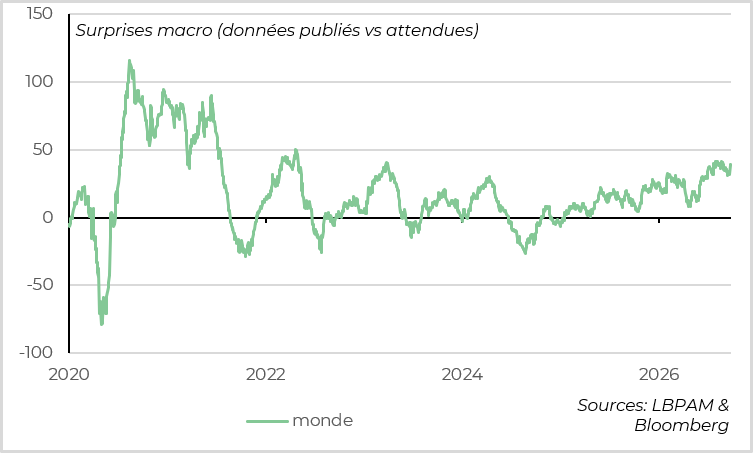
Overall, September data do not show the slowdown in economic activity that many had expected following the renewed rise in geopolitical tensions and energy prices, higher interest rates, and political uncertainties linked to elections and fiscal debates (France, the United Kingdom, and the United States). In fact, PMIs suggest that the global economy has continued to reaccelerate since the beginning of the summer.
We do not want to overreact to a single data release, especially since services PMIs can be volatile from one month to the next and the final estimates may be revised slightly lower. Nevertheless, this latest reading follows more than a year and a half of positive surprises in the global economy, which has done more than simply withstand the multiple shocks experienced since last year. Excluding the recoveries that followed the 2009 and 2020 recessions, this is the longest period of positive economic surprises seen in at least 25 years.
Under these conditions, it is likely that growth will remain stronger than previously expected through the end of the year. The cyclical recovery is allowing employment gains to offset a larger share of the loss in household purchasing power caused by higher energy prices. At the same time, investment appears less sensitive than usual to higher interest rates and uncertainty, supported by artificial intelligence, defence spending, and public investment programmes. Financial conditions also remain supportive despite higher policy rates.
With energy prices moving higher and inflation expected to rise through early next year, a somewhat greater recalibration of monetary policy than currently embedded in our baseline scenario (one additional rate hike from both the ECB and the Fed) may be warranted. Moreover, if these positive surprises reflect an increase in potential growth, driven by AI and stronger investment from both companies and governments, equilibrium interest rates may ultimately prove higher than current estimates suggest (around 2.5% in the Euro Area and 3.5% in the United States).
This further strengthens expectations of additional ECB rate hikes
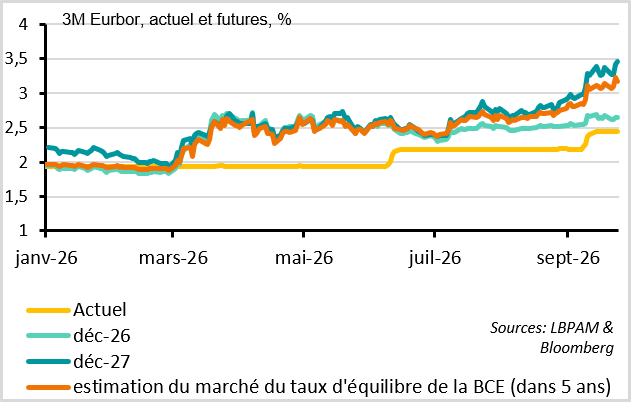
This is increasingly reflected in market pricing and helps explain the sharp rise in long-term bond yields. Markets are now pricing in nearly four additional rate hikes on both sides of the Atlantic by next year, as well as equilibrium interest rates more than 75 basis points above the upper bound of central banks’ estimates. Despite inflationary and fiscal risks that could justify higher term premia, the recent rise in long-term yields has been driven almost entirely by higher expectations for central bank policy rates.
It is clear that the risk of larger and more persistent rate hikes has increased. That said, we continue to believe that central banks are likely to remain more measured than markets currently anticipate, particularly outside the United States. As long as underlying inflation does not begin to accelerate again, as is currently the case, and domestic inflationary pressures remain consistent with inflation targets (wages, labour market tightness, inflation expectations, etc.), there is no reason to act hastily. Especially since the risk of overreacting in the short term remains significant. A rapid decline in energy prices would materially reduce inflation risks, while the economy could prove less resilient next year as growth in AI-related investment slows and fiscal support gradually fades across most countries. This is why we continue to favour the short and intermediate segments of yield curves, particularly in Europe.
United States: Signs of a Cyclical Reacceleration Are Confirming
U.S. PMIs Surge Again in September
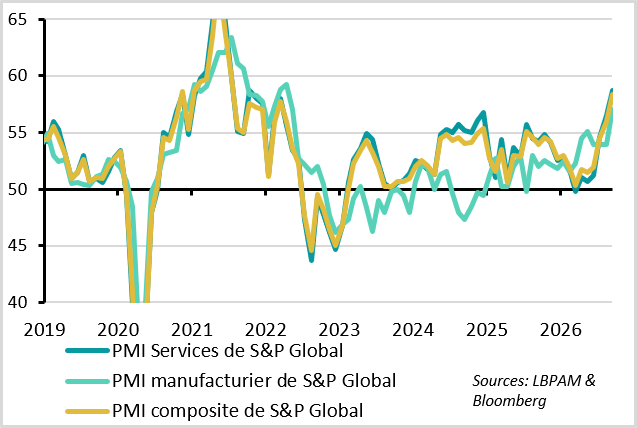
September flash PMI surveys show that the U.S. economy remains highly resilient and even appears to be accelerating. The composite PMI rose from 56.0 to 58.4, its highest level in five years, excluding the post-Covid rebound. Historically, such a reading has been consistent with GDP growth of around 4%, well above the 2% pace we currently forecast.
The increase in the PMI is broad-based. Manufacturing remains the main driver, with the manufacturing PMI jumping from 53.9 to 57.0 on the back of stronger new orders. This is consistent with the ongoing recovery in the global industrial cycle and, above all, the investment boom linked to artificial intelligence. However, the services PMI also rose sharply, from 56.5 to 58.7, suggesting that the rest of the economy, particularly consumer spending, remains robust as well.
For the Federal Reserve, the signs of reaccelerating activity and, above all, employment, with employment components reaching multi-year highs in both sectors, support the view that economic risks have receded. This was an important condition cited by the Fed as allowing it to raise rates in September. The data even suggest that the main risk may now be a renewed build-up of pressure on wages and domestic prices.
That said, despite the sharp increase in costs reported by businesses, particularly in the services sector, selling price inflation remains stable at a level only slightly above its historical average. This suggests that companies are passing through only a limited share of their higher costs, which, for now, helps contain the risk of second-round inflation effects.
Regional Surveys Remain Solid but Show No Further Improvement in September
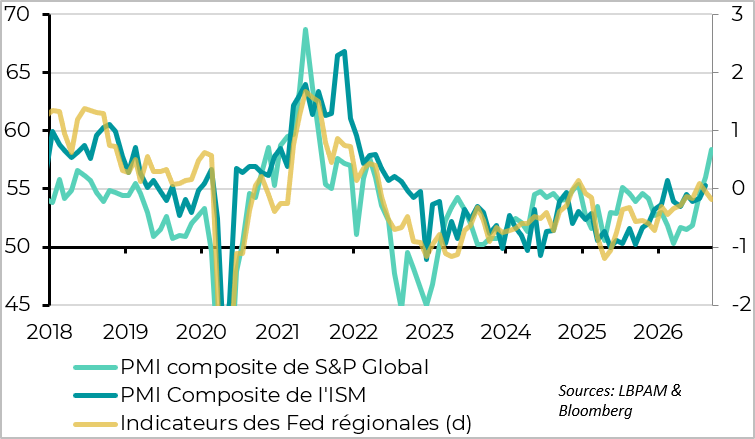
One should never overreact to a single data point. This is especially true given that the first regional Federal Reserve business surveys are less optimistic than the September PMIs, even though they remain consistent with solid economic growth. Moreover, the higher inflation environment compared with previous decades may be leading firms to overstate the growth in their sales and order volumes. We will have a clearer picture in two weeks when the ISM surveys are released, as they remain the most closely watched indicators of U.S. economic activity.
The Labour Market Has Shown Clearer Signs of Improvement Since August
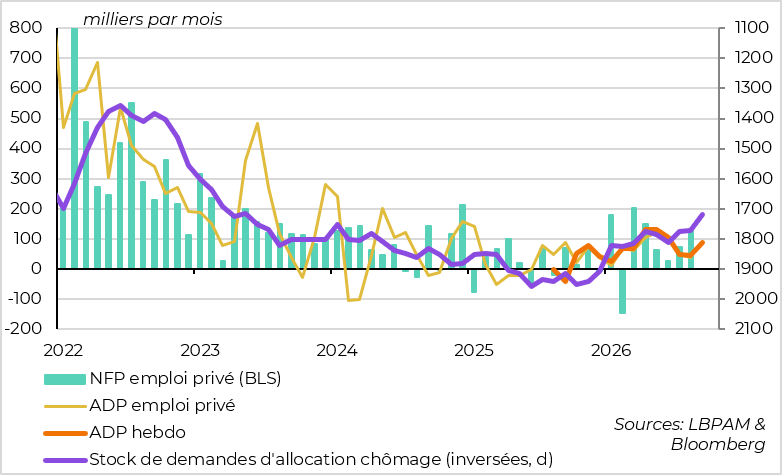
More importantly, recent data clearly increase the risk that employment and economic activity are not merely proving resilient, thereby allowing the Fed to focus primarily on its inflation mandate, but are actually reaccelerating and becoming, in and of themselves, a reason for the Fed to apply the brakes more forcefully.
Indeed, the hard data released so far for the third quarter, particularly the sharp rebound in retail sales in August, have led the Atlanta Fed’s GDP tracker to estimate growth of more than 5% for the quarter. In addition, private-sector job creation picked up again in early September according to the ADP report, while initial jobless claims fell to their lowest level in three years by mid-September. Taken together, these indicators suggest that the labour market may have continued to tighten in September following the very strong August employment reports (September's figures will be released next week).
Euro Area: PMIs Validate the ECB’s Hawkish Stance
Euro Area PMIs Reach Their Highest Level Since Early 2023 in September
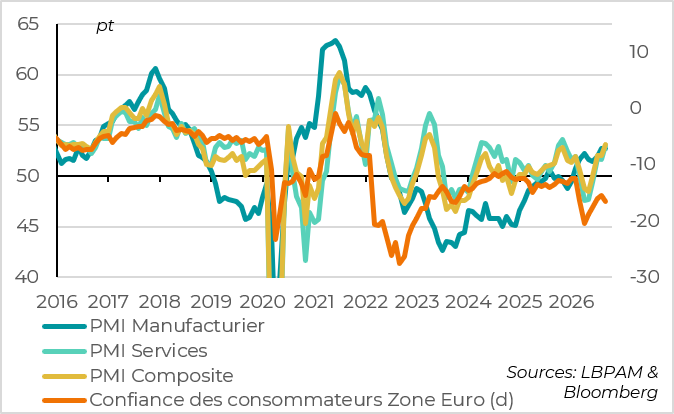
Euro Area PMIs also point to accelerating growth in September, which is surprising given the rise in energy prices, interest rates, and political risks since last month.
The composite PMI increased from 52.0 to 53.1, its highest level in three and a half years and a reading consistent with above-potential growth in the third quarter (around 0.4% to 0.5% quarter-on-quarter).
While the manufacturing PMI held at a satisfactory level of 52.7, the main surprise came from services, where the PMI rose back above its pre-Iran war level, reaching 53.0 in September. This is a welcome surprise, as service-sector activity benefits less than manufacturing from higher public investment (defence spending, etc.) and strong global demand for technology equipment. It suggests that domestic consumption is being supported by the global cycle despite the negative impact of higher energy prices on household purchasing power and consumer confidence. Indeed, consumer confidence declined in September following its summer rebound and remains at a relatively subdued level.
PMIs Rise Sharply in Germany and France While Remaining Elevated Across the Rest of the Euro Area
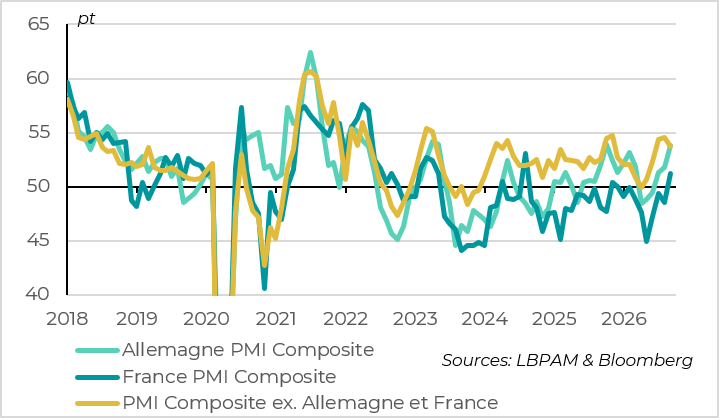
September’s preliminary PMI surveys also suggest that growth is becoming more evenly distributed across countries.
Germany’s PMI jumped by 2 points to 53.8, driven by a rebound in services activity, which returned to expansion territory for the first time in six months. France’s PMI also rose sharply, gaining more than two points to 51.2. While it continues to lag behind the rest of the Euro Area, it has at least moved out of contraction territory for the first time this year.
By contrast, PMIs in the rest of the Euro Area declined in September, although they remained at elevated levels following the strong increases recorded over the summer.
Germany’s IFO Survey Confirms Improving Economic Prospects Despite the Energy Shock
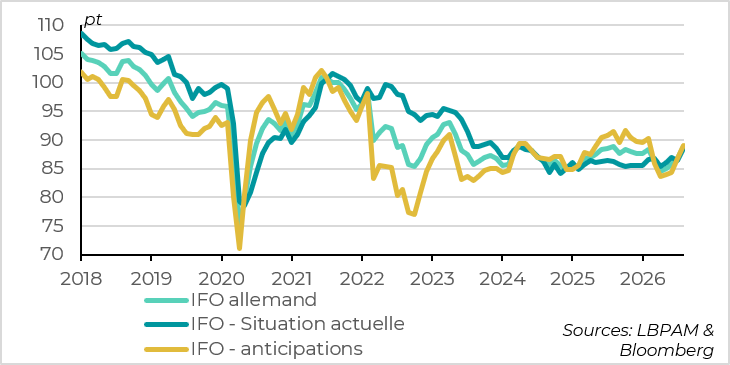
Germany’s IFO survey confirms that the German recovery remains on track after several months of doubts linked to the energy shock. The headline index reached a one-year high of 88.8, supported both by the continued improvement in firms’ assessment of current conditions and, in September, by a rebound in expectations for the months ahead. Despite the latest increase in energy prices, German companies are optimistic about the continuation of the recovery for the first time since the outbreak of the war in Iran. This improved sentiment is also spreading, to some extent, from manufacturing to more domestically oriented sectors, including services. Combined with stronger-than-expected growth in the first quarter, this has led German economic institutes to more than double their growth forecast for this year, from 0.6% in the spring to 1.3%.
By contrast, France’s INSEE survey does not confirm the sharp rise in the French PMI in September, as business confidence fell from 98 to 96, weighed down by services and retail trade. It is possible that September’s French PMI overstates the strength of growth, as it may partly reflect a rebound from the adverse weather conditions that weighed on activity in August. Nevertheless, taken as a whole, the business surveys remain consistent with slightly positive growth following the contraction recorded in the first half of the year.
Input Costs Rise Sharply Again, but Pass-Through to Selling Prices Remains Contained

Xavier Chapard
Deputy head of research