China meets its growth targets with an unbalanced economy
Link

What should investors take away from market developments on October 20, 2026? Sebastian Paris Horvitz shares his analysis and insights.
Overview
► The ongoing stalemate in the Middle East is continuing to put upward pressure on hydrocarbon prices. At this stage, there is little hope for progress in the negotiations, as President Trump appears to remain largely removed from the discussions. At the very least, he has pledged not to attack Iran before the midterm elections. As a result, Brent crude oil prices remain elevated, hovering around $107 per barrel.
As for natural gas, with Qatari production capacity still constrained and the need to rebuild inventories in the Northern Hemisphere ahead of winter, prices have surged again, reaching a new all-time high of €89/MWh in Europe. Under these conditions, the negative impact on household purchasing power is likely to continue weighing on consumer spending.
► We continue to expect a meaningful reopening of the Strait of Hormuz after the U.S. elections. As supply gradually becomes more abundant, hydrocarbon prices should begin to ease before year-end, with the decline expected to accelerate throughout 2027.
► While energy prices remain elevated, interest rates declined significantly last week. This easing was partly driven by a reduction in risk-taking across financial markets. In particular, investors are becoming increasingly concerned about the profitability of the massive investments being made in infrastructure related to the deployment of artificial intelligence. As a result, the most pronounced market adjustments have been observed in these sectors.
This shift toward lower risk has been particularly supportive for government bonds. For example, U.S. 10-year Treasury yields declined by more than 20 basis points (bps). In the euro area, however, the move was much more limited.
► This market environment is consistent with our cautious short-term positioning on risk assets and our overweight allocation to sovereign bonds. Nevertheless, despite the high level of uncertainty, we continue to believe that our core scenario of sustained growth, combined with declining energy prices and central banks that prove less aggressive than currently anticipated by markets, should remain supportive for risk assets over the medium term.
► In France, the weekend riots have heightened concerns surrounding the country’s public finances. As a result, long-term interest rates, which incorporate the risk premium associated with debt sustainability, rose sharply yesterday. The spread between French and German 10-year government bond yields has widened to 147 basis points (bps), bringing it very close to the levels observed during the euro sovereign debt crisis of 2011-2012. Today, France stands out as the euro area country with the widest yield spread relative to Germany.
► In the short term, the ongoing budget debate will have to square the circle of addressing current social demands while simultaneously reducing the public deficit by 2027. The government's minimum objective is to bring the deficit down to 5% of GDP, compared with an estimated 5.4% in 2026.
This implies finding between €15 billion and €20 billion in savings, at a time when the economic outlook remains far from encouraging and the cost of government borrowing continues to rise. The extent of the fiscal effort ultimately adopted will become clear when Parliament votes on the budget in mid-November.
► In Asia, economic data from China provided some reassuring signals. Indeed, third-quarter GDP growth figures came in stronger than expected, with the economy expanding by 4.5% year-on-year. This growth rate is in line with the government’s target range for the year (4.5%-5%).
The acceleration in growth was partly driven by highly targeted measures aimed at supporting domestic demand, particularly investment in technology and, more specifically, in the field of artificial intelligence (AI). However, as the September data show, overall investment remains weak, declining by 7.2% year-on-year.
► At the same time, although consumer spending, as measured by retail sales, rebounded in September (+1.1% year-on-year), it remains relatively subdued. Unemployment is still fairly high (5.2%), while consumer confidence remains depressed. The ongoing weakness of the real estate sector continues to weigh heavily on sentiment.
Indeed, the property market downturn remains a major drag on household confidence. The latest figures from the sector remain discouraging, with the correction deepening further in September. Real estate investment was down 20.6% year-on-year compared with the same period last year, highlighting the persistent weakness of the sector.
► In fact, Chinese authorities continue to rely on the export sector as a key driver of growth. The sector continues to support industrial production, helping to offset the weakness of domestic demand.
Nevertheless, while exports, particularly to the United States, are benefiting significantly from demand linked to the development of artificial intelligence, signs of growing constraints are beginning to emerge. Recent negotiations with the European Union, which is seeking to curb certain imports from China, illustrate this trend.
These headwinds could become a significant challenge for China’s growth model in 2027, especially if trade restrictions broaden beyond their current scope and further limit access to key export markets.
► While U.S. economic data have so far continued to demonstrate remarkable resilience, it is important to emphasize, as we have been doing for several months, that higher energy prices and rising interest rates are likely to act as a drag on growth in the months ahead.
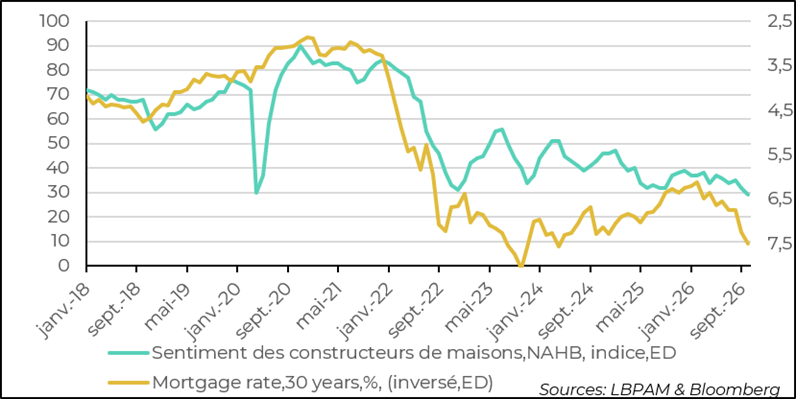
The results of the NAHB Housing Market Index for October are consistent with this view. Indeed, builder confidence declined once again, falling to its lowest level since 2012, a period that coincided with the gradual recovery of the housing market following the severe real estate crisis of 2008-2009.
The persistently high level of interest rates is clearly weighing on activity. We therefore continue to believe that, although the U.S. economy should still benefit in the near term from strong investment linked to the expansion of artificial intelligence, the combined effects of higher inflation and elevated interest rates are likely to contribute to a slowdown in economic growth over the coming months.
To go further
China: Growth Remains in Line with Targets
China: GDP Growth Rebounds in Q3 2026
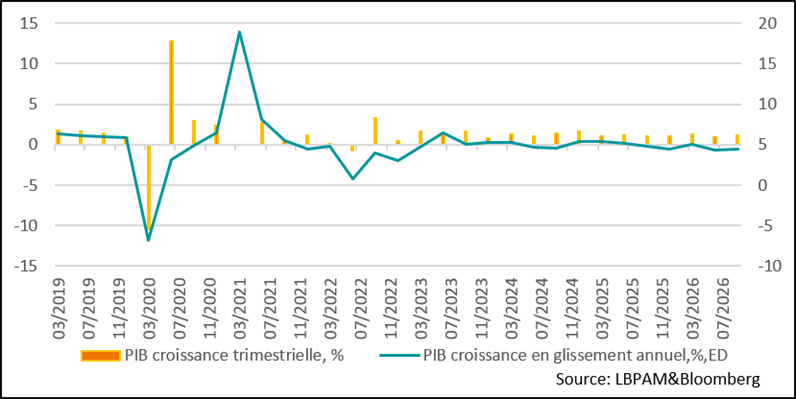
China has so far managed to withstand the energy shock affecting the global economy remarkably well. This resilience is largely attributable to the substantial strategic oil reserves that the country had built up, which have allowed it to partially shield itself from the sharp rise in hydrocarbon prices.
Nevertheless, GDP growth figures for Q3 2026 came in stronger than expected, with growth accelerating to 4.5% year-on-year, up from 4.3% in the previous quarter.
This expansion in economic activity keeps China on a growth trajectory that is broadly in line with the government’s target range of 4.5% to 5% for the year.
At the same time, growth remains unbalanced, with the external sector continuing to serve as its primary engine. Indeed, China’s export machine continues to support economic activity despite the tariff increases imposed by the United States.
Industrial Production Remains Strong... Thanks to External Demand
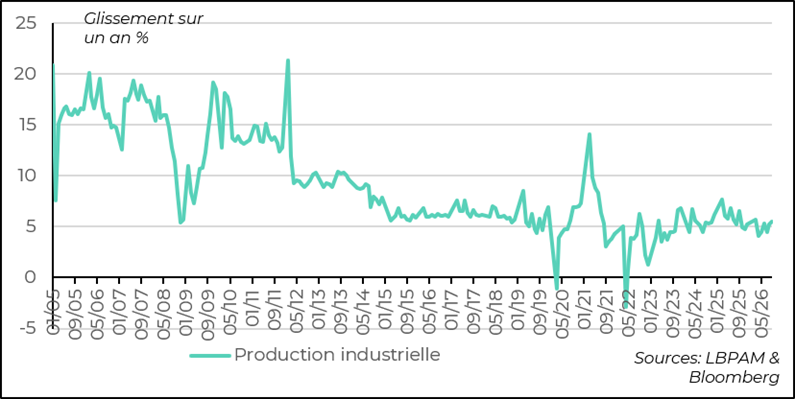
External demand for technology products, and particularly for key components used in the construction and deployment of data centers in the United States, continues to be a major boon for Chinese industry. Likewise, China’s automotive sector, driven in particular by the rapid development of electric vehicles, is continuing to expand its export footprint.
As a result, industrial activity accelerated further in September, with industrial production rising by 5.5% year-on-year.
Domestic Demand Remains Weak Despite a Modest Rebound in Consumption
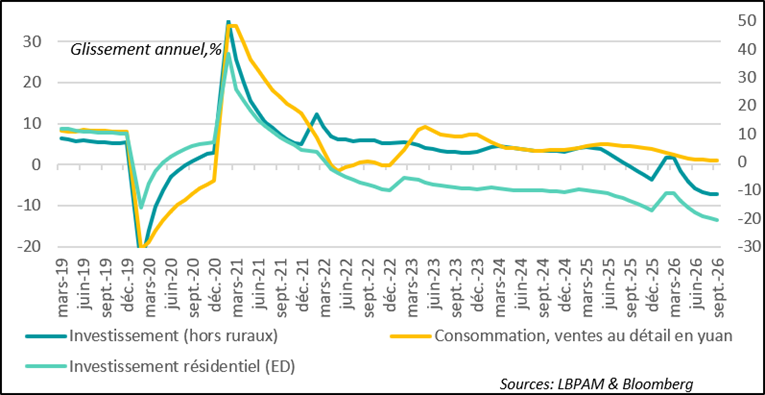
At the same time, domestic demand remains weak. Looking at short-term trends, consumer spending did rebound compared with the previous month, but the improvement remains modest. Retail sales rose by 1.1% year-on-year in yuan terms in September, up from 0.4% the month before.
It is difficult to anticipate a strong recovery in consumption given the lackluster labor market. The unemployment rate remains relatively high at 5.2%, while consumer confidence is likely to stay subdued as long as the property market remains under severe pressure. Indeed, the ongoing downturn in the real estate sector continues to weigh heavily on household sentiment.
In this regard, the latest housing market data remain far from encouraging, with the adjustment even intensifying in September. Real estate investment declined by 20.6% year-on-year, while home sales contracted by 13.7%.
At this stage, however, given the economy’s performance relative to the government's GDP growth target, the incentives to introduce additional measures to stimulate domestic demand appear more limited.
In fact, policymakers seem more inclined to continue prioritizing support for the technology sector, particularly industries linked to the development of artificial intelligence.
While the Chinese government is on track to achieve its growth objectives in 2026, it may need to do more in 2027 to support domestic demand. The export sector, which has been a key driver of growth, could face increasing headwinds next year, notably from new trade restrictions that may be imposed on Chinese companies. The recent discussions with the European Union aimed at limiting imports of Chinese automobiles provide an early indication of this trend. Other product categories could also come under greater scrutiny in the future.
United States: Rising Interest Rates Take a Toll on the Housing Market
Construction Activity Hit by Rising Interest Rates
Recent U.S. economic data have continued to show a notable degree of resilience. Nevertheless, as highlighted by the September consumption figures, signs of weakness are beginning to emerge. These signs of slowing growth may prove temporary, but they are also consistent with the headwinds that are gradually starting to weigh on domestic demand.
Rising inflation, particularly as a result of the persistent energy shock, is weighing on the broader economy. At the same time, elevated interest rates represent an additional constraint on growth.
The latest construction sector data clearly illustrate the negative impact of higher interest rates on activity. In particular, the NAHB Housing Market Index fell again, reaching its lowest level since the period surrounding the 2008-2009 housing crisis.
We continue to believe that, while the U.S. economy should still benefit in the short term from the expansion of investment related to artificial intelligence, the adverse effects of higher inflation and persistently elevated interest rates are likely to contribute to a slowdown in economic activity in the months ahead.

Sebastian Paris Horvitz
Head of of Researc