ECB raises rates and stays the course
Link

Persistent geopolitical tensions, rising energy prices and increasingly hawkish central bank communication... Xavier Chapard reviews the week's key developments and their implications for financial markets.
Overview
► The escalation between the United States and Iran continues to dominate financial markets, pushing oil prices well above $100 per barrel for the first time since May and European gas prices above EUR 80/MWh for the first time since 2022.
This situation continues to fuel inflation expectations and reinforce hawkish rhetoric from central banks. Combined with populist fiscal promises ahead of several upcoming elections, it is driving sovereign bond yields toward new cyclical highs.
As we had feared, the speed and magnitude of the rise in long-term interest rates are beginning to weigh on investors' risk appetite. Equity markets have edged lower, while credit spreads are showing early signs of widening. This supports our decision to reduce portfolio risk in the tactical asset allocation we recommend over the coming weeks.
►Our base case of a prolonged conflict in the Middle East without further escalation is being tested by threats against energy infrastructure. Should these threats result in damage to production or export capacity, the resulting energy shock would be significantly larger and more persistent than currently assumed in our scenario.
That said, we still do not rule out the possibility of an agreement between the Iranian and U.S. authorities ahead of the midterm elections, which could trigger a faster and more significant decline in energy prices. Overall, uncertainty remains elevated and risks continue to increase.
►Among the major central banks, the European Central Bank raised interest rates for the second time this year, bringing its policy rate to 2.5%. While this decision was widely expected, the ECB's communication proved more hawkish than anticipated.
Without explicitly committing to future policy actions, the ECB now believes inflation will remain elevated for longer and that risks around its updated forecasts are tilted to the upside. The Bank also appears less concerned about growth risks. Christine Lagarde made no attempt to push back against market expectations, which now price in three additional rate hikes. It is therefore reasonable to conclude that this week's move is unlikely to be the final increase in the current tightening cycle.
►We nevertheless maintain our view that the ECB will deliver only one additional rate hike before year-end, although the risk of another increase in early 2027 has risen. We continue to believe that markets are overestimating the extent of future monetary tightening, making the short end of European yield curves particularly attractive.
►Market attention will now turn to the U.S. inflation data due later today and next week's Federal Reserve meeting. Unless August inflation surprises significantly to the upside, we believe the Fed will wait until after the midterm elections before implementing another modest rate increase. However, the probability of a hike as early as next week has increased.
The U.S. administration is not making the Fed's task any easier when it comes to reassuring bond investors. This week, the U.S. Treasury repurchased $6 billion of long-dated bonds (10 to 20 years maturity). While this amount was three times larger than previous buyback operations, it fell short of the expectations created by Scott Bessent's announcements earlier this summer.
►As a result, the operation failed to ease pressure on long-term yields, which climbed above 5.3%, their highest level since 2007. This illustrates that while financial engineering and Treasury interventions may temporarily support government bond markets, only a decline in inflation risks, particularly through lower commodity prices, an improvement in fiscal prospects, or a stronger commitment from the Fed through actual rate hikes would be capable of sustainably reducing the risk of further increases in long-term yields.
In this regard, Donald Trump's proposal to provide a $5,000 payment to U.S. households in the event of a Republican victory in November does little to support fiscal discipline.
Despite long-term U.S. government bond yields having reached fundamentally attractive levels, we remain cautious ahead of the midterm elections.
►The Bank of Japan (BoJ) will also meet next week. Recent comments from BoJ officials, combined with pressure from the United States, have reinforced expectations of further rate increases.
Beyond the rate hike that now appears almost certain this month, BoJ policymakers have reiterated their willingness to continue normalising monetary policy if inflation risks persist. We expect another rate increase before year-end, followed by further gradual tightening in 2027.
With policy rates potentially reaching 1%, Japan would continue the normalization of its monetary policy framework and move closer to the standards prevailing in other major developed economies.
To go further
ECB: another rate hike, likely not the last
The ECB raises rates to the upper end of its neutral rate range
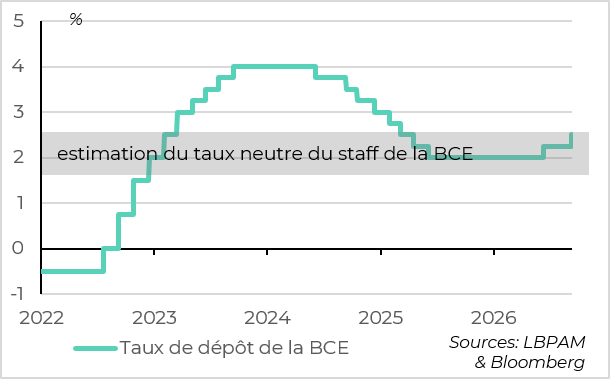
The European Central Bank (ECB) raised its policy rates by 25 basis points for the second time this year. This unanimous decision was widely anticipated, given the extension and intensification of the energy shock, as well as the resilience of economic indicators since the July meeting, during which several Governing Council members had already advocated further rate increases.
The deposit rate now stands at 2.5%, which corresponds to the upper end of the ECB's estimated neutral rate range (1.75% to 2.5%, according to the ECB's Chief Economist). This suggests that monetary policy is now neutral to slightly restrictive for the economy. Previously, the ECB had estimated the upper bound of the neutral rate at 2.25%. As the ECB noted, this position provides flexibility in an environment characterized by elevated uncertainty.
In its statement, the ECB once again refrained from offering explicit guidance on the future path of rates, reiterating that decisions will continue to be taken on a meeting-by-meeting basis and will remain data dependent. Christine Lagarde delivered a similar message during the press conference, even noting that the future trajectory of policy rates had not been discussed during the meeting. In principle, therefore, the ECB does not currently signal any explicit bias regarding future decisions.
However, it was clear from this meeting that the ECB does not believe its tightening cycle is over.
Compared with its July statement, the ECB added that inflation is expected to remain "significantly above target for a prolonged period," that risks to inflation remain tilted to the upside, and that the Governing Council remains fully committed to returning inflation to its 2% medium-term target.
The ECB revises inflation and growth forecasts higher
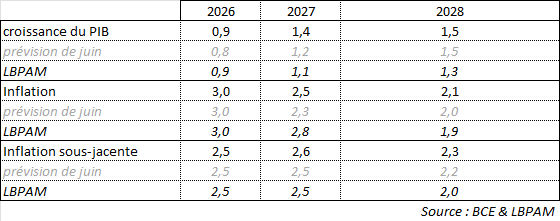
The updated staff projections also point toward a more restrictive policy stance.
ECB staff revised their inflation forecasts upward for both 2027 and 2028, while also raising growth projections for 2026 and 2027. Unlike the projections released in June, inflation is no longer expected to fully return to 2% within the two-year forecast horizon.
Energy prices are already closer to the adverse xcenario than to the baseline
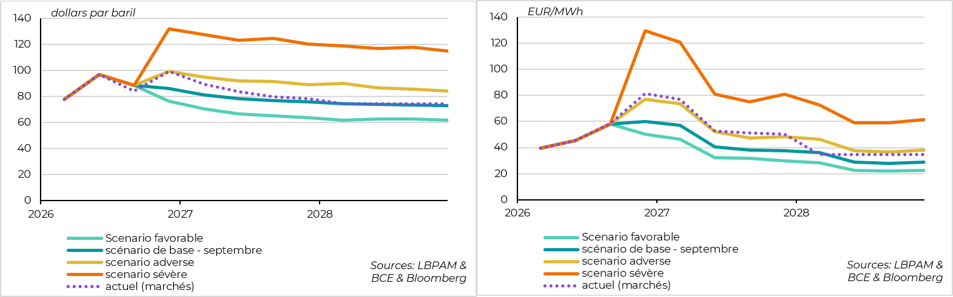
The energy price assumptions embedded in the ECB's baseline scenario have already become outdated.
Given the sharp rise in energy prices in recent weeks, inflation projections would likely have been significantly higher had the staff used current market prices rather than those prevailing in mid-August. In fact, current energy prices are now closer to the ECB's adverse scenario than to its baseline scenario.
Inflation risks appear greater than growth risks
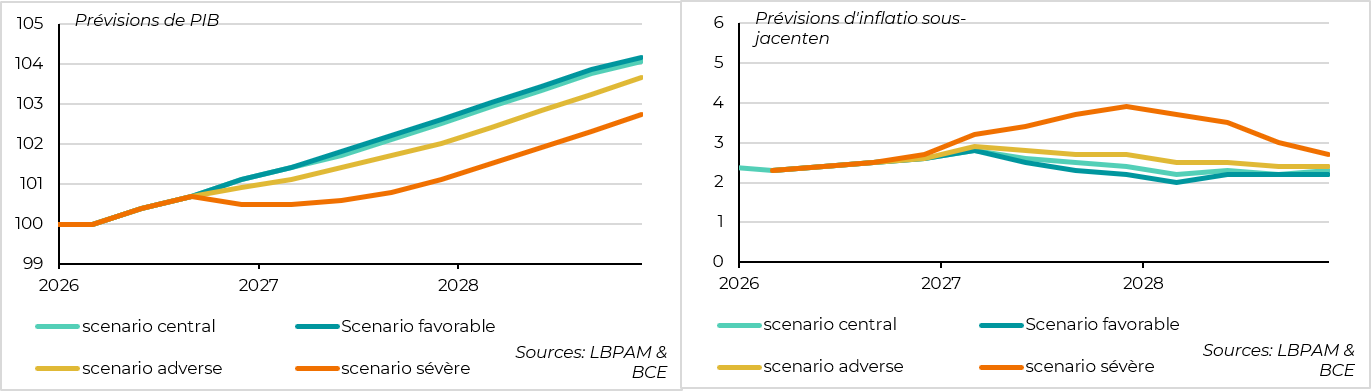
Furthermore, in all of the ECB's alternative energy-price scenarios, core inflation remains above target over the next two years, while the economy avoids recession, even under the most adverse assumptions.
From a risk-management perspective, this suggests that the ECB faces a greater risk of doing too little than of doing too much.
Markets now expect rates above 3%
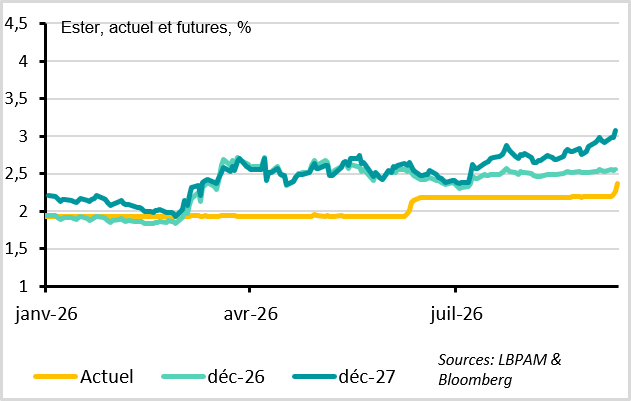
Financial markets reacted strongly to the ECB's more hawkish tone, as well as to the renewed rise in energy prices, by pricing in additional monetary tightening.
Markets now anticipate three more rate hikes by next year, which would bring the policy rate to 3.25%, compared with only two additional hikes being priced in before the meeting.
Our scenario remains less aggressive than the market's
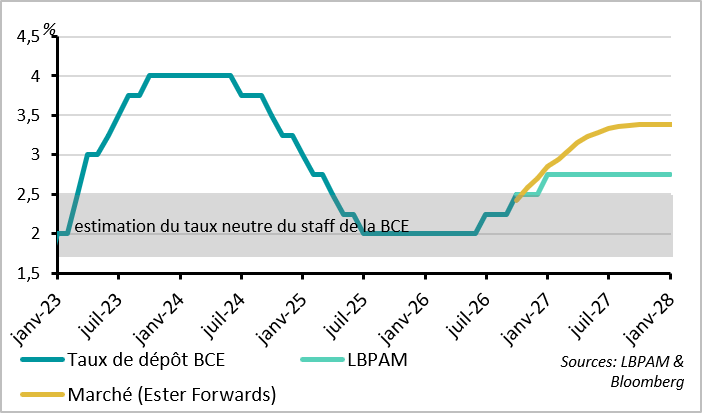
For our part, we continue to expect only one additional ECB rate hike, in December, which would take the policy rate to 2.75%, although the risk of a further hike in the first quarter of 2027 has increased.
While our energy-price outlook lies between the ECB's baseline and adverse scenarios, we believe a only marginally restrictive monetary stance remains appropriate.
We expect the combined impact of the energy shock, rising long-term interest rates, and political uncertainty, particularly in France, to weigh more heavily on growth than the ECB currently anticipates.
Most importantly, we believe the second-round effects of the energy shock on domestic inflation will remain more limited than the ECB expects. Under this scenario, inflation could gradually return to target by 2028 without requiring significantly tighter monetary policy.
That said, risks around our scenario remain skewed toward additional rate hikes. This could occur if energy prices continue to rise or remain at current levels through year-end. It could also happen if the ECB reacts too aggressively to inflation, which is likely to continue rising until the end of the year before beginning to ease next spring.
Nevertheless, we still believe markets are pricing in too much ECB tightening. This underpins our overweight position in short- and intermediate-maturity sovereign bonds.

Xavier Chapard
Deputy head of research