Global growth is still holding up
Link

What should investors take away from market developments on October 27, 2026? Sebastian Paris Horvitz shares his analysis and insights.
Overview
► Recent rumors of a possible re-escalation of the conflict between the United States, Israel, and Iran following the U.S. midterm elections in early November have increased pressure on hydrocarbon prices. Brent crude oil is trading close to $117 per barrel, while natural gas prices in Europe continue to reach new record highs, approaching €100 per MWh.
► This is not good news for the global economy. The risk of the conflict becoming prolonged is increasing. Unfortunately, this further reinforces our scenario of an economic slowdown, driven by its negative impact on corporate costs and household purchasing power.
► We remain tactically cautious on risk assets and maintain our constructive bias toward sovereign bonds, although we have slightly scaled back our positions following the sharp decline in yields over recent weeks.
► In the short term, an agreement among countries in the region to reopen the Strait of Hormuz appears to be the most promising option, albeit a fragile one. All Gulf countries are being weakened by the insecurity prevailing in the region and by the substantial loss of financial resources. Indeed, while crude oil flows appear to be normalizing, albeit with very high transportation costs, refined petroleum products and liquefied natural gas (LNG) remain blocked.
► The results of the Israeli parliamentary elections are likely to become known on Wednesday. Uncertainty remains high as to who will emerge victorious. Opinion polls do not point to a clear majority for either the ruling coalition, which brings together the right wing, religious parties and the far right, or the opposition. Prime Minister B. Netanyahu has, in recent days, stepped up warnings about the conflict with Iran in an effort to sway the vote in his favor. A potential change of government could alter Israel’s strategy in the region and also influence the U.S. approach.
► This weekend, in Brazil’s presidential election, incumbent President Lula surprised many observers by securing victory. He had been widely expected to lose following Bolsonaro’s strong performance in the first round. Financial markets had adopted a very favorable view of Bolsonaro, who was seen as significantly more business-friendly, particularly toward the agricultural sector. In addition, he was perceived as being more willing to tackle the challenge of restoring public finances.
► Lula’s victory therefore came as a major disappointment to financial markets. The Brazilian stock market plunged by more than 16% at the opening, while interest rates rose sharply. In our view, this reaction appears excessive. The president will need to build compromises with other political forces in Congress, as the government does not hold a majority. In this context, we believe the risk of a continued deterioration in public finances remains limited, particularly given the need to secure broader parliamentary support for fiscal measures.
► In France, discussions on the 2027 budget are still ongoing, but at this stage there is no clear path to putting public finances back on a more sustainable trajectory. So far, several key spending-cut measures, particularly those related to pensions, have been rejected during parliamentary votes. This difficulty in reaching compromises among political parties to achieve a meaningful reduction in the deficit (from an estimated 5.4% of GDP in 2026 to 5.0% in 2027) increases the likelihood that the government will resort to pushing the budget through by force, for example by invoking Article 49.3 of the Constitution.
► Despite the persistence of the energy shock, an environment disrupted by major elections, and growing investor concerns about the future profitability of the massive investments being made in artificial intelligence (AI), global economic activity has so far remained resilient, although there are signs of some moderation. Indeed, S&P’s preliminary PMI surveys for October across a wide range of countries and regions showed that growth is still holding up, albeit with differing dynamics across economies.
► In the United States, the slowdown in economic activity remains very modest, particularly in the services sector. However, the composite index remains at a very high level, close to its highest reading of the past five years. Manufacturing continues to be a key driver of growth, with the sector’s index reaching its highest level in four years. As in the previous month, the survey indicates that hiring intentions are increasing, reflecting the strength of economic activity. However, this signal was not really confirmed by the official employment data released for the previous month.
► At the same time, cost pressures continue to intensify. More importantly, according to the survey, companies appear increasingly able to pass higher costs on to their customers, supported by the strength of demand. These developments point to a potential increase in inflationary pressures, reinforcing the upward trend in inflation observed in September.
► The rising cost of living remains one of the key factors weighing on U.S. household sentiment and is likely to be a major issue in the upcoming midterm elections. This is reflected in the University of Michigan’s final consumer sentiment survey for October, which showed a deterioration in confidence compared with the previous month, although sentiment recovered somewhat from the preliminary reading released earlier in October.
For now, inflation expectations remain elevated both in the short term and over the medium term, but they did not increase further this month. Nevertheless, we continue to believe that the negative impact of the rising cost of living will act as a drag on consumer spending in the quarters ahead.
► In the euro area, S&P’s preliminary PMI surveys also pointed to a moderation in economic activity, although growth remains at a much weaker pace than in the United States. Nevertheless, economic activity in Germany has proven resilient, particularly in the manufacturing sector. The strength of the German economy was confirmed by the latest IFO survey, whose headline index improved further. The expectations component has returned to its highest level since early 2022. Beyond the continued expansion of exports, German fiscal stimulus appears to be providing a meaningful boost to economic activity.
► In fact, the weakening of activity across the euro area is largely attributable to France, where growth is losing momentum in both manufacturing and services. Indeed, both sectoral indices fell back into contraction territory in October. This is clearly not an encouraging sign for the country’s growth outlook, although the resilience of the broader euro area should provide some support to the French economy.
At the same time, inflationary pressures linked to rising costs remain elevated across the region. This is also a negative signal for growth, as it could further erode household purchasing power.
To go further
United States: Economic activity remains robust despite weaker confidence
Economic activity remains very robust according to S&P PMI surveys
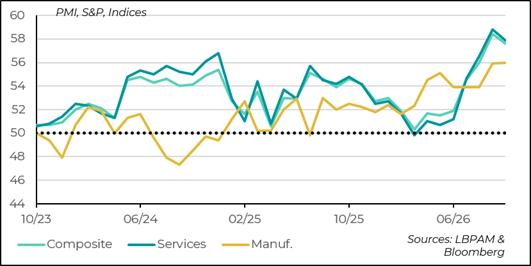
S&P’s preliminary PMI surveys for October continued to suggest that the economy is maintaining very strong momentum. Although the composite index (manufacturing and services) eased slightly, pointing to some moderation in activity, it remains at a very elevated level and is still consistent with strong GDP growth. In fact, the index remains close to the highest levels recorded over the past five years. Activity in AI-related sectors continues to be a major driver of growth.
At the same time, the surveys indicate that supply bottlenecks are beginning to emerge as a result of sustained demand, while companies are increasing their hiring intentions to cope with this surge in activity. This trend had already started to appear in the previous survey, but it was not reflected in the official employment figures released for the prior month. We will see next week whether employment growth indeed accelerates more markedly.
The impact of the conflict in Iran, combined with higher fuel prices, is also pushing up corporate costs. As a result, all of the price indicators in the survey moved higher. In particular, strong demand appears to be making it easier for companies to pass rising costs on to their customers.
This could signal a further build-up of inflationary pressures in the U.S. economy and would be consistent with the upward trend recently observed in consumer price indices. This is clearly an area that the Fed will continue to monitor closely.
Household confidence remains weak amid declining purchasing power and rising interest rates
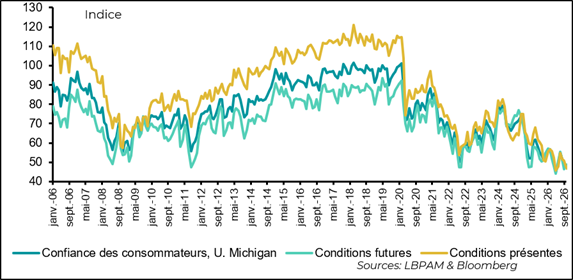
Indeed, rising inflation and the resulting loss of purchasing power, driven in particular by higher fuel prices caused by shortages of refined petroleum products, remain among the main concerns of U.S. households. As a result, the University of Michigan’s final consumer sentiment survey for October shows that confidence remains depressed, although conditions appear somewhat less negative than suggested by the preliminary estimates released earlier in the month.
Inflation expectations remain elevated in both the short and medium term
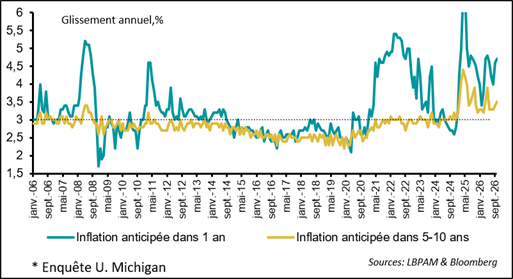
This erosion of purchasing power is also reflected in inflation expectations, which remain elevated both in the short and medium term. The persistence of such high inflation expectations is clearly not good news for the Fed and will remain a key area of concern in the months ahead. As is the case for most market participants, we believe the central bank is unlikely to take action this week, with the midterm elections scheduled to take place in just one week's time.
The other major source of concern for households is, of course, rising interest rates, which are weighing particularly heavily on the housing market. Purchase intentions have fallen to their lowest level on record.
Confidence remains low among both Democratic and independent voters
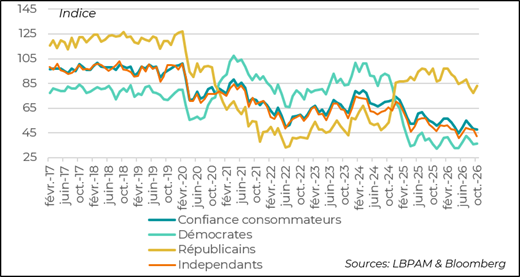
As is well known, the University of Michigan survey also provides data broken down by political affiliation. Here again, the picture has changed little, with both Democratic and independent voters continuing to report historically low levels of confidence.
Polls continue to suggest that Democrats are likely to regain a majority in the House of Representatives, while their chances of also winning control of the Senate remain relatively high, although the odds are considerably lower for the Senate than for the House.
Euro Area: Economic Activity Holds Up… Except in France
Euro Area: Economic Activity Is Slowing but Remains Resilient
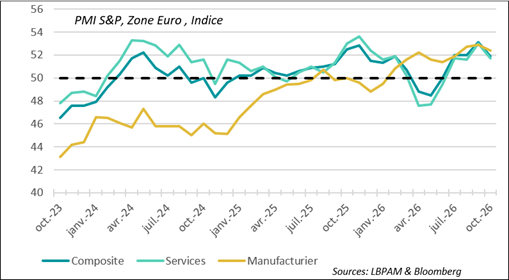
As elsewhere, economic activity in the euro area slowed in October, according to S&P’s preliminary PMI surveys. The slowdown was most pronounced in the services sector, a development that can likely be attributed to the persistence of elevated inflation.
Nevertheless, the euro area figures continue to mask significant disparities across countries. In fact, a large part of the region’s weakness can be traced back to the marked slowdown in activity in France.
France Lagging Behind While Industry Holds Up in the Euro Area
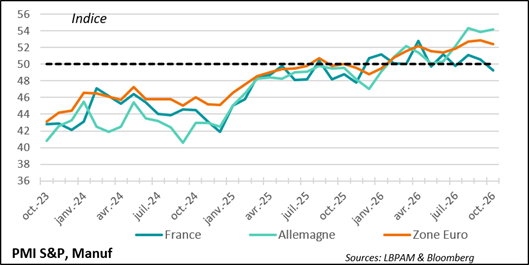
In manufacturing, activity has slowed somewhat and has fallen back into contraction territory, in contrast with the broader euro area, particularly Germany, where manufacturing activity accelerated in October. Germany’s strong export performance, together with continued government support measures, continues to provide significant momentum to economic activity.
Activity Remains Resilient in Services... but Slumps in France
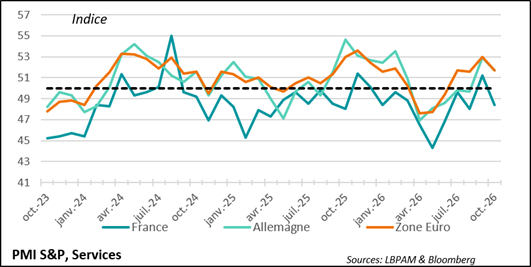
But it is in the services sector that activity in France has fallen the most behind the rest of the region. Beyond the negative impact of weaker purchasing power, political uncertainty and the recent riots have also weighed on confidence.
One can hope that the continued growth momentum in the rest of the euro area will provide some support to the French economy. However, the current environment in France remains far from conducive to a rebound in activity.
Moreover, France will most likely have to face some degree of fiscal tightening in 2027, even if it proves relatively moderate.
At the same time, as in the United States, the PMI survey points to a sharp rise in price pressures over the month, which represents a source of vulnerability going forward. In particular, the steep increase in natural gas prices in recent weeks is likely to weigh on growth across the euro area.
IFO Confirms the Resilience of Economic Activity... and, Above All, Improving Prospects
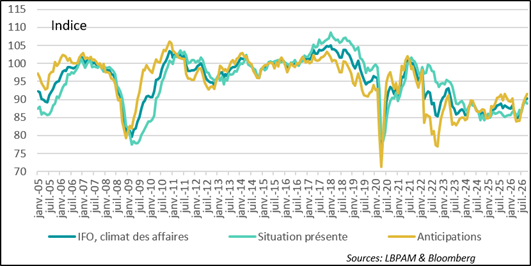
The October IFO survey for the German economy, much like the PMI surveys, delivered a rather encouraging message. Not only did the headline index improve further, but the expectations component also reached its highest level since early 2022. The continued support provided by government policy appears to be bearing fruit, despite a political environment that remains tense. The resilience of the German economy is a positive factor for the broader European economy.

Sebastian Paris Horvitz
Head of of Researc