Headwinds in early September, but economic outlook remains solid
Link

Between geopolitical tensions, rising energy prices, and persistent inflationary pressures, Xavier Chapard analyzes the main factors influencing the markets in this autumn of September 2026.
Overview
► Since the resumption of bombing in the Middle East last weekend, the tone of US authorities remains contradictory. Donald Trump claims the strikes will be "short-lived," while his Secretary of State indicates they will continue as long as the Iranians threaten shipping lanes. At the same time, the US army continues to deploy reinforcements in the region.
► In any case, pressure continues to increase on energy prices, with oil rising above $95 per barrel for the first time since July and, above all, a gas price in Europe exceeding €70/MWh for the first time since the beginning of 2023.
► We changed our central scenario on Iran during the summer, shifting from an assumption of a rapid de facto resolution of the conflict to that of an impasse. Against this backdrop, we expect energy prices to remain elevated in the coming months, but without another major shock. The risks around this scenario now appear more balanced, between a more significant military escalation and the possibility of a rapid agreement.
► Given the resilience of the global economy to the shock observed in the first half of the year, the impact on our macroeconomic scenario should, in our view, result in a slight slowdown in growth in the second half of the year, without calling into question its overall momentum. Within this context, the new rise in the global PMI in August, to its highest level in three years, constitutes a reassuring signal, especially since this improvement is relatively widespread.
► However, inflation is likely to remain too high for a longer period, even if second-round effects remain limited and we expect a sharp slowdown in inflation in the second half of next year. This analysis is supported by the figures from the eurozone: inflation reached 3.3% in August, its highest level since 2023, under the effect of the further increase in energy prices. It could still accelerate in the coming months, especially if food inflation rises more sharply again.
► That being said, core inflation slowed slightly in August, particularly in services, suggesting that the transmission of the energy shock to domestic inflation remains limited, six months after its onset.
► Overall, relatively resilient growth combined with persistently high inflation would increase pressure on central banks in the short term. We now expect two further rate hikes from the Fed and the ECB by the first quarter of 2027.
► However, if our scenario of limited second-round effects is confirmed, we believe that central banks will not need to raise their rates as much as the markets currently expect. This could allow interest rates to stabilize in the short term, even though other factors, including political and budgetary uncertainties, continue to fuel the risk of a further increase.
► This risk should not be underestimated. Given the levels already reached by long-term rates, generally at their highest since the early 2000s in developed economies, a new rapid rise could weigh more significantly on risky asset markets and on economic prospects.
Going Further
World: global growth remains very solid this summer
The global PMI reaches a three-year high thanks to services
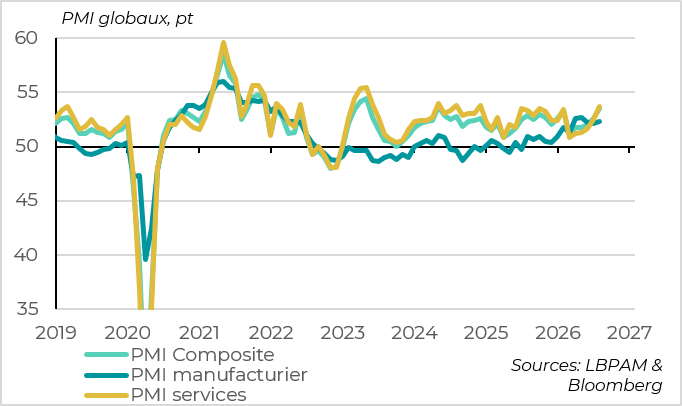
The global composite PMI, the best coincident indicator of the world economy, shows that global growth remains solid this summer, and may even be accelerating slightly. This supports the recovery in corporate profits, beyond just the technology and energy sectors, and justifies interest rates and equity markets moving to cyclical peaks.
The PMI rose again significantly in August to reach 53.5 points. It thus rises above its pre-conflict level with Iran and its historical average. It even reached its highest level in more than three years.
More widespread growth geographically
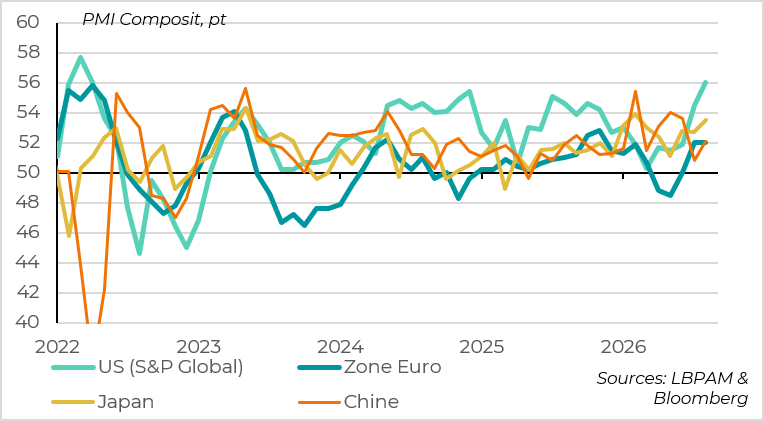
This increase also appears to be widespread. From a sectoral perspective, activity remains solid in industry after its recovery in the first half of the year, but the improvement is now more pronounced in services.
Geographically, the PMI advanced in nearly three quarters of the countries covered by the survey, which confirms the broadening of the global growth dynamic.
Activity continues to surprise positively despite shocks
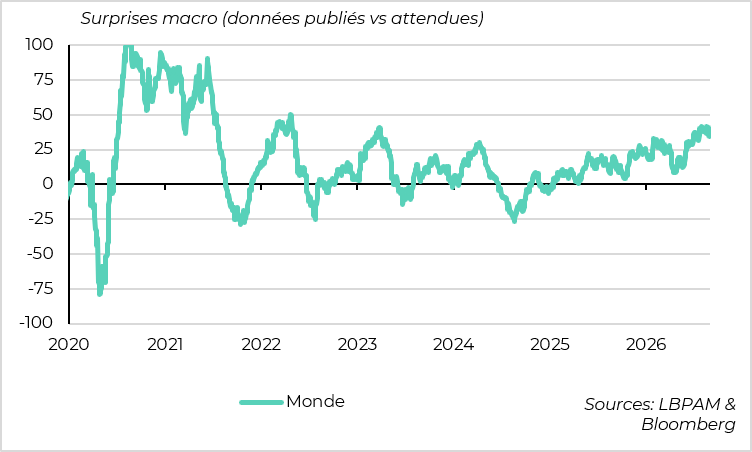
Despite this favorable trend, we believe that economic conditions could slow down slightly in the coming months due to rising geopolitical tensions, rising energy prices, high interest rates, and political uncertainties linked to upcoming elections and budget deadlines in France, the United Kingdom, and the United States.
That being said, the global economy has shown much greater resilience than expected for a year now despite major shocks, whether geopolitical, commercial, or energy-related. We are thus going through the longest period of positive macroeconomic surprises since the global financial crisis, and these surprises are no longer limited to the United States.
This dynamic, driven by a particularly robust investment cycle and significant fiscal support, should continue. Therefore, despite some short-term headwinds, we continue to expect the global growth cycle to continue in the coming quarters.
That is why we are adopting a slightly more cautious approach tactically in our asset allocation in the short term, while remaining constructive from a structural point of view.
United States: The strength of activity and the resilience of employment maintain pressure on the Fed
Cyclical indicators remain very solid in August
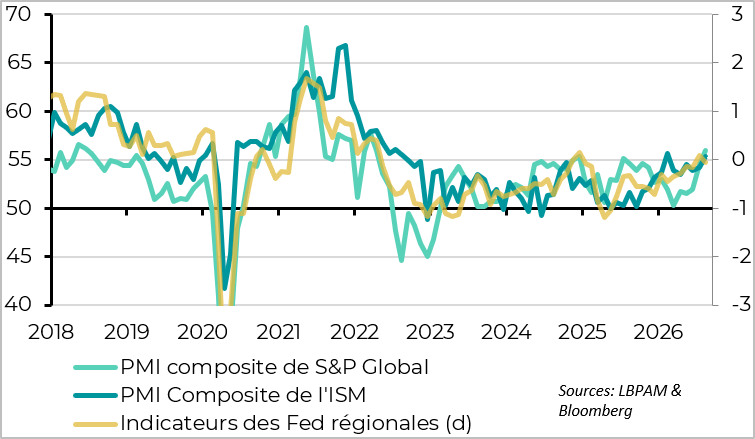
PMIs rose sharply in August to reach their highest level since 2022, or even higher according to surveys. The S&P Global PMI stands at 56 points, while the ISM PMI reaches 55.4 points.
These indicators point to a reacceleration of activity after the moderate slowdown observed at the beginning of the year, at a rate above the potential growth rate of the US economy. This improvement is mainly driven by services, while the manufacturing sector remains at high levels.
We expected positive but moderate growth this summer, due to the erosion of household real purchasing power, a hypothesis confirmed by slightly less favorable statistics during the summer. However, leading indicators now suggest upward risks to this scenario.
This resistance can be explained in particular by the boom in investments related to artificial intelligence and by a rise in energy prices that is more contained than elsewhere in the world. Conversely, the recent rise in interest rates could be a moderate brake on activity in the fourth quarter.
The ISM services index signals dynamic activity but also persistent inflationary pressures
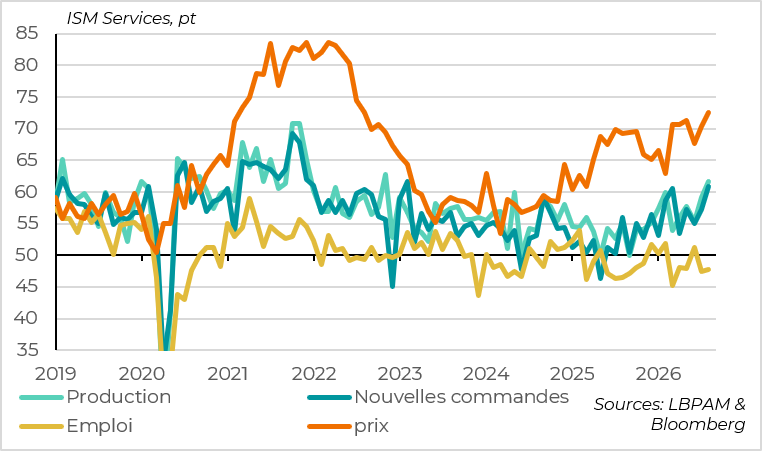
The jump in the ISM services index, from 54.1 to 55.4 points in August, is based on particularly strong components.
The increase in production and new orders suggests that demand remains robust. Conversely, the employment index remains slightly in contraction territory, despite a marginal improvement. This reflects a certain caution on the part of companies despite a favorable economic environment.
At the same time, the services sector's index of prices paid continues to rise, reaching its highest level since mid-2022.
The companies surveyed particularly emphasize the impact of tariffs and Middle Eastern tensions on their costs. This confirms that inflationary pressures remain significant beyond just the effect of energy prices and increases the risk of a slower slowdown of inflation towards the Fed's target.
A less dynamic but still balanced labor market
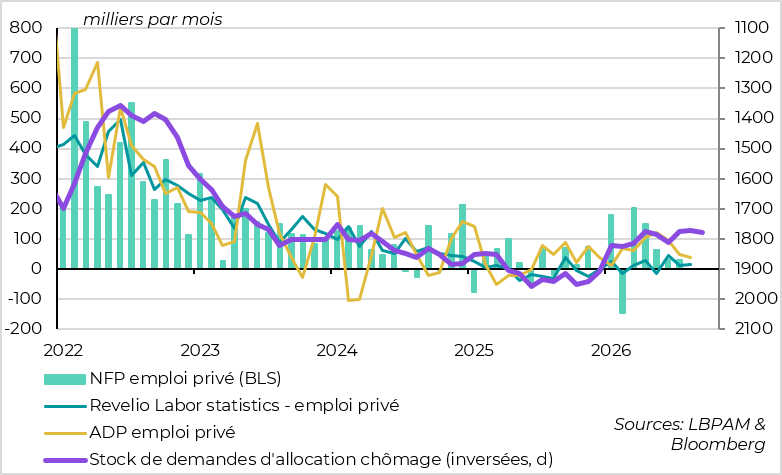
Before the release of the official August employment report this afternoon, available indicators suggest a slight slowdown in job creation after the rebound observed in the second quarter.
Even so, these would still be enough to keep the economy close to full employment. This situation is consistent with limited job offers and a still low level of dismissals.
According to private surveys, including ADP's, private sector employment increased by less than 50,000 jobs in August. At the same time, unemployment claims and dismissals would continue to decline slightly, while the ratio between job offers and unemployment would stabilize at a favorable level.
If official figures do not reserve any major surprises, the Fed's assessment that the labor market remains generally balanced should be confirmed.
Therefore, even though the slowdown in job creation rather argues in favor of patience, the solid activity limits the risk of a marked deterioration in employment. The Fed's attention should therefore continue to focus more on its price stability mandate than on its employment mandate.
The risk of a rate hike as early as September is increasing, even though our central scenario remains one of a hike in December, followed by another in the first quarter of 2027.
Eurozone: higher inflation justifies measured rate hikes
Inflation reaches a new high of 3.3% under the influence of energy
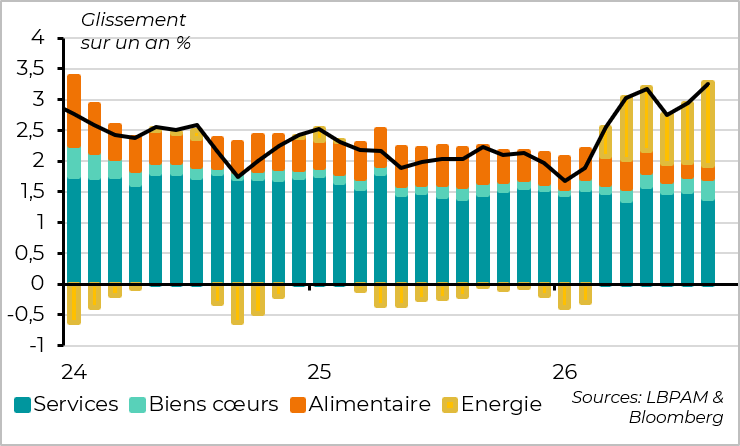
Inflation in the eurozone accelerated in August, rising from 2.9% to 3.3% year-on-year.
This increase was largely expected, as it mainly reflects the rebound in energy prices observed since July. However, it drives inflation to its highest level since 2023.
If energy prices, particularly for gas and electricity, remain persistently high in a scenario of an unresolved conflict in the Middle East, and if food inflation rises again after remaining limited so far (1.2%), inflation could continue to increase and remain significantly above 3% over the next few months.
Core inflation slows slightly, sign of contained domestic pressures
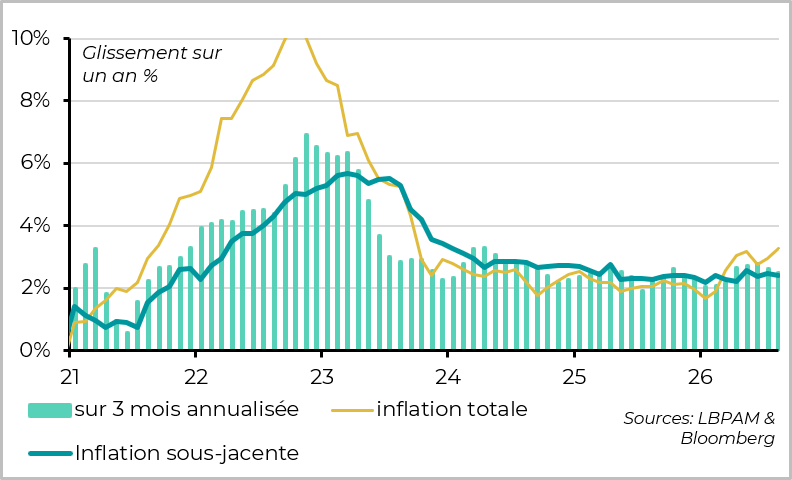
Conversely, six months after the start of the conflict in Iran, the second-round effects remain little visible.
Core inflation fell slightly in August, from 2.5% to 2.4%, while the consensus expected it to remain stable. It is also slowing down sequentially after the acceleration observed in the spring.
Services are slowing down while goods are accelerating
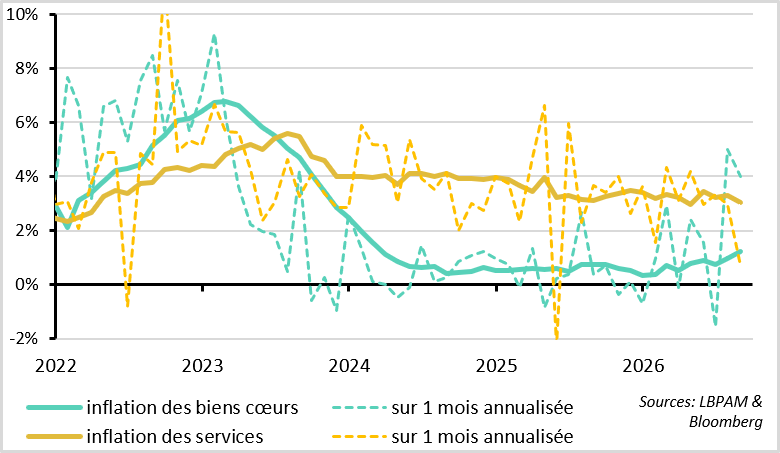
The slowdown in core inflation comes mainly from services, where inflation falls to 3.0%, its lowest level since 2022.
This moderation was likely amplified by the weak price increase in the tourism sector, which is particularly volatile and sensitive to changes in energy prices. However, it suggests that domestic tensions and the transmission of rising costs to final prices remain limited.
Conversely, inflation excluding energy and food continued to accelerate, reaching 1.2%. This development seems more linked to the increase in prices of technological goods, a phenomenon now also visible in Europe.
High inflation until spring before a more marked slowdown
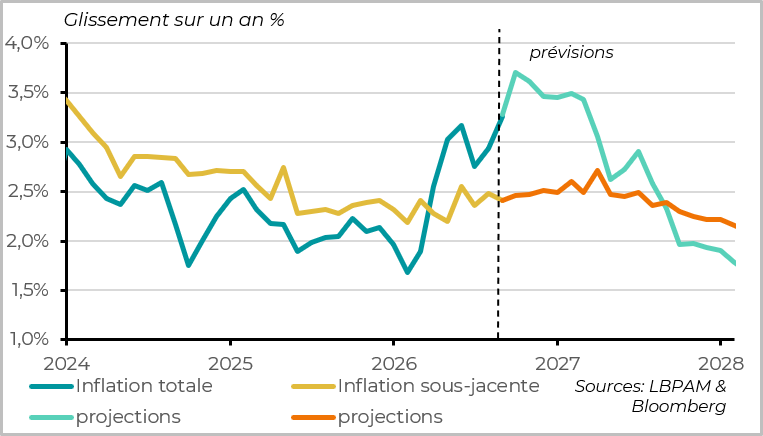
Overall, inflation is expected to continue to rise slightly over the next few months due to gas and electricity prices, while core inflation should remain relatively stable at around 2.5%.
However, we expect a more pronounced slowdown starting next spring, as we believe that the second-round effects on wages and service prices will remain contained.
For the ECB, even though current inflation remains slightly below the projections formulated in June, the sharper than expected rise in gas and electricity prices should lead the institution to raise its inflation forecasts for the end of 2026 and 2027.
Combined with the resilient growth observed since the energy shock of the first half of the year, these factors justify, in our view, a further increase in rates next week as well as the maintenance of a restrictive bias in the ECB's communication.
However, the absence of significant transmission of higher energy prices to the rest of the economy is a reassuring factor. Domestic pressures appear significantly less strong than in 2022, limiting the risk of a more persistent higher inflation.
The ECB should therefore not adopt a significantly more restrictive tone than that already priced in by the markets, which now anticipate an additional rate hike next year.

Xavier Chapard
Deputy Director of Research