Interest rates still higher
Link

Rate hikes, geopolitical tensions, and a return of inflationary pressures: Sebastian Paris Horvitz reviews the main events marking the markets in this autumn of September 2026.
Overview
►The US bombings of Iran and the latter's response targeting US interests in Jordan and the UAE have obviously created new tensions on energy prices. This US attack may come as a surprise, insofar as Donald Trump's new strategy appears to favor financial sanctions against entities financing the country.
►It now seems clear that a resolution of the conflict, accompanied by a full opening of the Strait of Hormuz, is not a preferred scenario in the short term. We believe we have entered a phase of stagnation. However, even if this were to last for several months, it can be thought that energy price increases should remain contained. We have assumed energy prices (oil and gas) at high levels, but not high enough to suddenly darken the economic outlook.
►In this scenario, energy prices will play a role as a growth brake, without constituting a major obstacle.
►At the same time, another brake has gained traction in recent months: interest rates, which have experienced a significant increase in most developed countries, with long-term rates reaching their highest levels in almost two decades.
►These increases reflect, in our opinion, a number of factors. First of all, it is clear that the uncertainty surrounding the trajectory of fiscal and monetary policies plays an important role. Budgetary imbalances, already exacerbated by the major crises we have experienced in recent years (financial crisis and Covid), combined with today's strong pressures related to security issues and increasing interventionism, cannot fail to worry investors. On the central bank side, persistently high inflation levels, even if mainly due to the energy shock caused by the war in Iran, create upward pressure on key interest rates.
►On the monetary front, the highly anticipated speech by K. Warsh, delivered last Friday at the Jackson Hole conference organized by the Kansas City Fed, helped reinforce expectations of an increase in US key interest rates. Indeed, K. Warsh again emphasized his commitment to bringing inflation back towards the Fed's target of 2%. Most importantly, for the first time since taking the helm of the Fed, he spoke out on the economic situation in the United States.
His assessment is unequivocal: inflation is too high and the Fed must act, while the US economy, particularly the labor market, remains strong.
►However, the essential question remains knowing when the Fed will act and with what extent. We continue to believe that it will wait for the end of the political sequence of the mid-term legislative elections, scheduled for early November, before intervening. We therefore expect a rate increase at the end of the year, followed by another at the beginning of 2027.
At the same time, K. Warsh created his own credibility problem by strongly criticizing the persistence of high inflation without actually taking action. Therefore, following his speech and in order to restore his credibility, he may decide to intervene more quickly.
►On the statistics side, across the Atlantic, as the country moves towards the mid-term elections, the University of Michigan survey on consumer confidence for the month of August did not bring good news to the government, with a further decline in this indicator. In particular, medium and long-term (5 to 10 years) inflation expectations remain at the high end of their historical range.
►In the Eurozone, inflation figures for August, which began to be published last week, show an acceleration under the effect of rising energy prices. In France, it rose to 2.7% year-on-year, in Germany to 2.9%, and in Spain to 4.5%.
At the same time, it is reassuring to note that at this stage, fears of second-round effects are not truly visible, as core inflation rates remain contained.
►Inflation figures for the entire euro zone will be published today. Overall inflation is expected to exceed 3%, but the most important information will be about core inflation. In our view, it should remain stable around 2.5%, which would be a reassuring factor for the ECB.
However, another increase in key rates this month or next seems almost certain. Subsequently, the ECB will need to exercise caution in the conduct of its monetary policy, especially if the feared second-round effects do not materialize. In our opinion, the market remains too aggressive in its expectations for future increases.
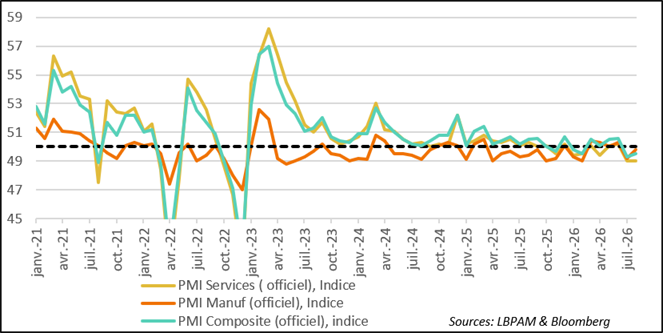
►In China, the initial economic indicators showed that the domestic situation is not improving. In fact, official PMIs for the services sector remained depressed, just below the expansion threshold. This argues in favor of a new targeted boost from the government to support domestic demand.
Going Further
Interest rates: long rates still higher
Throughout the developed world, rates are at their highest
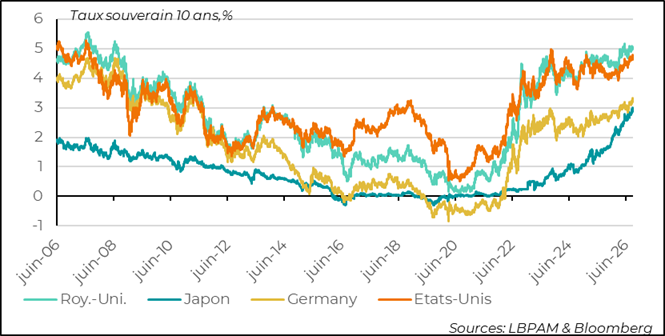
The rise in long-term sovereign yields obviously marked the summer, with a fevered atmosphere on the bond markets.
These increases appear to reflect a multitude of pressures exerted on long rates.
Nevertheless, the essential elements, in our opinion, lie in the uncertainty surrounding the trajectory of budgetary and monetary policies.
We know that the budgetary situation of many countries has deteriorated significantly over the past decade, following very large-scale crises. But the recent period, marked by increasing geopolitical tensions, puts additional pressure on public finances, particularly in the area of security.
Furthermore, the interventionist and populist temptations observed in many countries are amplifying the fragility of public accounts.
It is difficult to imagine these factors dissipating quickly. In this context, pressure on long-term rates is likely to persist.
Similarly, on the monetary front, the energy shock caused by the war in Iran came to add further pressure on central banks, even though the fight against inflation had not yet been fully successful, that is to say brought inflation back towards the targets set by the central banks.
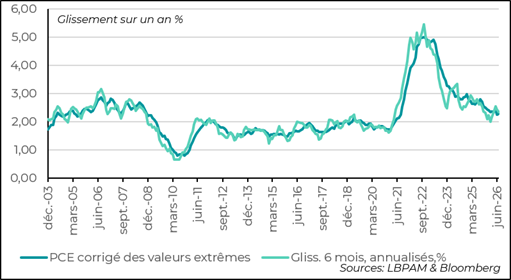
This is particularly the case in the United States. Moreover, that is the message K. Warsh has been sending since taking the helm of the Fed. However, while warning about inflationary risks and pointing out in particular that it is not acceptable for inflation to remain persistently above the 2% target for so long (since 2021, inflation measured by the consumer price deflator has remained well above this objective), he did not really act, which somewhat undermined his credibility.
His speech at Jackson Hole last Friday aimed precisely to restore this credibility, with an analysis of the US economic situation leaving little room for doubt about the need to continue fighting inflation.
It remains to be seen when this intervention will take place. Given the US political situation, we believe he could wait for the results of the mid-term elections in early November before acting. However, the credibility deficit he himself has created could push him to intervene earlier, with the support of a growing number of members of the Fed's monetary policy committee.
This element of uncertainty regarding the Fed's future trajectory could therefore continue to weigh on rates.
Inflation expectations remain well anchored
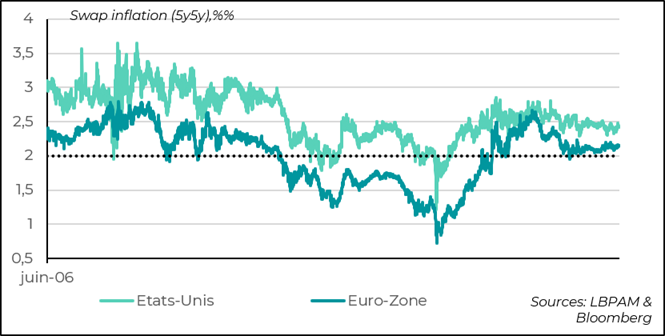
At the same time, and this is a reassuring point, inflation expectations observed on the markets remain well anchored on both sides of the Atlantic.
High term premiums
It seems that uncertainties about the future are primarily weighing on long-term rates, especially those related to the future direction of public policies. This situation is reflected in particular in the increase in term premiums.
Furthermore, given the scale of investments dedicated to the development of artificial intelligence (AI), competition for capital allocation between different asset classes is also likely to contribute to upward pressure on interest rates. This effect could be reinforced by higher growth expectations, fueled by the expected productivity gains from AI.
In this context, it seems necessary to us to remain particularly agile in managing sovereign interest rate exposures. We also need to incorporate the idea that interest rates should remain high for some time yet.
United States: consumer confidence remains low
Confidence is deteriorating again
The University of Michigan's final survey on household confidence was down. It remains at particularly low levels.
This is obviously not good news for the incumbent government two months ahead of the mid-term elections.
A decline that affects all political sensibilities
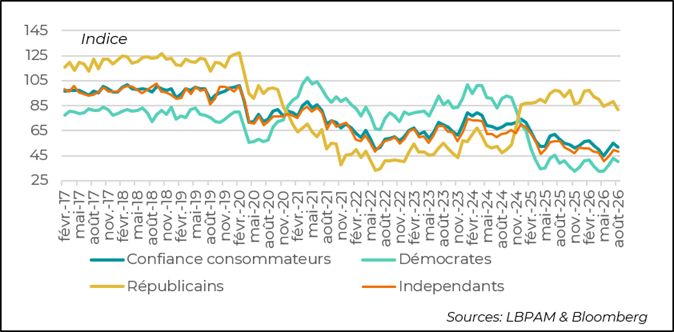
More worryingly, this deterioration concerns all political sensibilities, including households declaring themselves close to the Republican Party.
Long-term inflation expectations remain high
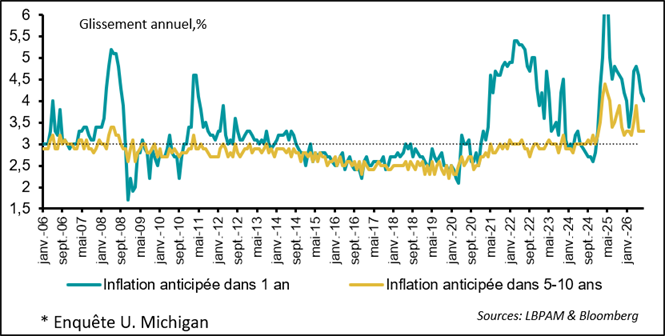
Concerns about the economic situation continue to dominate, particularly regarding inflation. Let us recall that this subject played a determining role in the rejection of the Democratic candidate during the last presidential election.
Therefore, long-term inflation expectations remain at the high end of their historical range.
At the same time, it should be noted that despite this low level of confidence, the consumption dynamic remains relatively solid in the United States, thanks in particular to a resilient labor market. This remains a significant support for the country's growth prospects in the coming quarters.
China: domestic activity remains weak
Official PMIs point to sluggish domestic growth
The official PMIs for August were relatively weak, with services remaining in contractionary territory in particular.
The Chinese economy therefore continues to be mainly driven by industry and the export sector, while domestic demand remains weak. Furthermore, the stagnation of the real estate sector persists.
In order to correct this dynamic and achieve its GDP growth targets, which range between 4.5% and 5%, especially in a context where new tensions are emerging with the United States, it is very likely that the Chinese authorities will soon implement new targeted support measures in favor of the domestic economy.

Sebastian Paris Horvitz
Director of Research