No respite for French public debt
Link

What should investors take away from market developments on October 23, 2026? Xavier Chapard shares his insights and analysis.
Overview
►Once again, France is taking center stage in international markets this week, alongside oil and AI, unfortunately not for the right reasons. France's 10-year borrowing cost has risen above 5% for the first time since 2002, surpassing that of the United States. Meanwhile, the spread over Germany has climbed close to its historical highs, last seen during the Eurozone sovereign debt crisis, and France now carries the highest risk premium among Eurozone countries.
►Volatility could remain elevated in the short term, given the uncertainty surrounding the passage of the budget, the ongoing social unrest, and Moody’s review of France’s sovereign rating this evening (with a risk of a downgrade from Aa3 to A1, which would align Moody’s rating with those of S&P and Fitch).
Beyond these near-term risks, the risk premium on French government debt may appear attractive relative to the country's fundamentals. However, it remains unclear whether investors, most of whom are foreign, will be willing to significantly increase their exposure to French debt while political uncertainty and concerns regarding the trajectory of public finances are likely to remain very high, at least until next year's elections. This is why we continue to maintain a cautious stance on French government debt.
►For now, the stress remains largely concentrated on French government debt, meaning that the risks of a financial crisis or a significant tightening in financial conditions appear limited to us. In this context, we continue to believe that a scenario of stable growth around 1% in the Eurozone remains the most likely outcome.
Moreover, French business confidence edged up slightly in October, rising from 96 to 97 according to the latest INSEE survey, supported by both the manufacturing and services sectors.
►As for the ECB, which meets next week, we believe it will maintain a stance of “constructive ambiguity” toward France, signaling that it stands ready to intervene in sovereign bond markets if necessary, while refraining from specifying the exact conditions that would trigger such action.
That said, this reinforces our view that the ECB will remain cautious regarding further rate hikes, even as energy prices and the associated inflationary risks continue to rise. We expect the ECB to keep interest rates unchanged in October before raising them in December, and likely once more in early 2027.
►Oil and gas prices rose again this week, driven by the continuation of attacks on Saudi Arabia, the lack of progress in negotiations between Iran and the United States, and, above all, reports suggesting that the United States and Israel have prepared plans to resume strikes against Iran following the midterm elections in early November. If confirmed, this would represent a significant risk to our baseline scenario, which assumes a de-escalation of tensions around the Strait of Hormuz and a decline in energy prices from year-end onward.
In any case, the rise in European gas prices ahead of winter, reaching their highest level since 2022, is weighing on consumer confidence in both the Eurozone and the United Kingdom. In October, confidence has fallen back close to the lows reached last spring. This is consistent with our expectation of a slowdown in consumer spending during the fourth quarter and reinforces our cautious stance toward risk assets in the short term.
►Across the Channel, the latest data should remove the remaining reservations within the Bank of England about joining the broader rate-hiking cycle. Inflation accelerated more than expected in September, rising from 3.1% to 3.5%, driven not only by higher energy inflation but also by rising services inflation.
At the same time, the labor market appears to have finally stabilized, with the unemployment rate falling from 4.9% to 4.7% in August, private-sector employment increasing in September, and wage growth stabilizing at a still somewhat elevated level.
We believe that rising second-round inflation risks and diminishing concerns about the labor market will lead the BoE to raise interest rates for the first time this year in early November, and again in February, when inflation is expected to be well above 4%.
To go further
France: Markets Further Intensify Pressure on Public Debt
Tensions surrounding French government debt are rising sharply
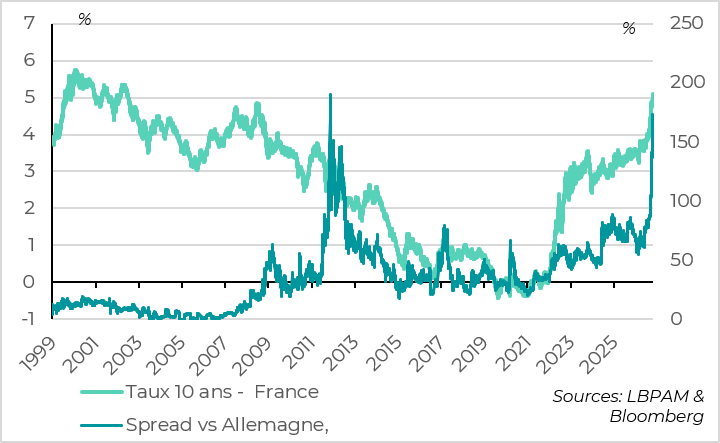
The 10-year yield spread between Germany and France, which has been under pressure since the 2024 dissolution, has widened sharply since the end of the summer. It rose from 80 to 140 basis points during September, driven by the announcement of a new fiscal slippage this year (with the deficit revised from 5.0% to 5.4% of GDP), the start of negotiations on the 2027 budget and, above all, the launch of the presidential campaign. It then fluctuated around 140 basis points during the first half of October, after speculative positions held by hedge funds were unwound as heightened volatility made them too risky. However, the spread has widened sharply again since last weekend’s events, likely due to sales by longer-term foreign investors, and is now approaching 175 basis points. France’s risk premium is now the highest in the Eurozone and has only exceeded its current level for two days, at the end of 2011, during the Eurozone sovereign debt crisis. This will weigh on the French economy relative to its European peers.
Although German yields have begun to benefit from their safe-haven status since the beginning of the month, this has not been enough to offset the widening of the French spread. As a result, the French 10-year yield has risen above 5% for the first time since 2002. This is not an immediate catastrophe, as the cost of French debt adjusts only gradually, given that the average maturity of French government debt exceeds eight years. Nevertheless, it complicates both the current situation and the prospects for fiscal consolidation. The average interest rate on French government debt has already increased from 1% to 2% since 2020 and would reach 3% before the end of the next presidential term if yields remain at their current levels. This would require an additional fiscal adjustment equivalent to 1.5 percentage points of GDP to stabilize public finances.
The fiscal adjustment required to stabilize public debt is substantial
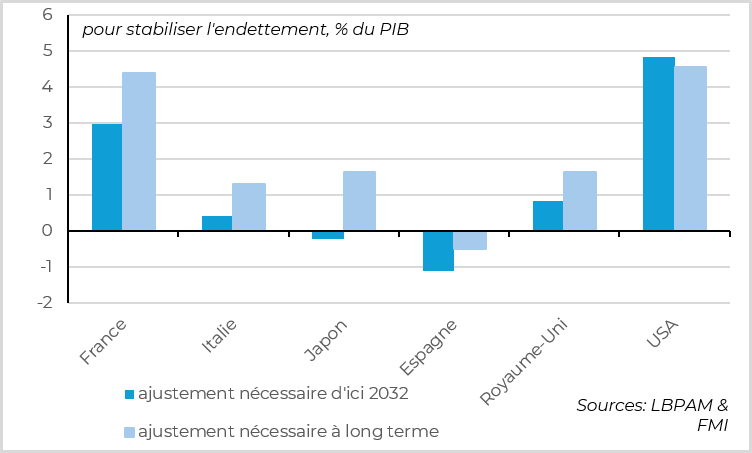
There are still several short-term risks that could generate volatility, including the adoption of the 2027 budget, the evolution of social unrest, and Moody’s review of France’s sovereign rating later today. Once these hurdles have been cleared, one could argue that the risk premium currently embedded in French government debt may attract investors, as it appears difficult to justify in light of France’s macro-financial fundamentals. However, will these investors, most of whom are foreign (55% of French government debt is foreign-owned, as is virtually all of the additional debt issued since the beginning of the year), be willing buyers while the political outlook and fiscal trajectory remain highly uncertain, at least until the presidential and legislative elections?
Yet a substantial fiscal adjustment appears unavoidable. To stabilize the debt-to-GDP ratio, which is rapidly approaching 120%, France would need to improve its primary fiscal balance (excluding interest payments) by more than 3 percentage points of GDP. After the United States, this represents the largest fiscal adjustment facing any major advanced economy over the coming years.
But such an adjustment would not be unprecedented, even in France
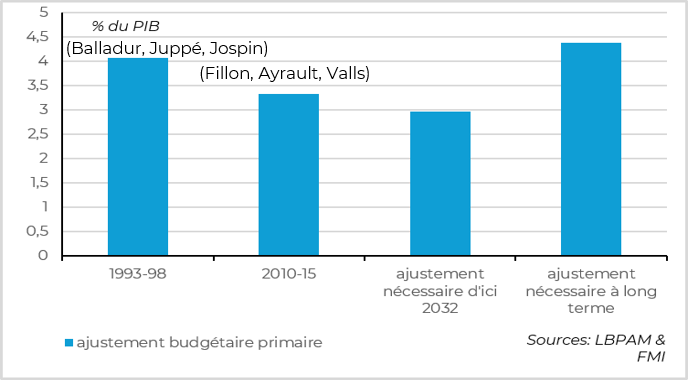
The good news is that such an adjustment is neither impossible nor unprecedented, even for France.
First, the required effort is far smaller than the more than 10 percentage points of GDP adjustment undertaken by Spain and Portugal in the early 2010s, not to mention Greece, and is broadly comparable in scale to that carried out by Italy.
Moreover, fiscal adjustments of a similar magnitude have already been implemented in France, in the mid-1990s and again in the early 2010s. That said, economic growth is weaker today than it was in the 1990s, the scope for raising taxes is more limited than in the early 2010s, and those past adjustments came at a significant cost in terms of unemployment. This makes the reform effort more challenging, particularly in today's fragmented political environment.
French business confidence remains resilient in October
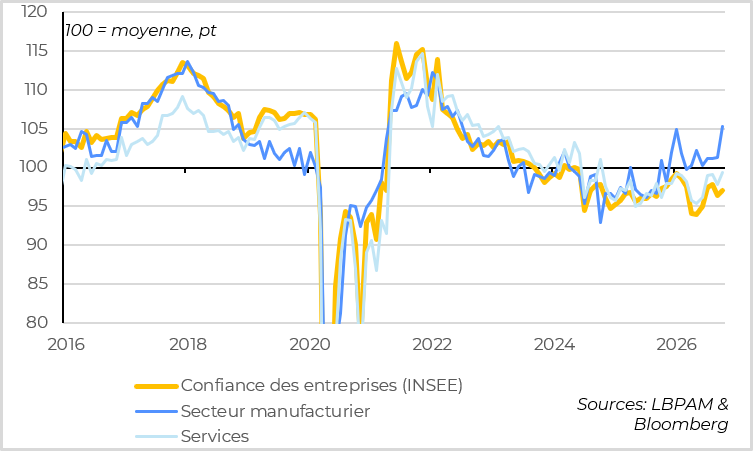
From a cyclical perspective, France continues to hold up thanks to a favorable global environment. Business confidence edged up in October, according to the INSEE survey, rising from 96 to 97 points. While still below its historical average, this level remains consistent with modest positive growth.
The improvement was driven by the industrial sector, where confidence surged to 105, its highest level since mid-2022. This is in line with the strength of the global industrial recovery. Confidence in the services sector remains more subdued at 99 points, but it also increased in October to its highest level in two years. This suggests that domestic demand is not as depressed as might be feared.
However, retail, construction and employment are facing greater difficulties
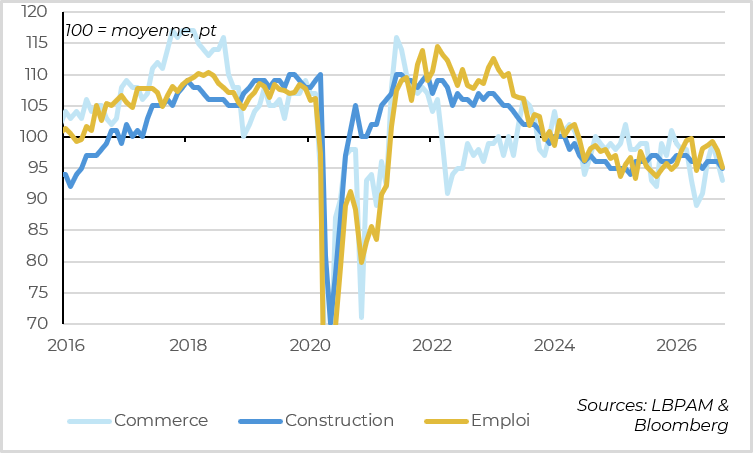
It is reassuring that French business confidence has so far remained resilient despite rising financial tensions and political uncertainty. However, it is not clear that this will be enough to ease social tensions. Retail and construction are being hit by higher energy prices and rising interest rates, which are weighing on households. In addition, companies report a further reduction in hiring in October, with the INSEE employment indicator falling back to 95 points.
United Kingdom: On Track to Join the Rate-Hiking Cycle
The BoE is the last major central bank yet to raise interest rates this year
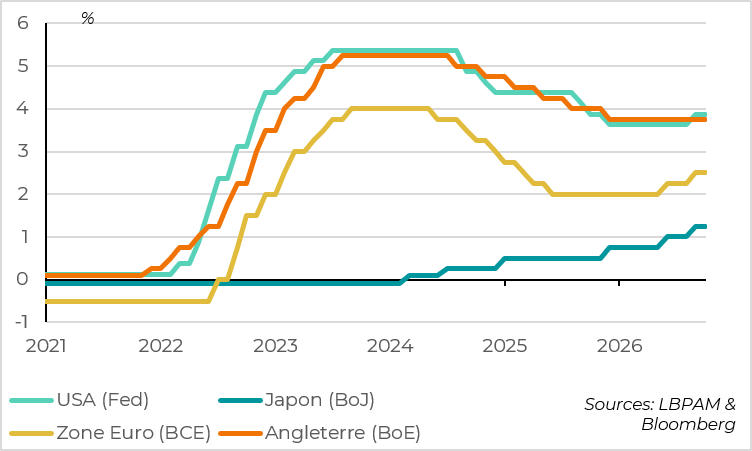
The Bank of England has kept interest rates unchanged at 3.75% this year, setting it apart from the other three major central banks, all of which have resumed tightening monetary policy since the summer. That said, the likelihood of a rate hike has increased following the renewed rise in energy prices this summer, as a more prolonged inflation shock and the resilience of the economy raise the risk of indirect inflationary pressures and second-round effects on wages.
At the September meeting, three of the nine Monetary Policy Committee members voted in favour of a rate increase, and the accompanying statement indicated that a prolonged energy shock would require the BoE to take action.
Against this backdrop, the macroeconomic data released this week, unlike last month's figures, should be enough to convince the Committee's centrist members of the need to begin raising interest rates.
Inflation Accelerates in September, Mainly but Not Solely Due to Energy Prices
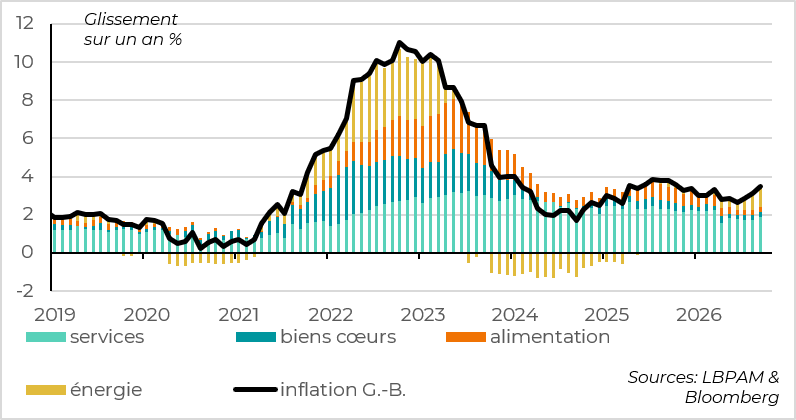
First, inflation accelerated more than expected in September, rising from 3.1% to 3.5%. This increase was driven mainly by energy prices, while food price inflation remained relatively contained at 1.6%. However, current energy prices are likely to push headline inflation higher in the coming months, with inflation expected to rise well above 4% by early 2027.
Core Inflation Edges Higher for the First Time in Six Months
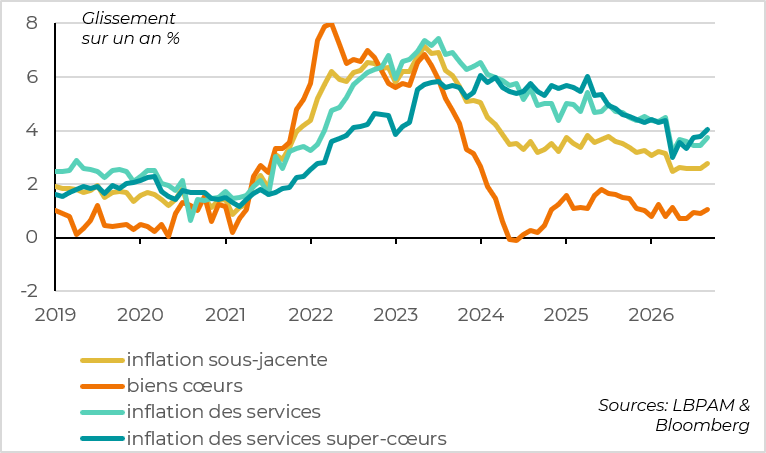
More importantly, the increase in inflation in September was also partly driven by core inflation, which rose from 2.6% to 2.8% after remaining stable in recent months.
There is little evidence that this reflects a broader pass-through of the energy shock to domestic prices. Core goods inflation increased only modestly, from 0.9% to 1.0%, and the rise was concentrated in computer equipment, likely linked to AI-related demand. Meanwhile, services inflation accelerated from 3.4% to 3.7%, but this was largely driven by categories directly affected by higher energy prices, such as airfares and transport services.
Nevertheless, the figures suggest that inflation is likely to remain somewhat higher than previously expected. This reflects both the direct impact of higher energy prices and the fact that inflation in other components is no longer showing meaningful signs of easing.
The Unemployment Rate Declines and Employment Appears to Be Stabilising at Last
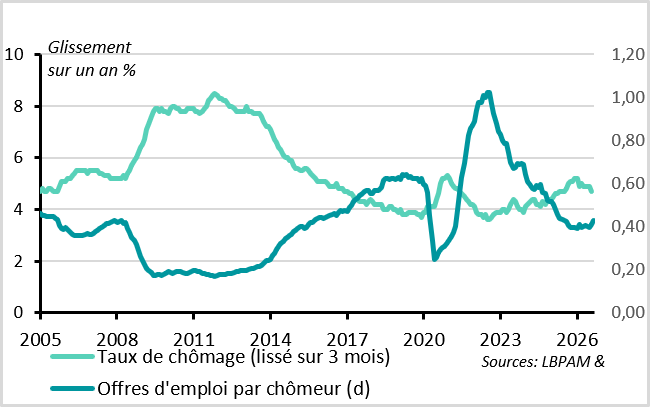
Beyond inflation, the labour market had been the BoE’s main reason for caution, as it had been softening slightly and was not generating significant inflationary pressures. However, the latest data point to a stabilisation, or even a modest recovery, in employment, which is consistent with the economy’s continued resilience.
The unemployment rate unexpectedly fell from 4.9% to 4.7% in August, its lowest level in a year and below the 5.0% rate projected by the BoE for the third quarter. Importantly, this decline reflects stronger employment rather than a lower participation rate. In September, payroll employment increased by 13,000 jobs after having effectively stabilised in August (following an upward revision from an initial estimate of a 26,000 decline), bringing to an end six consecutive months of job losses.
Caution remains warranted, as these figures are often subject to significant revisions and other labour market indicators remained weak in September, including unemployment benefit claims and job vacancies. Nevertheless, the data suggest that the labour market may finally be starting to stabilise after the sharp deterioration seen in 2025.
Wage Pressures Have Stopped Easing This Summer
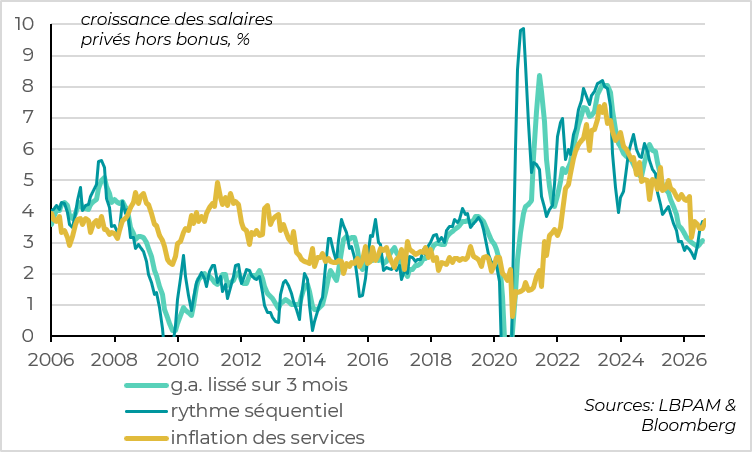
In addition, wage growth stopped slowing and even picked up slightly over the summer, with private-sector pay excluding bonuses rising from 2.9% to 3.0%. This is only marginally above the level generally considered consistent with inflation returning to target. As a result, wages are not currently a source of stronger inflationary pressures. However, they are no longer contributing to disinflation either, and should not be allowed to accelerate further.
Overall, these data should be sufficient to prompt the BoE to raise interest rates at its next meeting in early November. Moreover, with inflation expected to exceed 4% in early 2027, we believe the BoE will deliver a second rate hike in February, taking the policy rate to 4.25%.

Xavier Chapard
Deputy head of research