Pauses before further, measured rate hikes
Link

What should investors take away from market developments on October 30, 2026? Xavier Chapard shares his insights and analysis.
Overview
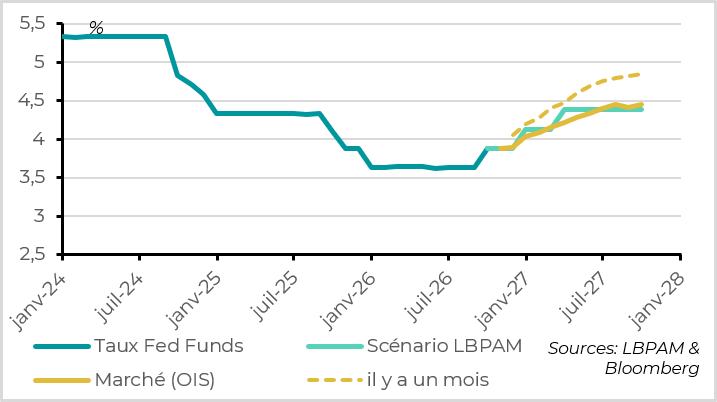
►Despite continued increases in energy prices, particularly natural gas prices in Europe, which reached EUR 100/MWh, and upside inflation surprises since the summer, the three major central banks kept their policy rates unchanged this week after raising them in September. They maintain a tightening bias and, in our view, are still likely to raise rates in December and modestly further next year. However, as we expected, they remain measured in their monetary tightening in the face of a supply shock and at a time when economic and financial conditions are far less conducive to persistent inflation than they were in 2021-23. That said, over the past month markets have moved closer to our less aggressive rate scenario, and long-term yields have declined alongside weaker risk appetite, somewhat reducing the attractiveness of sovereign bonds, which have been our preferred asset class since the start of the autumn.
►The surprise may be that both the Fed and the ECB have emphasized the tightening of financial conditions in recent weeks (higher interest rates and the correction in risk assets), suggesting that they are paying close attention to it despite persistent inflation risks. This is reassuring for risk assets such as equities, which appear to be becoming more attractive again now that valuations have eased and corporate earnings continue to surprise on the upside. That said, some caution remains warranted in the very short term, with the midterm elections approaching and a forthcoming decision by the U.S. President regarding his strategy in the Middle East.
►The ECB Governing Council kept its policy rates unchanged yesterday, as widely expected. The decision was unanimous, although discussions focused on whether rates should be raised further in response to increasing inflation risks stemming from higher energy prices. Likely in exchange for the hawks’ support for this pause, Christine Lagarde clearly indicated that a rate hike in December is virtually a done deal, barring any major surprises between now and then.
That said, beyond the upward risks to the inflation outlook, the ECB’s communication placed greater emphasis on the fact that underlying inflation is showing no signs of reaccelerating and that financial conditions have tightened since the summer, particularly due to higher long-term interest rates and wider sovereign spreads. This suggests that the ECB will maintain a measured approach in response to the intensification and persistence of the energy shock.
Overall, we maintain our baseline scenario of one rate hike in December and a final hike in March. That meeting would be the first under the ECB’s new president, following Lagarde’s announced departure in February. It is worth recalling, however, that Mario Draghi cut rates at his very first ECB meeting in 2011, marking a significant shift in the direction of monetary policy at the time.
►The Fed kept interest rates unchanged in October, as expected, in order to allow for the “accumulation of further information” ahead of its next meeting in December. It appears less urgent than it did in September to raise rates again, notably because financial conditions have tightened somewhat since its last meeting (and probably also because the midterm elections are taking place next week). However, the strength of the economy and the persistence of inflation above target, as confirmed by the data released yesterday, continue to justify further rate hikes to bring inflation back to target “within a reasonable timeframe.” We continue to expect the Fed to raise rates in December and likely again in March.
►Indeed, U.S. growth accelerated more than expected in the third quarter, rising from 2.2% to 3.4%. It continues to benefit from the AI-related investment boom, which shows few signs of losing momentum and is also supporting the rest of the world through stronger U.S. imports. Growth has also been supported by still-robust consumer spending over the summer, although consumption has begun to lose some momentum since September due to the decline in households’ purchasing power. Nevertheless, it should remain resilient thanks to the strength of the labor market. At the same time, the latest inflation data confirm that underlying U.S. inflation is not slowing and remains close to one percentage point above the Fed’s target (3.1% in September according to the Fed’s preferred inflation measure).
►The Bank of Japan (BoJ) kept its policy rate unchanged at 1.25% this morning, following its September rate hike, as widely expected. However, it stated for the first time that underlying inflation has reached its 2% target, supporting the case for a further normalization of monetary policy. We continue to expect the BoJ to raise rates again in December and to bring them closer to 2% over the course of next year.
►Across the Channel, the presentation of the UK budget by the new Chancellor delivered no major surprises, removing a source of risk for bond markets, even though the most significant fiscal decisions have merely been postponed until next year. As we expected, the government announced a number of temporary support measures aimed at limiting the increase in households’ energy bills, offset by targeted tax increases phased in over time. The projected deficit is rising due to higher debt-servicing costs, but it remains on a downward trajectory and continues to comply with the fiscal rules that the UK has set for itself.
Overall, the economic impact of this budget is only marginally less restrictive than previously expected for next year. With the budget announcement now behind it, the Bank of England (BoE) can begin raising interest rates for the first time this year in early November, and we expect a second rate hike in February, when inflation is projected to be above 4%.
To go further
ECB: A December Rate Hike Looks Almost Certain After This Week’s Pause
ECB Energy Shock Intensity Indicator Enters “Major Shock” Territory in October
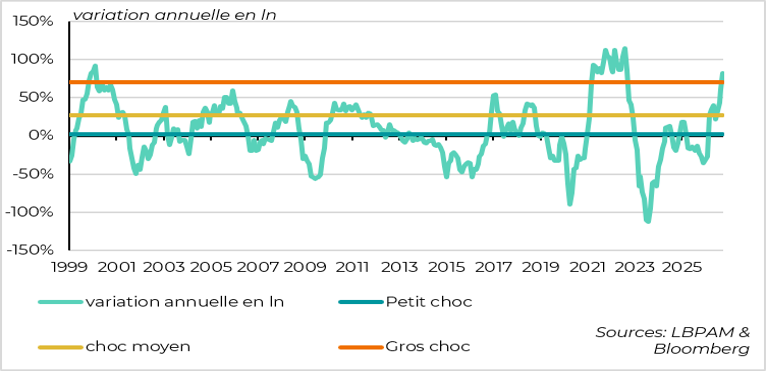
As expected, the ECB left its policy rates unchanged this week after raising them to 2.5% in September.
The decision was unanimous, although one could have expected some members to support another rate hike given the intensification and persistence of the energy shock. Indeed, oil and gas prices are now above the adverse scenario presented by the ECB in September. Moreover, according to the ECB’s own indicators, the rise in oil and gas prices has now reached a level that increases the risk of more persistent inflationary pressures.
As we expected, the ECB did not focus solely on the first criterion guiding its monetary policy decisions (the inflation outlook and associated risks), which clearly argues for further rate hikes. It also referred several times to the other two criteria (the trend in underlying inflation and the transmission of monetary policy to the economy), which support maintaining a measured approach to monetary tightening.
Underlying Inflation Measures Remain Stable So Far Despite Higher Energy Inflation
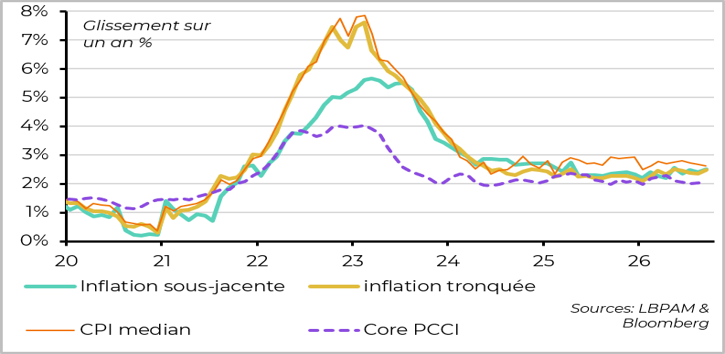
Indeed, the ECB noted that “underlying inflation has remained broadly stable so far,” and wage growth is showing no signs of reaccelerating. This reduces the risk that higher energy costs will spill over into the prices of goods and services that are not directly affected, or that they will lead to more persistent inflationary and wage pressures.
Financial Conditions Have Tightened More Noticeably Since Late September
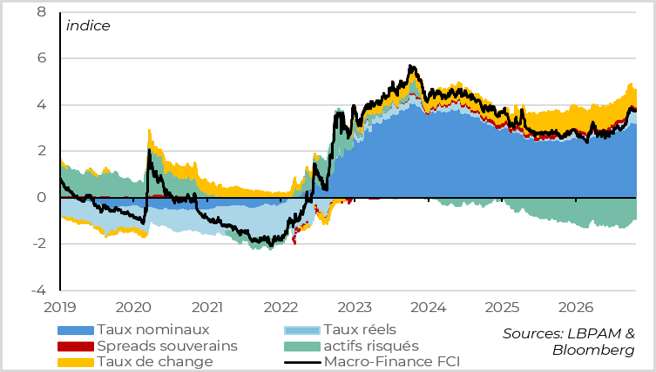
The ECB also noted that “financial conditions have tightened since its previous meeting,” which is a downside factor for both growth and inflation over the medium term. Indeed, the indicator developed by ECB staff to track the impact of market conditions on the economy has tightened more noticeably over the past month, after remaining broadly stable following the ECB’s first rate hike in June. This reflects not only higher interest rates, particularly real rates, but also the correction in equity markets and the widening of risk premia on both corporate credit and sovereign bonds. As a result, financial conditions are becoming more restrictive even without additional ECB rate hikes.
It is also worth noting that, when questioned about tensions in the French government bond market, Christine Lagarde maintained what we expected would be a “constructive ambiguity.” She stated that the ECB has the necessary tools to intervene in sovereign bond markets if needed, while refraining from specifying the conditions that would trigger such action. This helped ensure that the ECB had no meaningful impact on the French spread yesterday, which was probably its intention, as it seeks to avoid appearing politically involved as long as market tensions do not become systemic. Lagarde also stressed that member states should pursue sound fiscal policies and take into account the likelihood that borrowing costs will remain higher for longer.
Bank Lending Conditions Are Also Tightening Somewhat, Though Not Abruptly
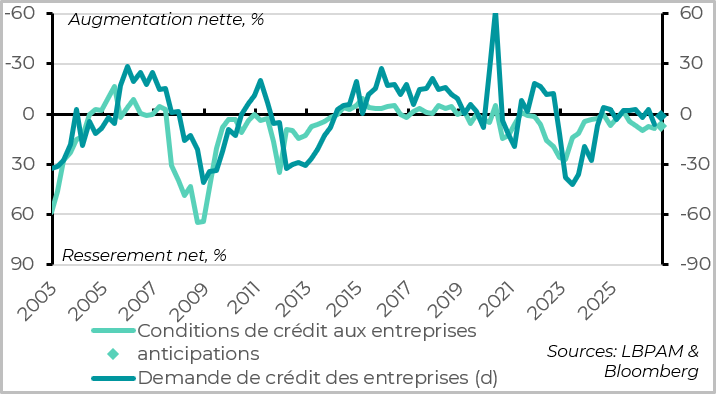
In addition to less accommodative financial conditions in the markets, a particularly important development for an economy as bank-intermediated as the euro area is that bank lending conditions have also been tightening in the second half of the year, which is likely to weigh somewhat on growth and, ultimately, on inflation. In the latest ECB survey conducted between late September and early November, banks reported a moderate tightening of credit standards for businesses due to increased uncertainty, particularly in France. More importantly, they indicated that demand for credit from both companies and households has declined as a result of higher interest rates.
Overall, both financial markets and banks are amplifying the impact of the ECB’s rate hikes on the economy and inflation, thereby reducing the extent of additional rate increases required.
The ECB Will Have to Revise Its Inflation Forecasts Significantly Higher in December
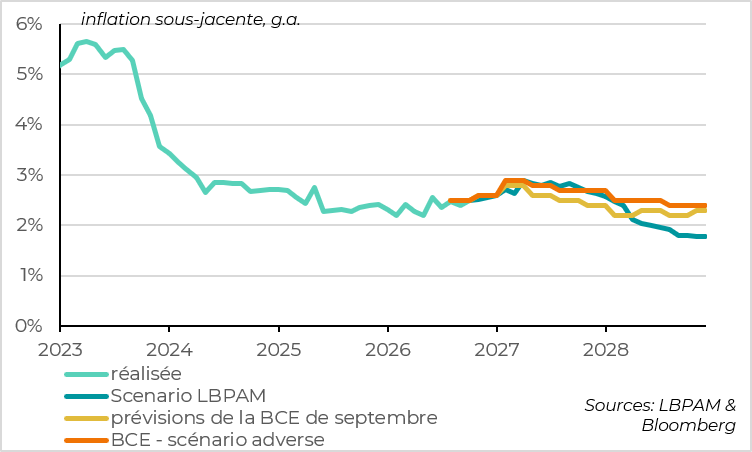
However, Lagarde also stressed that the key question during the meeting was whether a rate hike was needed immediately or whether the ECB could afford to wait until December. While the ECB ultimately decided unanimously to wait a little longer, Lagarde stated that current conditions could have justified a rate increase this week and that, barring any major surprise, “the direction of travel was fairly clear” going forward. This strongly suggests that a rate hike at the December meeting is almost a foregone conclusion. Moreover, as the ECB will have to revise its inflation projections significantly higher again in December, it is likely to maintain a tightening bias well into next year.
We continue to expect two additional rate hikes, in December and March
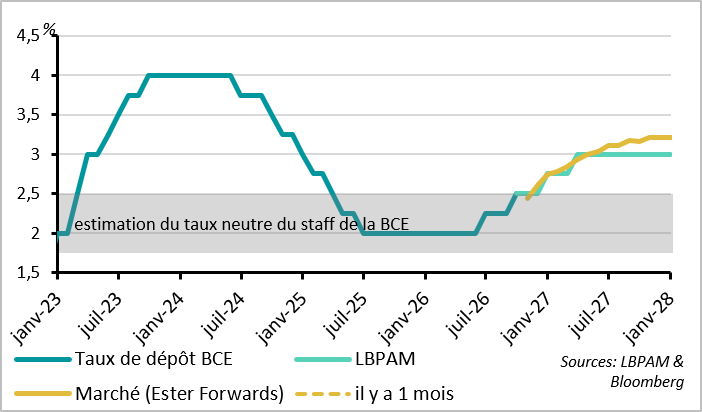
One factor adding uncertainty for next year is Christine Lagarde’s announcement yesterday that she will leave the ECB after the February meeting rather than at the end of her term in October. Combined with Isabel Schnabel’s planned departure to the IMF in January and Philippe Lane’s scheduled departure at the end of his term in May, this means that the ECB’s three most senior positions will all be renewed in early 2027. However, it is likely that a decision on at least the first two appointments will be made by the mid-December European Council, since it is responsible for approving appointments to the ECB’s Executive Board. The new president could therefore find themselves preparing to raise rates at their very first meeting, should our scenario of a final rate hike in March materialize.
United States: Growth and Inflation Continue to Surprise on the Upside
U.S. Growth Accelerates Over the Summer, Driven by Very Strong Domestic Demand
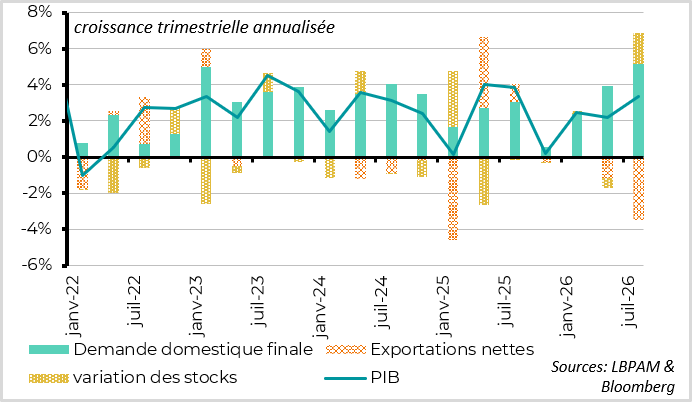
U.S. growth accelerated from 2.2% to 3.4% in the third quarter, coming in 0.2 percentage points above expectations. Growth was driven by private final domestic demand, which accelerated from 4.6% to 4.9%, reaching its highest level since early 2023.
Investment Remains at Historically High Levels, Driven by AI
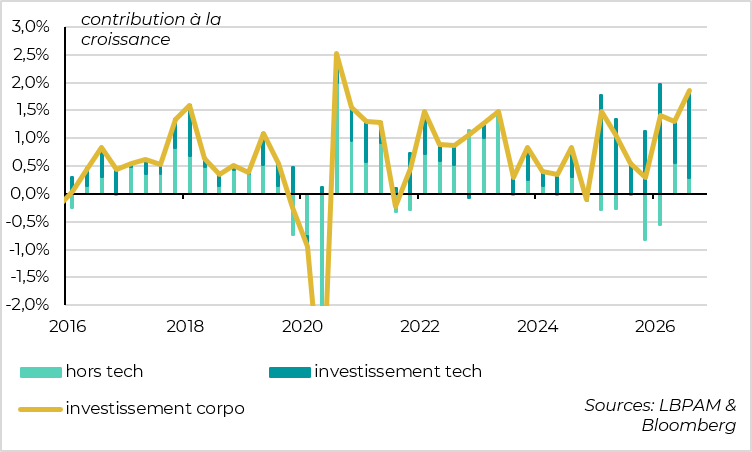
As expected, business investment remained very strong, supported by the ongoing AI boom, rising by more than 13% on an annualized basis after a 9% increase in the second quarter. It continues to be driven by technology investment, which has grown by more than 20% since the beginning of the year.
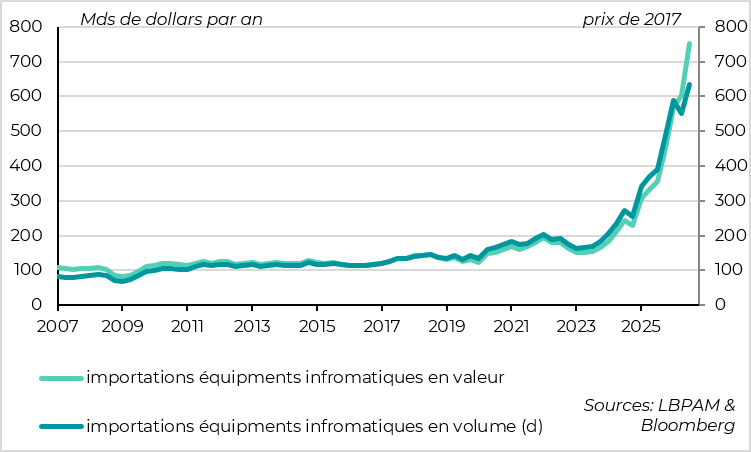
Demand in the technology sector is supporting activity not only in the United States but also in the rest of the world through higher imports. As a result, net exports subtracted 3.3 percentage points from third-quarter growth due to the surge in imports, with around two-thirds of this negative contribution stemming from increased imports of information technology-related goods.
Consumer Spending Remained the Main Driver of Growth Over the Summer
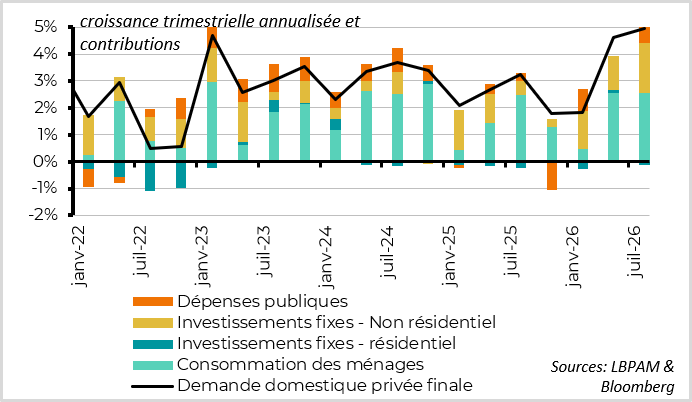
Despite the historic AI boom, household consumption remained the primary driver of U.S. growth, rising by 3.8% for the second consecutive quarter. Goods consumption proved resilient despite higher prices, increasing by 3% over the quarter. However, the biggest surprise came from services consumption, which accelerated to above 4% this summer for the first time since mid-2022.
By contrast, residential investment resumed its gradual decline, which is not surprising given the sector’s sensitivity to higher interest rates and rising construction material costs.
Inflation Accelerates in September, Mainly but Not Solely Because of Energy Prices
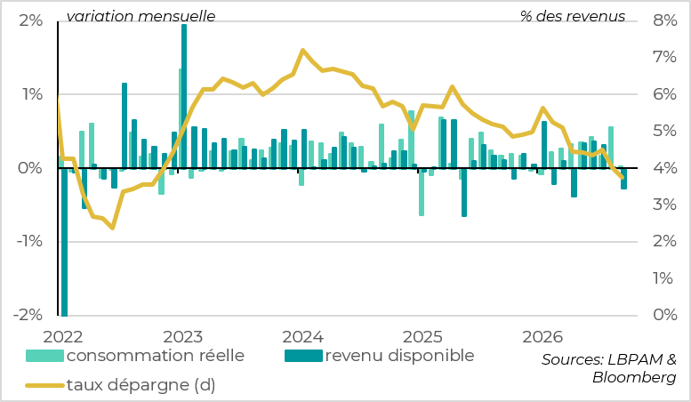
That said, consumer spending was flat in September after increasing by 0.5% in August, suggesting some loss of momentum following the summer. This would be consistent with the decline in households’ purchasing power resulting from higher inflation and reduced fiscal support since the summer. The saving rate fell back below 4% for the first time since 2022, limiting households’ ability to smooth price shocks. Nevertheless, the resilience of employment and wage income is reducing the risk of an abrupt slowdown in consumer spending.
By contrast, residential investment resumed its gradual decline, which is not surprising given the sector’s sensitivity to higher interest rates and rising construction material costs.
Core Inflation Reaccelerates in September
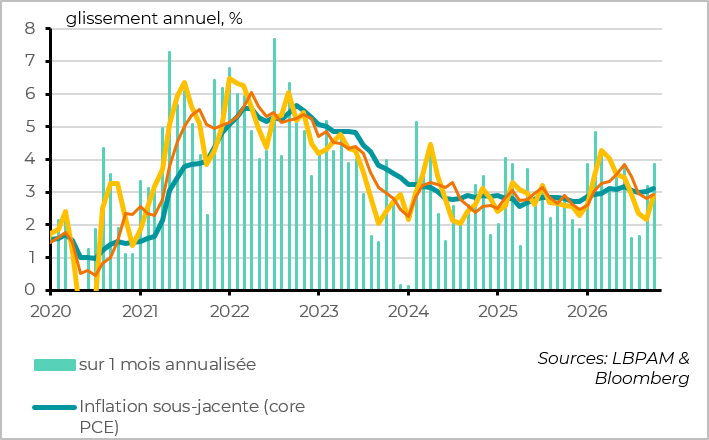
At the same time, inflation picked up again. Consumer prices rose by 0.5% month-on-month and 3.6% year-on-year, driven by a more than 9% monthly increase in fuel prices. More importantly, as expected following upside surprises in both CPI and producer price inflation data, core PCE inflation, the Fed’s preferred inflation gauge, accelerated noticeably in September. It is running at around 3% on a three-, six-, and twelve-month annualized basis, broadly unchanged from its level at the end of the second quarter and still about one percentage point above the Fed’s target. Finally, price increases have become more broad-based than in previous months, affecting most categories of goods and services.
The Unemployment Rate Declines as Employment Finally Appears to Be Stabilizing
The latest economic data largely confirm the assessment of the economy presented by Fed Chair Jerome Powell on Wednesday, when he stated that growth remained strong and that inflation had been running above target for six years. In addition, he argued that financial conditions were still not restrictive.
Against this backdrop, one may wonder why the Fed did not raise rates on Wednesday, even though two of its twelve members voted in favor of a hike. Christopher Waller explained that financial conditions had nevertheless tightened since September due to higher interest rates and the decline in AI-related assets, which he partly attributed to the effects of the Fed’s September rate hike. For the majority of Fed officials, this provides scope to wait for the substantial amount of data due before December in order to determine the appropriate monetary policy stance. We find these arguments only somewhat convincing. In our view, the Fed mainly judged that there was no urgency to accelerate rate hikes and therefore saw no need to take the risk of raising rates just one week before the midterm elections. However, that is not something the Fed can explicitly say.
Overall, following Wednesday’s Fed meeting, a rate hike in December appears highly likely to us, while a final increase in early 2027 also remains probable, even though the Fed’s tone this week was somewhat less hawkish than it had been in September.

Xavier Chapard
Deputy head of research