Pending talks between Xi Jinping and Donald Trump
Link

As geopolitical tensions show signs of easing, energy prices continue to soften and the Bank of Japan pursues its monetary policy normalization, Sebastian Paris Horvitz, Head of Research, examines the implications for global financial markets.
Overview
► The continued easing of energy prices has provided some support to market sentiment, although Brent crude oil remains close to USD 100 per barrel. Rumours of renewed talks between the United States and Iran appear to have contributed to this period of calm in energy markets. Nevertheless, the most promising development remains the prospect of an agreement among Gulf countries that would allow for a lasting reopening of the Strait of Hormuz. At this stage, however, we continue to expect a status quo scenario, with oil and gas prices likely to remain elevated in the short term.
► This partly explains why long-term interest rates remain elevated, despite significant fluctuations in recent days. Moreover, it is clear that fiscal imbalances continue to exert upward pressure on yields.
► French sovereign bonds have come under particular pressure in recent days. As an illustration, the yield spread between 10-year French and German government bonds has widened beyond 100 basis points, making it the largest spread currently observed within the euro area. Uncertainty surrounding the negotiations over the 2027 budget, as well as the policy proposals put forward by candidates for next year’s presidential election, are a source of concern for investors. At this stage, we remain cautious on French government debt within fixed-income allocations.
► In addition to the decline in energy prices, markets were also supported by reports pointing to strong demand for Meta’s artificial intelligence agent, known as Muse. More specifically, several semiconductor manufacturers involved in its deployment, including AMD and Intel, posted strong stock market gains. This development reassured investors about the sustainability of demand for companies providing the infrastructure required to support the expansion of AI. As a result, it helped offset concerns raised by calls from some industry leaders to slow the development of the technology due to the potential risks it may pose.
► These calls, however, were met with opposing views from policymakers, particularly in the United States and China. Some observers therefore expect the issue to be discussed by Presidents Xi Jinping and Donald Trump during their meeting scheduled for later this week. At this stage, the meeting appears more likely to focus on easing tensions than on confrontation. In particular, U.S. authorities seem willing to postpone the introduction of new tariffs that had been considered in response to China’s excess industrial capacity. For markets, the absence of any new tensions would already be welcome news.
► Discussions between the U.S. and Chinese presidents will take place alongside the opening of the United Nations General Assembly. While the session officially begins today, several countries have already sought to distinguish themselves. In this context, a group including Brazil, Canada, India, Australia and the European Union issued a joint statement in support of multilateralism in response to the growing polarization of the world. Despite ongoing tensions, some hopes remain for progress in a number of conflicts, particularly in the Middle East.
► These discussions could bring positive news for markets. However, it should not be forgotten that the past two weeks have been largely dominated by central banks. The message sent to investors is clear: policy rates are expected to continue rising. Nevertheless, we still believe that markets are pricing in overly aggressive rate hikes in both Europe and the United States. By contrast, we are broadly aligned with market expectations regarding the future path of interest rates in Japan.
► Despite expectations of further increases in Japanese policy rates, the yen failed to extend the appreciation trend observed following interventions by the Japanese authorities in the foreign exchange market, supported by the United States. At the time, U.S. Treasury Secretary Scott Bessent appeared confident that these actions had succeeded in easing downward pressure on the currency.
► In fact, the widely anticipated 25-basis-point rate hike announced last week was accompanied by a particularly cautious message, leading markets to question the pace of monetary policy normalization. This shift in sentiment contributed to putting the yen back on a depreciation path. Despite the statements made by Kazuo Ueda, Governor of the Bank of Japan (BoJ), we continue to believe that the BoJ will somewhat accelerate the normalization of its monetary policy.
► By early next year, two additional rate hikes are likely to be implemented, despite potential reluctance from the government. The latest inflation figures remain consistent with inflation stabilising around 2%, despite the continued use of energy price control measures. This trend should help bring the yen, which remains close to its lowest levels against the U.S. dollar since the late 1980s, back toward a level that is less disruptive for the global economy.
To go further
Japan: BoJ Puts the Brakes on the Yen’s Appreciation Momentum
The Yen Resumes Its Decline and Remains Near Its Lowest Levels Since the Late 1980s
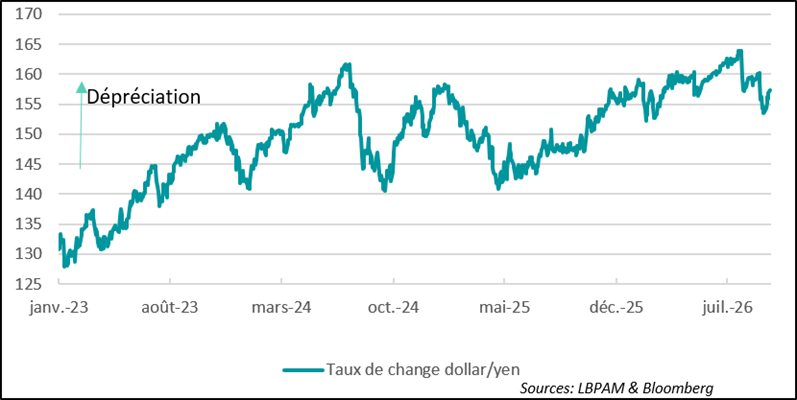
After hitting a low point in July, the yen experienced a marked appreciation, supported in particular by interventions from the Japanese authorities in the foreign exchange market, backed by the United States, as well as by expectations of a faster normalization of monetary policy by the Bank of Japan (BoJ). However, the Japanese currency has weakened again in recent weeks. Against the U.S. dollar, the yen therefore remains close to the lows reached since the mid-1980s.
This renewed trend can partly be explained by the cautious tone adopted by the BoJ when it delivered the widely expected 25-basis-point increase in its policy rate last week.
Kazuo Ueda, the Bank’s Governor, once again reaffirmed his gradual approach to monetary policy normalization. This cautious stance also reflects the position of Sanae Takaichi, who supports maintaining accommodative monetary conditions to complement her expansionary fiscal policy agenda. Moreover, the two members of the monetary policy committee appointed by her government voted against the policy rate increase last week.
The central bank thus acknowledges that financial conditions remain accommodative and continue to support economic activity.
Inflation Figures Continue to Point to Stabilisation Around 2%
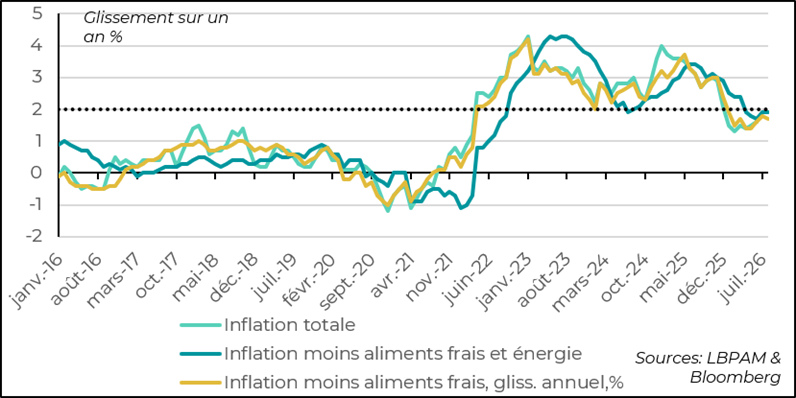
At the same time, August inflation figures, while slightly below expectations, with headline inflation rising 1.9% year-on-year, remain consistent with inflation stabilising around 2%, the Bank of Japan's target. Core inflation, excluding energy and fresh food, also came in at 1.9%.
However, these figures mask the fact that energy prices continue to be regulated by public authorities, which helps keep inflation artificially lower than it would otherwise be.
Against this backdrop, the cautious tone adopted by Kazuo Ueda appears to have tempered some investors’ expectations regarding the central bank’s intentions.
Rate Hike Expectations Remain Consistent with the Monetary Policy Normalisation Process
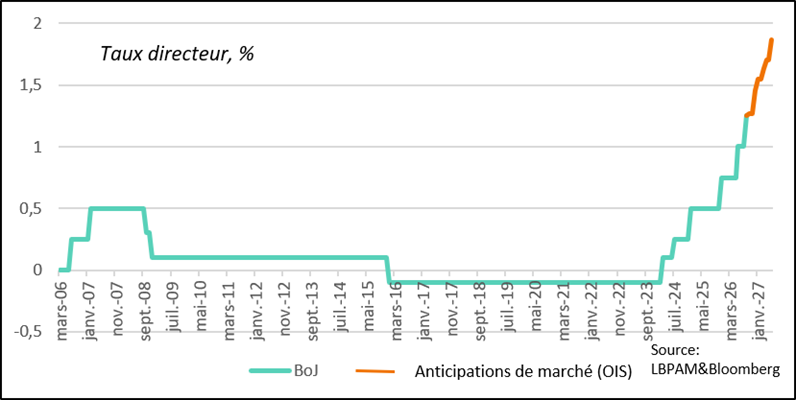
Nevertheless, in our view, market expectations remain consistent with the monetary policy normalization required to prevent inflation from accelerating in an economy that continues to benefit from significant fiscal support and where wages are growing at a sustained pace.
In the short term, this depreciation of the yen, combined with still-solid global demand, should continue to support Japanese equity markets. Against this backdrop, we maintain a positive outlook on Japanese equities.

Sebastian Paris Horvitz
Head of of Researc