Strong activity, but a U.S. labor market showing no signs of overheating
Link

Against a backdrop of persistently high energy prices and sustainably restrictive interest rates, Sebastian Paris Horvitz, Head of Research, looks back at the resilience of the global economy, inflation trends, and the outlook for financial markets.
Overview
► Despite estimates from some observers suggesting a substantial increase in oil flows transiting through the Strait of Hormuz, oil and gas prices remain elevated. The willingness of certain shipping operators to continue using the route, together with the protection provided by the U.S. Navy, is believed to explain this trend. Nevertheless, the market remains cautious and continues to price in a significant risk premium on hydrocarbons, with Brent crude still trading above USD 100 per barrel. In the absence of an agreement guaranteeing the security of the passage, this risk premium is expected to persist.
► At the same time, efforts are being made to alleviate energy costs. This is the objective of the G7 agreement to release 100 million barrels of diesel and crude oil from strategic reserves over the next four months. The strong contribution of European countries to this initiative is believed to have helped ease the threat by the U.S. President to suspend exports of diesel produced in the United States. Across the Atlantic, diesel prices remain close to their historical highs, well above USD 6 per gallon.
► These additional volumes released from strategic reserves should provide some relief, but they are not sufficient to durably alter price dynamics. Our central scenario remains one of a prolonged stalemate in the Middle East, although we expect a gradual easing of tensions during November, which should lead to a more pronounced decline in energy prices.
► Energy prices will continue to weigh on purchasing power. Eurozone inflation data for September also reflect the recent increase in hydrocarbon prices. Headline inflation accelerated to 3.8% year-on-year, while core inflation also edged up slightly to 2.5%. This increase was mainly driven by base effects affecting certain services, particularly airfares. Beyond these temporary factors, we do not observe any second-round effects that would signal a broadening of inflationary pressures, which is reassuring for the ECB. We remain among those who believe that the ECB will maintain a cautious approach, and we expect only two policy rate hikes between now and the end of the year and early 2027.
► Although uncertainty surrounding energy costs is contributing to the persistence of high interest rates, more favorable growth prospects also appear to be playing an important role. More specifically, financing this growth, driven by both the public and private sectors, seems to be exerting upward pressure on interest rates.
► Like many observers, we note the resilience of the global economy in the face of rising energy costs and the sharp increase in interest rates. Nevertheless, we continue to believe that these shocks will not be painless for growth. In this context, we believe that current levels across almost the entire yield curve, particularly at intermediate maturities (notably five-year government bonds), are pricing in monetary policies that are significantly more restrictive than those embedded in our scenarios. As a result, they offer value on both sides of the Atlantic, with a preference for Europe.
► However, it is important to remain agile and exercise a great deal of caution in asset management given the current environment. Indeed, global economic activity data continue to surprise on the upside. The latest global PMI surveys for September came in very close to preliminary estimates. JPMorgan’s Global Composite PMI reached its highest level since spring 2023. This performance reflects the continued strength of the industrial cycle, particularly driven by investment related to artificial intelligence, as well as the ongoing recovery in services activity, especially in business-oriented services.
► In the euro area, activity levels remain below those observed in the rest of the world, but they continue to point to solid growth in the second quarter of 2026 and a favorable short-term outlook. Significant disparities nevertheless persist across countries: Italy is experiencing a marked slowdown in activity, while Spain continues to show strong momentum. Moreover, as elsewhere in the world, the increase in energy costs is substantial and could weigh on activity if it persists, particularly if companies struggle to pass these costs on through higher selling prices.
► In the United States, September’s ISM surveys delivered a somewhat more moderate message on economic activity than the S&P surveys. The ISM Services Index eased slightly in September, although it remained at a high level. By contrast, the Services PMI published by S&P reached its highest level since 2022. However, cost-related indicators remained less reassuring, with the prices index rising sharply to its highest level since November 2022.
► In addition, these surveys also painted a very positive picture of employment in the services sector, in line with the signals already observed in the ISM Manufacturing survey.
► However, this message was not fully confirmed by last month’s employment report. Indeed, job creation in September came in significantly below expectations, with only 29,000 jobs added overall, including 46,000 in the private sector, compared with expectations of 90,000. In addition, employment figures for the previous two months were revised downward by a combined 60,000 jobs.
► The three-month trend nevertheless remains solid, with an average of 50,000 jobs created per month, a pace close to that required to absorb new entrants into the labor market and keep the unemployment rate stable. Indeed, according to the household survey, the unemployment rate rose only marginally, from 4.1% to 4.2%.
► It should be noted, however, that despite their resilience, these figures appear less robust than in the previous month, particularly due to a noticeable reduction in the number of sectors contributing to job creation.
► At the same time, despite an unemployment rate that remains low, wage pressures appear to be very contained according to the establishment survey. Average hourly earnings slowed to 3.0% year-on-year, marking their weakest increase since 2021. Given the potential biases associated with this indicator, it will nevertheless be important to await the Atlanta Fed wage growth data to confirm the absence of emerging wage pressures. Sustained wage moderation would be welcome news for the Federal Reserve.
► Finally, regarding French public finances, the government is due to present its 2027 budget, which aims to reduce the deficit by more than EUR 40 billion in order to bring it down to 5% of GDP next year, following the fiscal slippage recorded in 2026. Despite a slight recent decline, the yield spread between France and Germany on 10-year government bonds remains the widest in the euro area, at 136 basis points. In the absence of a credible path to ensuring the sustainability of French public debt, markets may continue to demand a significant risk premium on French sovereign bonds.
To go further
Global Activity: Momentum Remains Strong
Activity in both the services and manufacturing sectors remains robust
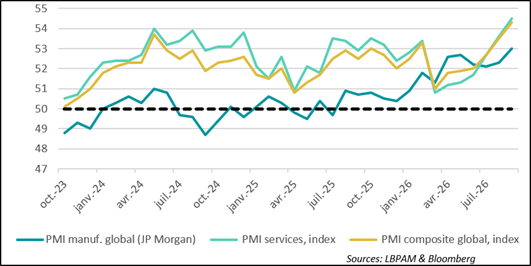
According to S&P PMI surveys, global activity remains strong and even appears to have accelerated in September. In particular, the industrial cycle, still supported by investment linked to artificial intelligence, now seems to be spilling over into the services sector, with a marked expansion in business-oriented activities across most regions.
U.S. Activity Remains the Most Dynamic
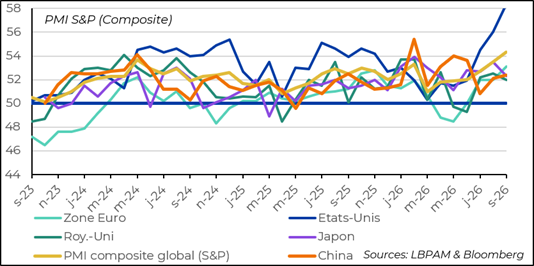
Unsurprisingly, given the massive investments in artificial intelligence, the United States remains the most dynamic economy, with activity even showing renewed momentum in September.
At the same time, survey data also point to an improvement in the euro area. The Composite PMI (manufacturing and services) rose again, reaching a level that would be consistent with an acceleration in growth during the third quarter of 2026.
In China, activity trends have also improved. However, despite the recovery in domestic demand, the export sector remains the main driver of growth. This persistent lack of momentum in domestic activity has already led the authorities to step up their support measures, notably through financial initiatives aimed at stimulating domestic demand.
It is also worth noting that the surveys continue to highlight strong pressures on companies’ production costs, as well as an increased risk that these higher costs will be passed on to customers through higher prices. This situation represents one of the key risks for the months ahead and remains a major concern for central banks.
United States: A Resilient Labor Market
Services Activity Eases Slightly
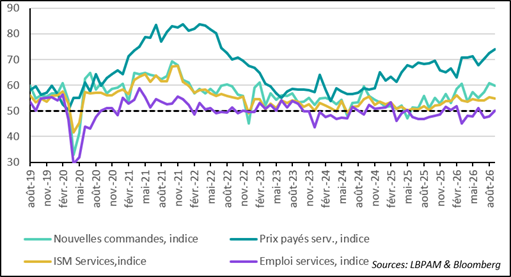
The ISM Services survey followed a similar trajectory to that observed in the manufacturing sector, with activity easing slightly in September. Nevertheless, it remained at a robust level. New orders, in particular, recorded a modest decline.
The reasons behind this moderation remain difficult to identify with precision. However, cost pressures appear to continue intensifying, as reflected in the further increase in the Prices Paid Index, which is approaching the levels seen in 2022. This rise in costs, combined with the persistence of high interest rates, could become a significant headwind for activity in the months ahead. At this stage, however, momentum in the sector remains solid.
Among the encouraging aspects of the survey was the improvement in employment conditions. The employment index moved back into expansion territory, suggesting renewed dynamism in the services labor market.
Hiring Disappointed in September
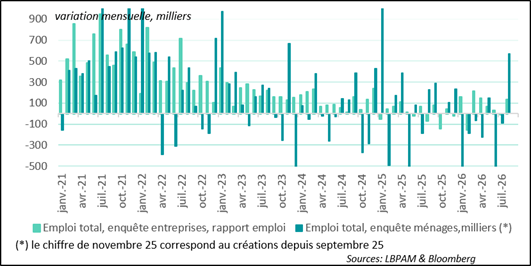
The improvement in hiring reported by the ISM Services survey, while the manufacturing employment index also remained in expansion territory, was not truly reflected in September’s employment report.
Indeed, job creation disappointed. According to the establishment survey, only 29,000 net jobs were created during the month, compared with 90,000 expected by the consensus. In addition, employment figures for previous months were revised downward.
These data should nevertheless be analyzed in the context of a labor market that has been significantly reshaped by the new immigration policy, which is reducing labor force inflows and, consequently, the growth of the working-age population.
As a result, when considering the three-month average of job creation, around 50,000 jobs per month, the pace observed now appears to be close to the “natural” growth rate of the labor force. Under these circumstances, despite slower hiring, the labor market can still be viewed as broadly resilient.
Moreover, the absence of a marked deterioration in other labor market indicators suggests that the U.S. economy is still not facing an imminent risk of a downturn.
More Companies Are Cutting Jobs Than Creating Them
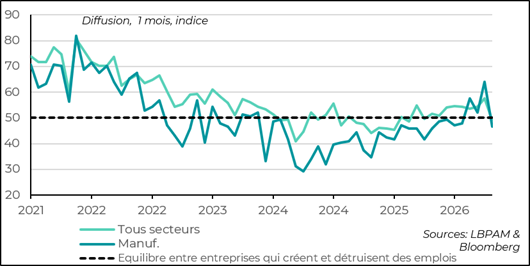
It should be noted, however, that the number of job-creating sectors declined sharply during the month, as reflected in the diffusion index published by the U.S. Department of Labor.
While this decline may prove temporary, it could also signal an increasingly two-speed economy, characterized by a handful of particularly dynamic sectors while others struggle to sustain their growth. These difficulties are notably the result of a still challenging economic and financial environment, marked by high energy costs and persistently restrictive interest rates.
In this context, weak job creation does not appear to reflect a broad-based slowdown in the economy, but rather a concentration of growth in a more limited number of sectors.
The Unemployment Rate Rises as Labor Force Participation Increases
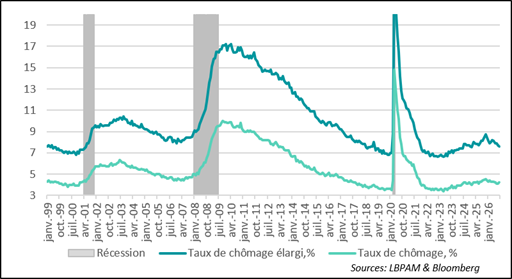
At the same time, the household survey delivered a more reassuring message regarding the strength of the labor market. Although the unemployment rate edged up slightly during the month, this increase was primarily driven by a rise in the labor force participation rate.
In other words, more people returned to the labor market in search of employment. This mechanically contributed to the slight increase in the unemployment rate, without signaling any significant deterioration in labor market conditions. Overall, the data continue to point to a broadly resilient labor market.
Wage Growth Is Slowing
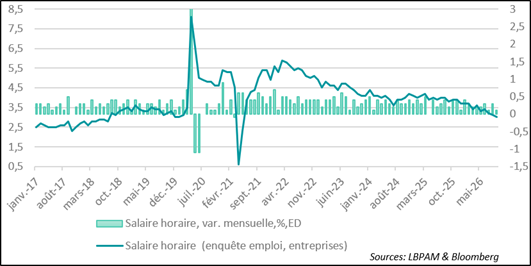
Despite a labor market that remains broadly resilient, wage pressures continue to ease. According to the establishment survey, average hourly earnings growth moderated again in September, reaching 3.0% year-on-year, its weakest pace since 2021.
However, this statistic should be interpreted with caution, as it can be significantly affected by composition effects. Changes in average wages may be influenced by the mix of job gains and losses across sectors and worker categories.
In this context, it will be useful to await the release later this week of the Atlanta Fed’s Wage Growth Tracker, which is generally regarded as a more reliable measure of underlying wage dynamics.
Confirmation of this wage deceleration would be welcome news for the Federal Reserve, as it would reinforce the view that inflationary pressures are gradually easing without a marked deterioration in labor market conditions.
Euro Area: Activity Remains Resilient While Inflation Continues to Be Driven by Energy Prices
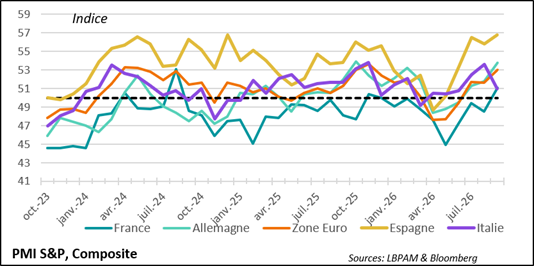
The PMI surveys pointed to an improvement in activity across the euro area, in both manufacturing and services, providing an encouraging signal for the European economy. In particular, activity in France remained in expansion territory, while Germany continued its recovery.
Beyond the support provided by the global industrial cycle, stimulus measures and public investment initiatives implemented in Germany are also helping to sustain economic activity.
At the same time, the picture is more mixed in Italy, where economic momentum appears to be easing somewhat, although activity remains in expansion territory.
The key question now is whether this momentum can be maintained in the coming months. Risks remain elevated, notably due to rising energy costs and still restrictive financial conditions.
The persistence of high interest rates could ultimately weigh more heavily on investment and domestic demand.
Inflation Continues to Be Driven by Energy Prices
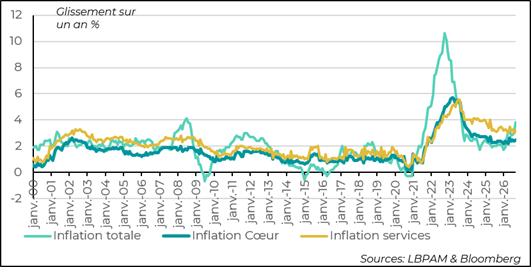
One of the main concerns regarding rising costs is the risk that inflation could continue to accelerate as higher energy prices spread more broadly across the economy.
From this perspective, the euro area inflation figures for September appear rather reassuring. While energy continues to be the main driver of price increases, we do not observe any meaningful second-round effects at this stage.
Headline inflation rose more than expected, reaching 3.8% year-on-year, mainly driven by energy prices but also by a stronger contribution from food prices. By contrast, core inflation came in at 2.5%, in line with expectations, representing only a slight increase compared with the previous month.
However, this rise is largely explained by base effects affecting certain categories of goods and services, notably airfares. Beyond these temporary factors, we do not see clear signs of significant second-round effects. In particular, services prices remain relatively well contained.
This is an encouraging signal for the ECB, as it suggests that inflationary pressures remain concentrated in the most volatile components for the time being, rather than spreading across the broader economy.

Sebastian Paris Horvitz
Head of of Researc