Strong headwinds to growth
Link

As energy prices remain elevated and long-term interest rates continue to rise, Sebastian Paris Horvitz, Head of Research, assesses the outlook for growth, inflation, and financial markets.
Overview
► Unfortunately, the Iranian authorities’ proposal to reopen the Strait of Hormuz did not receive President Trump’s approval. This proposal was a scaled-down version of the memorandum of understanding that had been signed last June. The American president’s refusal does not appear to have been accompanied by any counterproposal. It remains difficult to clearly identify the United States’ strategy for resolving this crisis, which is affecting the global economy as a whole.
► Faced with this situation, and despite the announcement that the Saudi oil pipeline recently damaged by air strikes has been brought back into operation, oil prices remain under pressure and well above $100 per barrel, while gas prices have stabilized above €70 per MWh.
► At this stage, our central scenario remains that of a continued stalemate in the conflict, followed by a gradual resolution after the U.S. midterm elections in November. As a result, we expect energy prices to remain elevated until then.
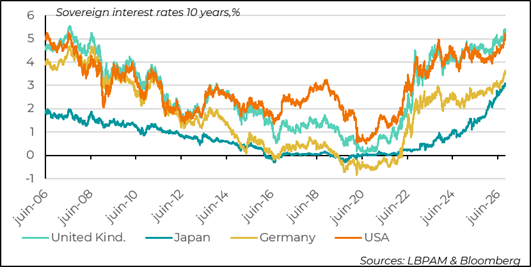
► The dynamics of energy prices are also maintaining upward pressure on interest rates across developed economies. However, as we have already noted, other forces are contributing to the rise in yields. Indeed, beyond inflation expectations, the most notable upward movement continues to come from real interest rates.
► The key questions currently dominating the market are:
(i) How high can long-term interest rates rise?
(ii) How will central banks react?
(iii) What are the risks to economic growth and to risk assets?
► Recent economic data point to an acceleration in growth. The recovery in the industrial sector, driven by fiscal support measures and massive investments in the development of artificial intelligence, appears to be spreading to other sectors, particularly services.
► This growth momentum is expected to persist in the short term. However, we believe that the continued presence of high energy prices, even if they begin to decline gradually, together with very elevated real interest rates, is likely to weigh on economic growth and eventually lead to a slowdown.
► Moreover, under these conditions, and as is already being priced in by bond markets, central banks may be forced to tighten monetary policy further in order to prevent their economies from overheating.
► Overall, despite the many uncertainties, we believe that growth should remain fairly resilient over the coming quarter, following an already surprisingly strong third quarter of 2026. However, as we move into the turn of the year, unless energy prices decline very rapidly, we expect a slowdown in the U.S. economy that is likely to spread across the global economy, driven primarily by higher interest rates.
► One could admittedly argue that current interest rate levels are still far from being restrictive enough to slow the economic cycle. Indeed, some believe that U.S. potential growth has increased and is pushing the neutral rate of interest significantly higher. Under this scenario, long-term yields, particularly in the United States, could continue to rise. This remains a possibility. However, if this assumption is primarily based on the spread of artificial intelligence (AI), we believe it is premature. While AI may ultimately deliver significant medium-term growth benefits once it becomes fully integrated across the economy, its impact on potential growth is unlikely to be felt to that extent just yet.
► The coming quarters will be the ultimate test of how much restraint central banks can impose on the economic cycle through further rate hikes and the associated level of long-term interest rates. To bring inflation back to target, we find it difficult to believe that there will be no cost to growth, with the additional risk of undermining the supportive backdrop for risk assets. This underpins our constructive view on bonds and our cautious stance on equities.
► Moreover, despite the broadly positive signals regarding the strength of the economic cycle, it remains noteworthy that consumer confidence in both the United States and the Eurozone remains subdued. Indeed, the final September reading of the University of Michigan survey came in at another low level, although it did show a slight improvement. More importantly, inflation continues to weigh on sentiment, with inflation expectations remaining elevated. Similarly, in Germany, consumer confidence, which had been recovering, surprised to the downside in October. Persistently high inflation likely played a role, as did the country's political situation.
To go further
Interest Rates: Ever Higher Yields
Interest Rates: At Their Highest Level in More Than 20 Years
Oil prices are once again approaching the highs reached in recent weeks, following President Trump’s refusal to accept the Iranian leadership’s proposal to end the conflict and, more importantly, to reopen the Strait of Hormuz. This remains a significant headwind to growth.
More importantly, given the risks to inflation, this is adding further upward pressure on interest rates in most countries around the world, notably through continued upward revisions to expectations for future central bank policy rate hikes.
In both Europe and the United States, markets are now pricing in nearly four rate hikes by mid-2027.
Real interest rates continue to rise sharply
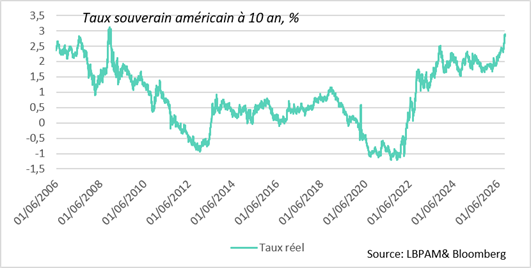
The rise in interest rates across the entire sovereign bond yield curve is partly driven by inflation concerns, but it also reflects a sharp increase in real interest rates, that is, nominal rates adjusted for inflation expectations.
This rise in real rates is particularly noteworthy, as they have returned to levels not seen since before the 2008-09 global financial crisis.
Several factors may be contributing to this trend. It could reflect the pressure created by the continuation of loose fiscal policies, leading to higher term premiums. It may also be driven by the strong demand for capital required to finance the rapid expansion of artificial intelligence (AI)-related investments. This latter explanation may also contain a positive structural element, namely higher potential growth driven by the significant productivity gains that AI could eventually deliver.
However, from a cyclical standpoint, the rapid increase in interest rates poses a risk to short-term economic growth, adding to the burden of elevated energy costs. While the AI industry may continue to expand, large segments of the economy are being negatively affected by higher borrowing costs. Sooner or later, aggregate demand is likely to come under pressure.
Financial Conditions Are Still Far From Restrictive
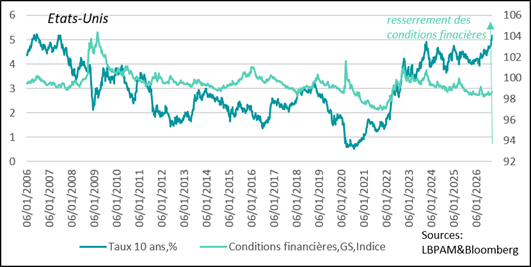
Admittedly, one could argue that it is far too early to worry about rising interest rates, as financial conditions indicators, namely the set of variables that capture the overall availability and cost of financing in the economy, still point to relatively accommodative conditions.
In the United States, for example, which has been a key driver of the recent global rise in interest rates, standard financial conditions indicators do not yet signal significant stress.
However, history suggests that this is not unusual. Economic and financial cycle turning points are often preceded by sharp increases in interest rates, which gradually undermine growth and weigh on virtually all asset classes, eventually leading to a deterioration in financial conditions.
At the same time, it is always difficult to determine the exact level of interest rates that could ultimately derail economic momentum. It is certainly possible that we are entering a new growth paradigm driven by artificial intelligence (AI). Yet even a powerful long-term trend can experience periodic setbacks and interruptions.
While significant opportunities may emerge over the long run, we prefer to maintain a degree of caution in the near term. From this perspective, we view current interest rate levels as attractive, as they appear too high not to weaken growth over the coming quarters. Paradoxically, the additional policy rate hikes we anticipate, which are more limited than those currently priced in by markets, could ultimately help alleviate some pressure and pave the way for lower long-term yields. Against this backdrop, we also remain cautious on risk assets.
Household Confidence: Still Under Pressure
U.S. Consumer Confidence Remains Weak
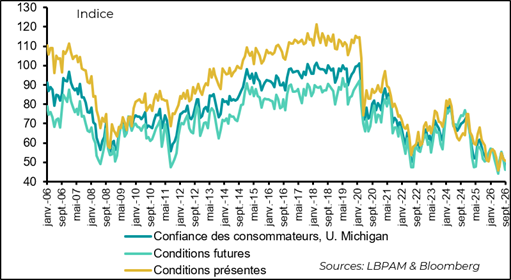
The final University of Michigan consumer sentiment survey for September came in slightly above the preliminary reading, but continued to signal very weak household confidence. Consumer sentiment remains at historically low levels.
Nevertheless, as we have observed in recent years, despite these subdued confidence readings, consumers continue to support economic growth and remain a key driver of the country’s economic expansion.
Inflation data continue to point to a trend close to 2%
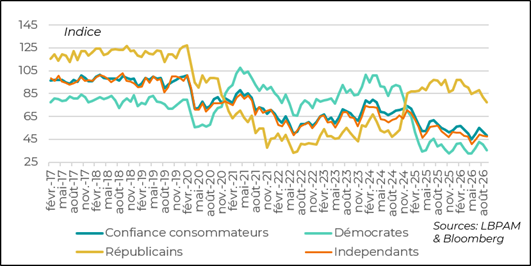
At the same time, it is noteworthy that the deterioration in consumer confidence is affecting voters across the political spectrum. While Republican voters had until now shown greater resilience, their confidence has been declining steadily for several months. This is likely an unfavorable signal ahead of the midterm congressional elections scheduled for early November.
Inflation Expectations Remain Elevated
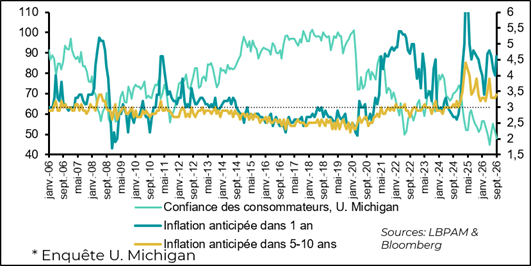
The key factor behind this weak consumer confidence is, of course, the deterioration in purchasing power, primarily driven by rising energy prices.
As a result, inflation expectations remain elevated, both in the short term and over the medium term.
Germany: Consumer Confidence Deteriorates Again
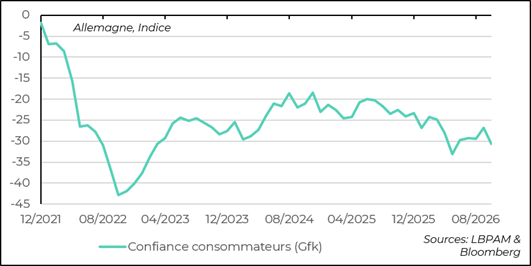
Despite the relatively encouraging message on economic activity conveyed by the PMI surveys, German consumer confidence deteriorated in the GfK survey for October, interrupting the improvement trend observed in previous months.
This could prove to be a negative signal for consumer spending, which remains weak. At the same time, German households, like consumers elsewhere, are reacting to a decline in purchasing power driven by higher living costs. In addition, the political environment is contributing to the prevailing uncertainty, with Chancellor approval ratings falling sharply and growing support for the far-right AfD party highlighting rising anxiety within the country.
Overall, the deterioration in confidence suggests that households remain cautious and that private consumption is likely to continue acting as a drag on growth in the near term.

Sebastian Paris Horvitz
Head of of Researc