The Closure of the Strait of Hormuz Threatens the Recovery in Economic Activity
Link

What are the key takeaways from the market news on July 17, 2026? Sebastian Paris Horvitz provides some insights.
Overview
►It is clear that the situation in the Strait of Hormuz has deteriorated. Not only has the ceasefire agreement effectively been abandoned, but the memorandum of understanding regarding the reopening of the Strait of Hormuz and the framework for future negotiations now appears to be defunct.
►Negotiations are still ongoing, but it is difficult to see how they could succeed. Among Iranian officials, the divide between those who wish to pursue a diplomatic path and those who advocate war appears to be deep. On the U.S. side, no clear exit strategy is emerging either, other than continuing the bombing campaign and imposing a new blockade of the Strait.
►Tanker traffic through the Strait of Hormuz appears to have been reduced to almost nothing. Unsurprisingly, oil and gas prices have resumed their upward trend. Since the beginning of July, the price of Brent crude has climbed back to $85 per barrel (+18%), while natural gas prices in Europe have risen to €55 per MWh (+28%).
►Despite this sharp increase, this is still far from signaling a radical shift in the market outlook. Indeed, the rise in energy prices remains well below what could be expected in the event of a prolonged closure of the Strait of Hormuz. In such a scenario, price increases would be significantly larger. It is particularly important to emphasize that the release of strategic reserves amounting to more than 4 million barrels per day, which has helped mitigate the shock, cannot be repeated indefinitely.
►While we had significantly reduced the probability of our adverse risk scenario—namely, a prolonged closure of the Strait of Hormuz—following the agreement reached a month ago, we now believe that this risk needs to be increased once again. Even if it does not ultimately materialize, the growing likelihood of such a scenario will weigh on confidence, while the increase in energy prices already observed will negatively affect purchasing power. These factors are likely to act as headwinds to economic growth.
►Nevertheless, at this stage, it is difficult to abandon our central scenario. Indeed, the economic and political costs of a prolonged stalemate are so substantial for both sides that it is hard to imagine a situation in which no solution is ultimately reached.
►In these new circumstances, we have decided to tactically reduce the level of risk in our portfolios.
►While developments in the Middle East are undermining the prospect of a swift resolution to the crisis and significantly lower energy prices, they are also making it more difficult to interpret recent economic data. Indeed, survey indicators that had started to show signs of improvement could quickly reverse course.
►In this context, even though U.S. inflation data for June were relatively reassuring, inflation could come under renewed upward pressure in the months ahead if energy markets do not ease as previously expected. Headline inflation slowed to 3.5% year-on-year, down from 4.2% in May.
►Furthermore, still on U.S. inflation, June producer price data were also released. Producer prices declined, largely due to lower energy prices. At the same time, several PPI components that are used to calculate the Personal Consumption Expenditures (PCE) deflator—the Federal Reserve’s preferred inflation measure—such as airfares and financial services fees, remain relatively elevated despite showing signs of moderation. This suggests that, on a year-on-year basis, PCE inflation is likely to remain higher than CPI inflation.
►On the demand side, retail sales data showed that U.S. consumer spending remains resilient. The “control group”—a broad basket of goods used to estimate goods consumption in GDP calculations—increased by 0.5% month-on-month in current dollars in June, following a 0.8% rise in May. As a result, consumer spending is likely to make a solid contribution to GDP growth in Q2 2026, despite the energy shock.
►In China, GDP growth disappointed in Q2 2026, slowing to 4.3% year-on-year. This marks the weakest growth rate in more than three years and falls short of the authorities’ growth target of 4.5%–5.0%. This weakness is still partly explained by relatively subdued domestic demand.
Nevertheless, June retail sales data proved more resilient, suggesting a rebound following the sharp decline recorded in the previous month. At the same time, investment contracted (-5.7% year-on-year), while the property sector continues to deteriorate. Although export-oriented industries remain the main driver of growth, we continue to believe that targeted policy measures will be introduced to support economic expansion.
Going Further
Hormuz: The Reopening Was Short-Lived
Collapse in Shipping Traffic Through the Strait of Hormuz
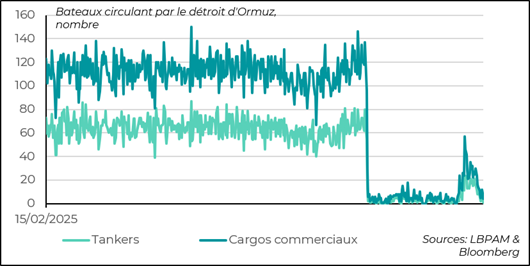
The collapse of the ceasefire between Iran and the United States has once again led to the near-total closure of the Strait of Hormuz. Very few vessels are now transiting through the Strait. Despite U.S. claims that it maintains control over the waterway, it is difficult to imagine shipping operators being willing to take the risk of sending vessels through it.
More importantly, deep divisions within the Iranian leadership—particularly between factions of the Revolutionary Guards close to Mr. Khamenei, the new Supreme Leader, that favor continuing the conflict, and U.S. authorities pursuing a more military than diplomatic strategy—have left both sides at an impasse for the time being.
It is clear that the economic and political costs of continuing the conflict are considerable for both belligerents, with the potential to undermine global growth once again.
As a result, like us, financial markets continue to believe that an agreement will eventually have to be reached between the two parties. This explains why the market reaction has remained relatively moderate so far.
The price of Brent crude oil has returned to $85 per barrel, representing an increase of nearly 18% from the lows seen in recent weeks. The increase in European natural gas prices, which now stand at close to €56 per MWh (+28%), has been even more pronounced. Nevertheless, current price levels remain far from what would be expected in the event of a prolonged closure of the Strait.
An offer that could become highly constrained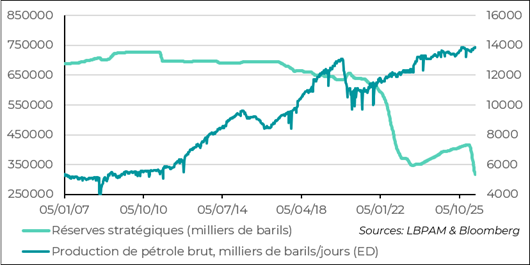
At the same time, a prolonged blockade could lead us into a far more serious situation than anything we have experienced so far in terms of price increases. Indeed, the drawdown of global oil inventories has played a very significant role in mitigating the energy shock caused by this crisis. The International Energy Agency estimates that 4.1 million barrels per day of inventories have been used to offset the loss of supply from the Gulf countries. The United States alone is believed to have injected more than one million barrels per day into the market.
Clearly, this is not sustainable, and inventories are being depleted. In the United States, strategic petroleum reserves are now at their lowest level since the early 1980s.
As a result, a blockade lasting only a few weeks could trigger a much more severe reaction in the oil market and energy prices.
Under these circumstances, although we had significantly reduced the probability of our alternative scenario—which envisaged a more severe energy shock following the agreements that led to the reopening of the Strait of Hormuz—we are now increasing that probability once again.
Consequently, from a tactical perspective, we are becoming more cautious and reducing our risk exposure. This positioning had previously reflected improved economic prospects resulting from the reopening and the sharp decline in energy prices.
United States: Consumer spending remains resilient as inflation eases
Inflation moderated much more than expected in June
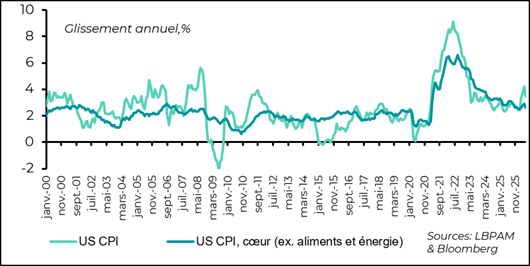
Inflation, as measured by the CPI, surprised to the downside in June. As expected, the sharp decline in energy prices made a major contribution to the drop in headline inflation (-0.4% month-on-month), accounting for most of the decrease. However, it was core inflation that delivered the biggest surprise. Indeed, core prices were unchanged over the month, whereas an increase had been anticipated. This was partly driven by a marked slowdown in shelter costs, which rose by just 0.1% month-on-month, compared with 0.3% in the previous month.
Overall, headline inflation fell to 3.5% year-on-year, down from 4.2% the previous month, while core inflation declined to 2.6% from 2.9%.
A slowdown in core inflation affecting even the most resilient components
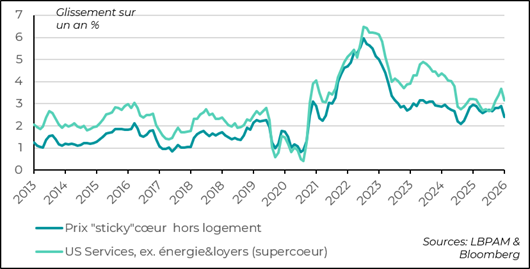
The decline in core inflation was broad-based, affecting all segments, including those that had previously proven the most resistant to easing. Notably, the index of so-called “sticky” prices—which typically adjusts only slowly to changing economic conditions—fell sharply during the month, significantly altering its underlying trend. Likewise, core services inflation excluding housing, a closely watched measure of underlying price pressures, recorded a meaningful decline.
Trend indicators are also moving lower
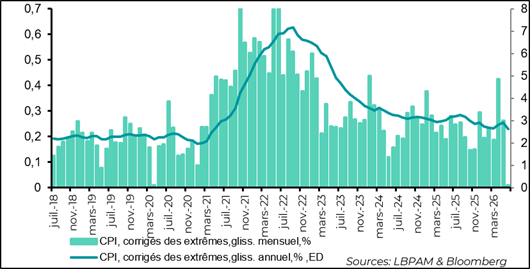
Likewise, trend inflation indicators are showing signs of moderation. For example, the Cleveland Fed’s measure, which excludes the price components that experienced the largest monthly increases and decreases, recorded a notable decline.
This sudden slowdown in core inflation appears somewhat surprising, particularly in an economy where domestic demand remains resilient. Some temporary factors may have played a role, including the highly aggressive promotional campaigns run by Amazon during the month. However, it will take another month or two of data to determine whether this marks the beginning of a new trend, especially as the recent rebound in energy prices could complicate the disinflation process.
Nevertheless, this development is striking in an economy where domestic demand—and consumer spending in particular—continues to hold up well.
Consumer spending remains resilient
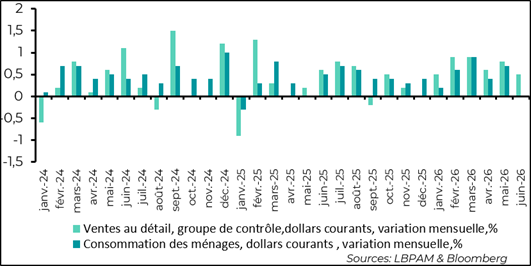
Indeed, retail sales data showed that consumers remained firmly engaged, with strong growth in goods purchases in both May and June. The control group, which includes the categories used to estimate consumption in GDP, rose by 0.5% in June, following a 0.8% increase in May. Given the sharp decline in inflation in June, the increase in real terms was therefore even more significant.
As a result, consumer spending is likely to make a very strong contribution to GDP growth in the second quarter of 2026.
Overall, it appears that U.S. consumers have so far been relatively unaffected by the energy shock. That said, we continue to believe that economic activity could face a more challenging environment in the third quarter of 2026, particularly as the household savings rate has already declined substantially.
China: Growth disappoints in Q2 2026
GDP growth slowed in Q2 2026
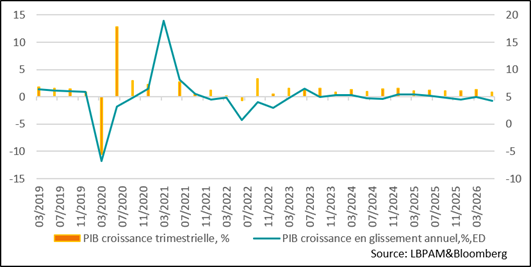
Chinese GDP growth disappointed in Q2 2026, slowing to 4.3% year-on-year. This marks the weakest pace of growth in more than three years and falls below the authorities’ target range of 4.5% to 5.0%.
Much of this weakness appears to stem from a marked slowdown in domestic demand, likely reflecting the fading impact of the support measures previously introduced to bolster household consumption. As these stimulus programs have been scaled back or expired, consumer spending has lost momentum, weighing on overall economic activity and highlighting the still-fragile nature of China’s recovery.
Consumer spending and investment lost momentum in June
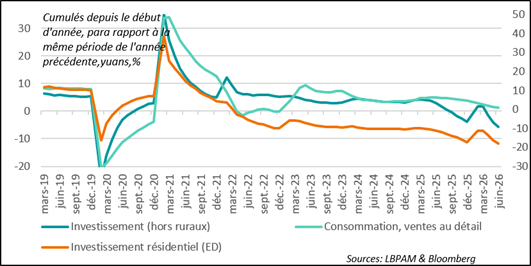
This weakening in domestic demand was confirmed by June’s consumption and investment data. Compared with the same period last year, the slowdown is clearly visible. Most notably, the prolonged downturn in the property sector continues, remaining a major drag on economic activity.
This development is likely to attract the attention of policymakers and, in our view, encourage them to introduce additional targeted measures to support growth. We expect such measures to be announced relatively soon.
At the same time, the authorities appear willing to rely on the strong performance of the external sector. Export activity has received a further boost from rising global demand for products linked to investment in artificial intelligence infrastructure, providing an important source of support for the economy despite the weakness in domestic demand.

Sebastian Paris Horvitz
Director of Research