The Energy Shock Is Not Behind Us Yet
Link

What should investors take away from market developments on October 9, 2026? Xavier Chapard shares his insights and analysis.
Overview
►Despite crude oil flows from the Middle East having almost returned to their pre-war levels, energy prices remain elevated. Gas prices in Europe continue to rise, which is not surprising given that flows through the Strait of Hormuz remain disrupted. The fact that oil prices are still trading above USD 100 per barrel is more unexpected. This suggests that transportation risks and costs, low inventory levels, and ongoing geopolitical uncertainty are, for the time being, preventing a more significant decline in prices. When combined with rising refining margins on fuels, whose prices have a direct impact on inflation, inflation is likely to increase further in the coming months.
►Our baseline scenario assumes a decline in energy prices from the end of the year onwards, which would lead to a marked slowdown in inflation starting next spring and limit the need for further monetary tightening. However, the risk of a more persistent shock is increasing as long as the situation in the Middle East remains highly uncertain.
►On the ECB side, the minutes of the September meeting were more balanced than the hawkish messages delivered during the meeting itself. Admittedly, policymakers remain concerned about inflation risks, which are tilted to the upside relative to the baseline scenario that already does not foresee a return to the 2% target before the end of 2028. The renewed increase in imported energy prices and the slight rise in inflation expectations since the previous meeting are unlikely to reassure the ECB.
However, ECB members also noted that they do not currently see any broad-based transmission of energy inflation into wages or services prices (i.e., second-round effects). They further emphasized that the risk of such second-round inflation effects depends heavily on labor market conditions, which are far less tight than they were in 2021-22.
When combined with the tightening of financial conditions since the last meeting (i.e., higher long-term interest rates, wider sovereign spreads, etc.), the balance of risks around the two additional rate hikes we expect by early 2027 appears skewed more to the downside than to the upside, contrary to what markets are still pricing in.
►The minutes of the latest Fed meeting contained no major surprises, confirming that “most participants judged that a further rate increase would likely be appropriate before the end of the year.” Indeed, 16 of the 18 members who submitted interest rate projections in mid-September (through the well-known “dot plot”) signaled at least one additional rate hike this year.
That said, Fed policymakers stressed that these rate increases are part of a risk-management approach, as inflation risks remain tilted to the upside while risks to employment are now considered broadly balanced. This suggests that the Fed does not see an urgent need to raise rates aggressively.
This view is consistent with our scenario, which anticipates one rate hike in December (rather than October) and a final increase in early 2027 to reverse the three “insurance” rate cuts implemented in 2025, when downside risks to the labor market were more pronounced.
►Markets continue to put pressure on France, with the 10-year yield spread versus Germany widening to 140 basis points at the end of the week, its highest level since Mario Draghi’s “whatever it takes” speech in 2012.
This move notably followed comments by the Governor of the Banque de France, who stated that he did not believe “the conditions are conducive to ECB intervention,” stressing that the ECB’s mandate is to fight inflation, “not to resolve France’s fiscal problems.”
However, these remarks are not particularly surprising. It would take a much more severe deterioration in financial conditions across the euro area, particularly affecting banks and extending beyond France, as well as significantly stronger fiscal consolidation efforts by France, before the ECB would consider intervening in the French sovereign bond market.
►The presentation of the National Rally (RN)'s alternative budget proposal has not changed the picture either. However, the proposal of highly ambitious fiscal targets, namely reducing the deficit below 3% of GDP in less than two years and introducing a binding constitutional “golden rule” on public finances, shows that the party currently leading in the polls is listening to market concerns and preserving political room to act on public finances.
That said, the very ambitious, perhaps overly ambitious, nature of these targets, combined with the lack of detailed measures explaining how they would be achieved, has limited the positive impact of these proposals on investor confidence.
To go further
World: The Energy Shock Is Not Behind Us Yet
Crude oil flows from the Middle East have almost returned to their pre-war levels, but gas flows have not
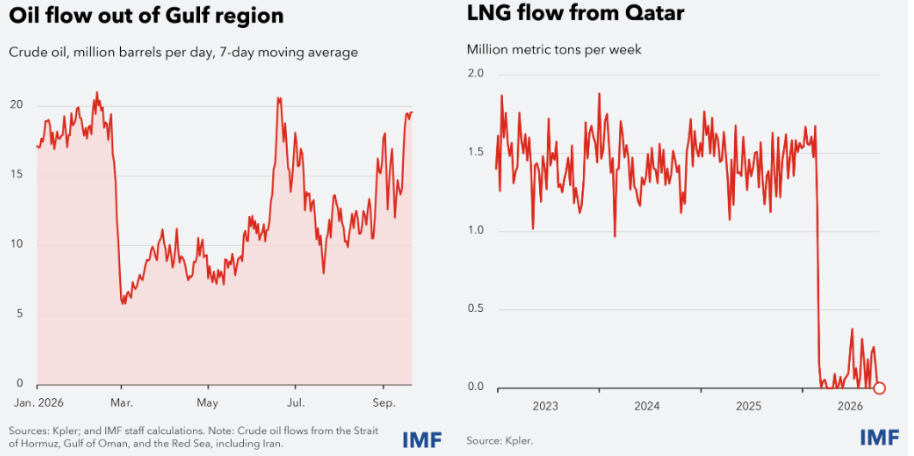
The IMF confirms that crude oil flows from the Middle East had, by the end of September, almost returned to their pre-war levels despite the absence of any agreement and despite Iran's exports remaining offline. This highlights the adaptability of the supply chain, including alternative routes and the resourcefulness of producers and shipping operators, and suggests that U.S. military protection of oil tankers has been more effective than previously anticipated.
This is encouraging news, although the situation for natural gas is far less favorable, with exports from Qatar remaining near zero.
Gas and Oil Prices Remain Elevated and May Decline More Slowly
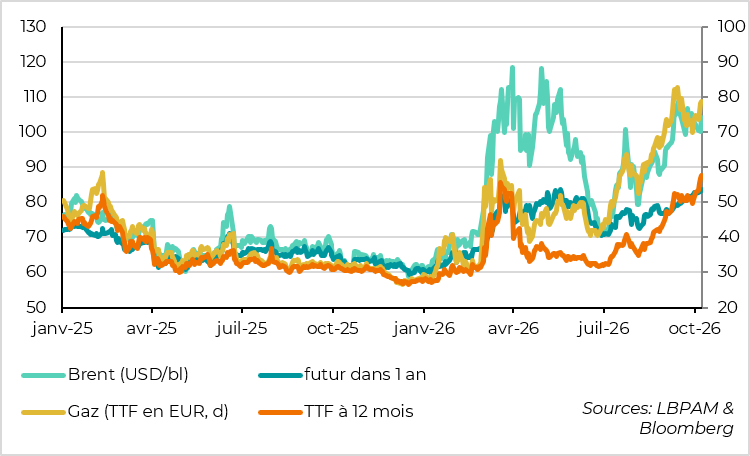
Under these circumstances, it is hardly surprising that gas prices are at their highest levels outside of the 2021-22 period, even if this is unwelcome news for Europe and Asia. This is broadly what could be expected from a prolonged conflict that continues to disrupt exports through the Strait of Hormuz.
What is more surprising, however, is that oil prices have remained so elevated despite the near normalization of crude oil flows. While crude oil prices are below their March-April peaks, they remain above USD 100 per barrel, well above the USD 60-70 range seen before the conflict. Moreover, markets expect prices to remain high, with oil projected to trade at around USD 85 per barrel in one year's time, a level still higher than that expected in March-April.
This likely reflects the sharp increase in transportation costs and risks, the persistence of a significant geopolitical risk premium given the continued uncertainty, and the fact that inventories remain substantially lower than before the war.
In any case, this is not enough to alleviate the energy shock. We continue to believe that the most likely scenario is a decline in energy prices, both for oil and, more gradually, for gas, from the end of the year onward, following the midterm elections. However, the risk of a more adverse scenario is increasing.
Gasoline Prices Hit Record Highs Due to Refining Constraints
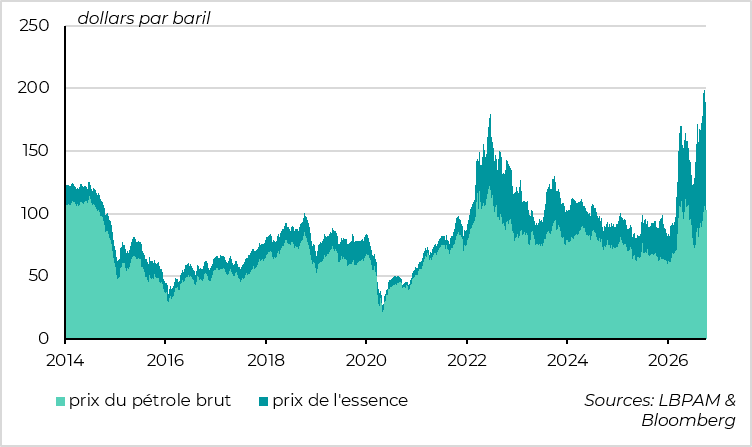
Refining margins have surged, approaching USD 100 per barrel, pushing gasoline and diesel prices to record highs. This reflects the insufficient global refining capacity outside Russia and the Middle East, as well as the fact that exports of refined products through the Strait of Hormuz remain well below pre-crisis levels.
Since it is fuel prices, rather than crude oil prices, that are directly included in inflation calculations, this has led us to revise our inflation forecasts upward for the coming months. Inflation is now expected to rise back above 3.5% in the United States and approach 4% in the euro area by early 2027.
We continue to expect a decline in energy prices from the beginning of next year, which should lead to a marked easing of inflation from next spring onward. However, here too, the risks of a more persistent energy shock are increasing.
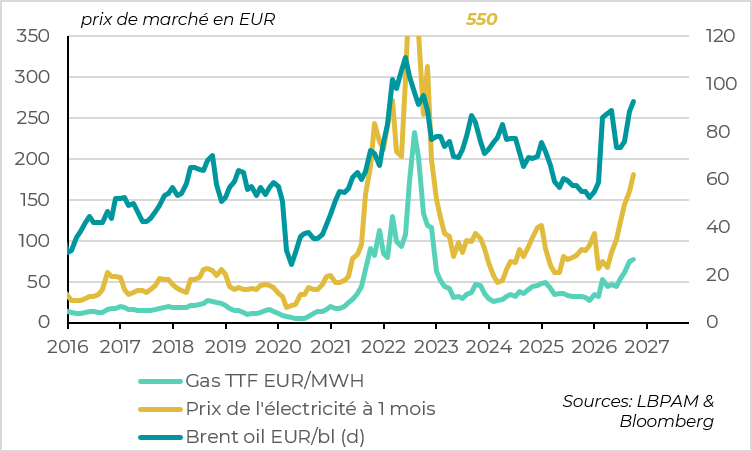
TThe situation is particularly unfavorable for Europe, as the shock to liquefied natural gas is more severe than that affecting oil, its prolonged duration is increasingly feeding through into electricity prices, and the depreciation of the euro is further raising the cost of dollar-denominated imports.
Overall, energy prices are currently above the adverse scenario presented by the ECB in September, although they remain well below the ECB’s severe stress scenario.
ECB: Between a Larger Energy Shock and Tighter Financial Conditions
The ECB’s energy price indicator is approaching a critical threshold
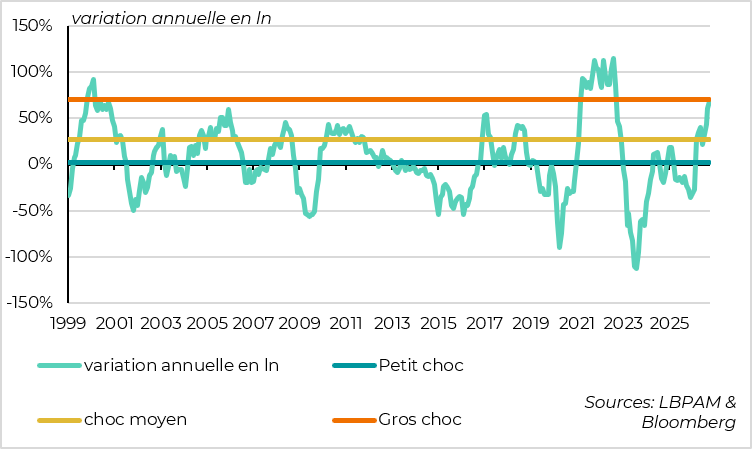
The persistence of a significant, albeit not extreme, energy shock could reinforce the ECB’s concerns that energy-driven inflation may spread to wages and domestic prices, requiring a stronger policy response to prevent inflation from becoming entrenched.
Indeed, the ECB’s composite energy price indicator has risen sharply since the summer, with its year-on-year increase reaching 68%, after remaining below 50% since the beginning of the year. This is important because it is approaching the 71% threshold which, according to ECB studies, has historically been associated with much more pronounced second-round effects.
Long-term interest rates in the euro area are rising partly because of higher inflation expectations
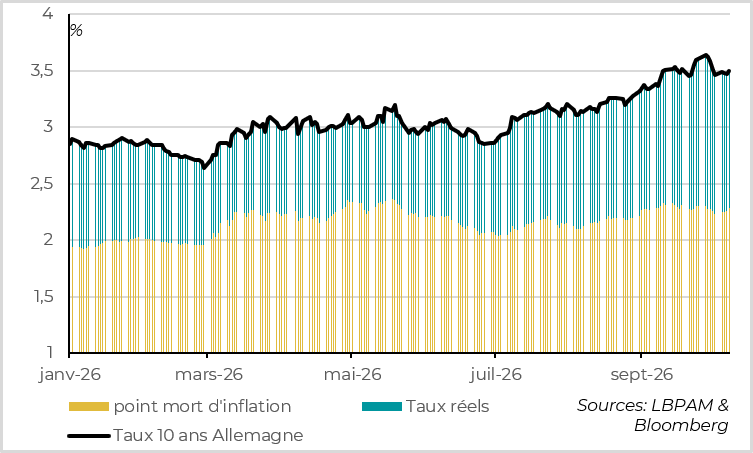
Moreover, unlike in the United States, part of the increase in long-term interest rates in the euro area this summer reflects a rise in inflation expectations. Indeed, 10-year inflation swaps have risen by 25 basis points over the past three months, although they remain at 2.3%. This is why the ECB considers inflation expectations to be at the upper end of their normal fluctuation range, even if they remain broadly anchored at a level consistent with its 2% inflation target.
We believe that the risks of persistent second-round inflation effects or a de-anchoring of inflation expectations remain limited in the euro area, notably because the ECB retains a high degree of credibility and the labor market is not under significant strain. However, the mere existence of these risks may justify a few rate hikes in response to a supply shock, in order to ensure that they do not materialize. After all, the cost of regaining control of inflation once it has been lost is extremely high.
Financial Conditions Have Tightened More Sharply Over the Past Month
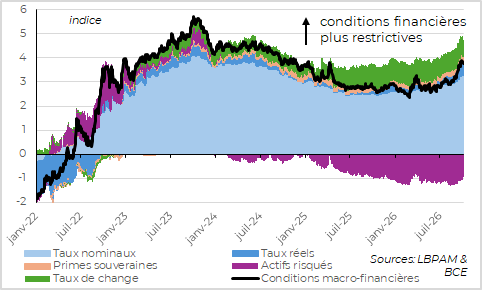
But alongside rising inflation risks, the ECB must also take into account the more pronounced deterioration in financial conditions since its mid-September meeting. Indeed, the macro-financial conditions indicator monitored by the ECB to assess the impact of financial conditions on economic activity and inflation has worsened since September, after remaining relatively stable until mid-year. This reflects the continued rise in interest rates, which is now accompanied by a significant widening of sovereign risk premiums, largely driven by France, and is no longer offset by the strong performance of risk assets.
All else being equal, tighter financial conditions act as a brake on growth and, ultimately, on inflation without requiring the ECB to raise interest rates further. Under such circumstances, a more aggressive ECB stance on rates could risk triggering an abrupt tightening of financial conditions, similar to what occurred in 2008 and 2011.
The ECB Should Raise Rates Cautiously
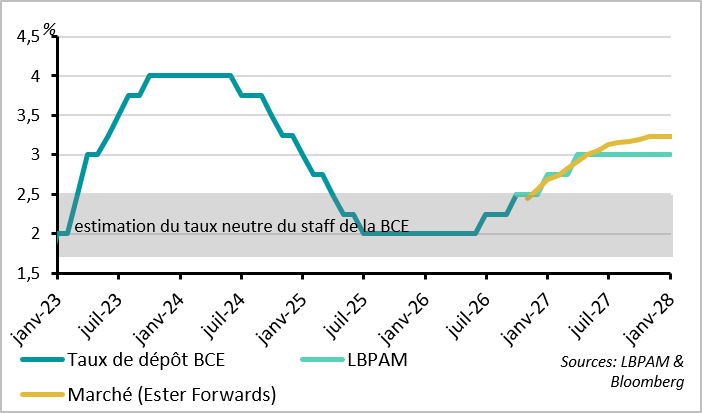
Caught between Scylla and Charybdis, we continue to believe that the ECB will raise interest rates somewhat further, but in a cautious manner, in order to preserve its anti-inflation credibility without placing excessive strain on an economy that is already facing negative shocks. We expect the ECB to pause in October, followed by a rate hike in December and probably one final increase in early 2027. Although markets have scaled back one of the rate hikes they were still pricing in a week ago, they continue to anticipate one more hike than we do.

Xavier Chapard
Deputy head of research