The Fed is almost being forced to raise interest rates
Link

Between geopolitical tensions in the Middle East, rising energy prices, and persistently elevated U.S. inflation, Sebastian Paris Horvitz, Director of Research, analyzes the implications for the Fed’s monetary policy and financial markets.
Overview
► The news coming from the Middle East is not encouraging. The flow of ships passing through the Strait of Hormuz to transport oil and gas remains limited. More importantly, attacks by Houthi and Iraqi militias on Saudi Arabia, which have disrupted access to the Red Sea and damaged one of the Kingdom’s main pipelines, have further intensified pressure on energy prices. Brent crude oil remained above $105 per barrel yesterday, its highest level since May, while natural gas prices in Europe stayed above $81, close to their all-time high.
► In the short term, there are few encouraging signs of any agreement between Iran and the United States. Meanwhile, talks involving Gulf countries, including Iran, could take place in the coming days to discuss the reopening of the Strait of Hormuz. Here again, the prospect of a viable agreement remains far from certain.
► We maintain our base-case scenario of a prolonged stalemate in the conflict, meaning the absence of an agreement capable of restoring normal energy flows from the region, at least through the period leading up to the U.S. elections. We assign a much lower probability to a more severe escalation of the conflict. As a result, we expect energy prices to remain elevated in the period ahead.
► In this context, our inflation forecasts are significantly higher than they were previously, although we still expect inflation to gradually converge toward central banks’ targets over the next two years.
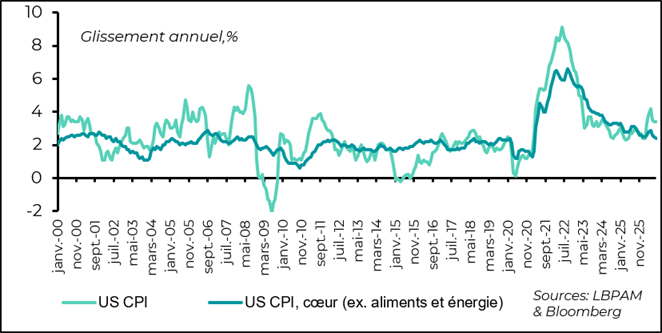
► The release of the U.S. Consumer Price Index (CPI) for August came in broadly in line with economists’ expectations, remaining unchanged at 3.4% year-over-year. Unsurprisingly, energy prices were the main contributor. Core inflation eased to 2.4% from 2.5% the previous month, although the monthly increase was higher than expected. Clearly, the key takeaway is that inflation remains too high. At the same time, a closer look at the underlying dynamics, particularly core inflation, suggests a trend toward moderation. However, this trend could still be undermined in the future by persistently high energy prices and continued solid economic growth.
► At the same time, the University of Michigan released its preliminary September consumer sentiment survey. The index fell sharply, approaching the record low reached last May. Rising inflation remains one of the key factors undermining household confidence. Indeed, medium-term inflation expectations have moved higher again, reaching 3.4%, well above the average of the past 30 years. Nevertheless, weak consumer confidence does not automatically translate into weaker consumption. Even so, this deterioration in consumer sentiment remains a factor that warrants close monitoring.
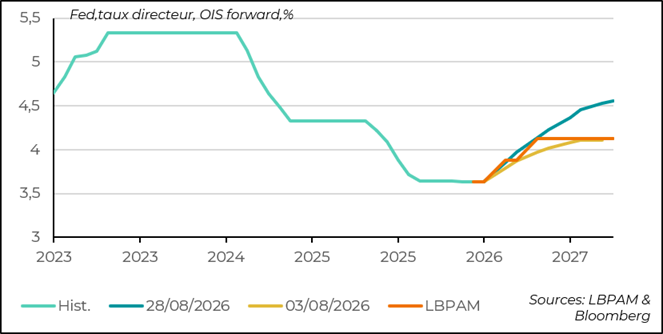
► What seems certain is that these inflation figures, which remain relatively high, have put even more pressure on the Fed, particularly on its Chairman, K. Warsh. Indeed, at last August’s Jackson Hole conference, he made it clear that the Fed must take action to bring inflation back toward its 2% target. In this context, while central bankers would have preferred to avoid taking action in the midst of the campaign leading up to the November midterm elections, they may have little choice but to raise the federal funds rate this week. In fact, the market is assigning a probability of more than 90% to such a move by the Fed.
► We expect the Fed to raise its policy rates by 25 basis points. The risk of a larger move exists, but in our view it remains limited. However, given the resilience of the U.S. economy, a second rate hike will likely be necessary to accelerate the convergence of inflation toward target. We expect this move to take place in December, after the elections.
Based on our assumption that energy prices will begin to normalize toward the end of the year, combined with a moderation in economic growth, we do not believe a more aggressive monetary tightening cycle will be necessary. With policy rates rising above 4% by year-end, monetary policy would move into restrictive territory, providing sufficient support to guide inflation back toward the Fed’s 2% target by late 2027.
► Our outlook for policy rates is significantly less hawkish than that currently priced in by the market. This explains our relatively constructive view on the short and intermediate segments of the U.S. sovereign yield curve. However, in the near term, persistent pressures on energy prices and uncertainty surrounding economic policy could push interest rates even higher. The 10-year Treasury yield rose above 5% yesterday, its highest level since 2023.
This increase in yields represents a headwind for risk assets and reinforces our cautious stance in the current environment, as the economy transitions toward a more restrictive monetary policy framework.
► In the Eurozone, beyond the upward pressure affecting sovereign interest rates across the board, it is hard to ignore the uncertainty surrounding the direction of economic policy in France, particularly with regard to fiscal policy. As budget discussions get underway and the presidential campaign gains momentum, these uncertainties are weighing on French government bond yields. As a result, the spread between French and German government bond yields has widened significantly in recent months. The gap between 10-year yields has reached 95 basis points, its highest level since the Eurozone sovereign debt crisis of 2011.
We therefore remain cautious on French sovereign bonds.
To go further
United States: The Fed Likely to Act in Response to Inflation
U.S. Inflation Remains Elevated
U.S. Inflation Remains Elevated
As expected, the increase in energy prices helped keep inflation at a relatively high level in August. Headline inflation remained unchanged at 3.4% year-over-year, while core inflation (excluding energy and food) edged down slightly to 2.4%.
These figures suggest that, in a context of persistently rising energy prices, inflation is unlikely to converge rapidly toward the Federal Reserve’s 2% target, as advocated by K. Warsh, the Fed Chair.
Nevertheless, it is important to emphasize that headline inflation still masks a more encouraging trend in underlying price pressures. While core inflation dynamics appear less concerning, higher energy costs could gradually feed through to the broader economy, especially in an environment where the labor market remains close to full employment.
Indicators Suggesting Inflation Is Taking an Unfavorable Turn
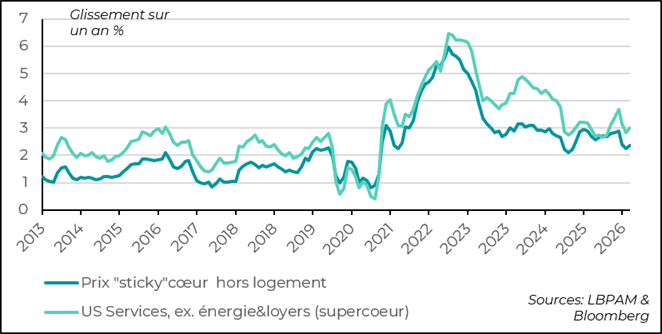
Some trend indicators appear to suggest that inflation accelerated in August. This is the case with the Atlanta Fed’s measure of “sticky” inflation, which tracks the prices of goods and services that tend to change infrequently. Excluding rents, this measure edged higher in August, breaking the downward trend observed in previous months.
Similarly, core services inflation excluding rents, often referred to as “supercore” inflation, rose slightly above 3%.
Mobile subscription costs are having a disproportionately large impact on price increases
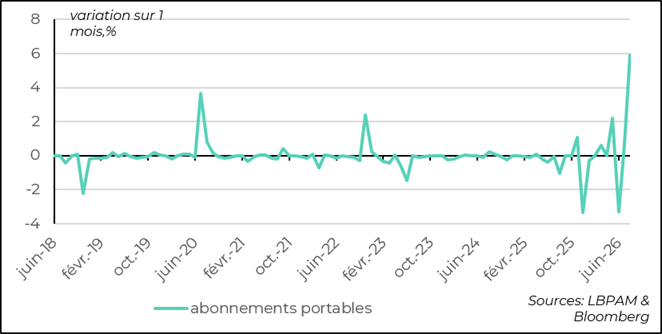
However, during the month there were a few sharp increases in prices that had shown only limited, and generally declining, growth for years, such as mobile phone subscription costs. In fact, these rose by more than 5% over the month, contributing nearly 0.1 percentage point to the increase in core inflation. Such a rise is unlikely to be repeated.
The underlying inflation trend measure, which excludes extreme price movements, continues to point to a downward trend
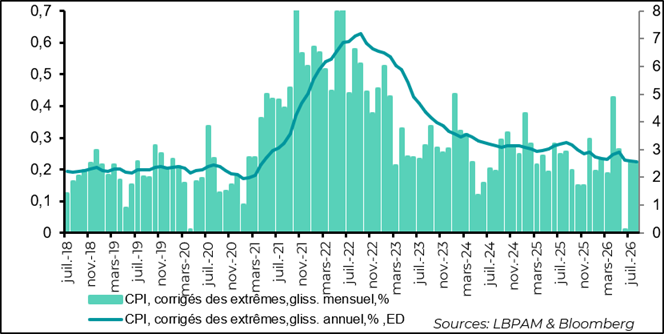
In fact, the Federal Reserve Bank of Cleveland’s measure that excludes extreme price movements, both upward and downward, continued to trend lower, although the overall level remains elevated.
In our view, therefore, while the August inflation figures confirm that inflation remains high, they do not point to a sharp shift in the underlying inflation trend.
Consumer Confidence Negatively Affected
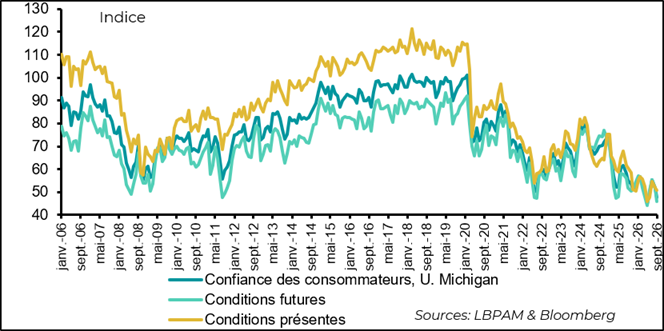
The impact of persistently high inflation is clearly reflected in the decline in consumer confidence, as highlighted by the preliminary University of Michigan survey.
Both the headline index and, in particular, the expectations component have fallen back close to their historical lows.
Households’ Inflation Expectations Are Rising Again
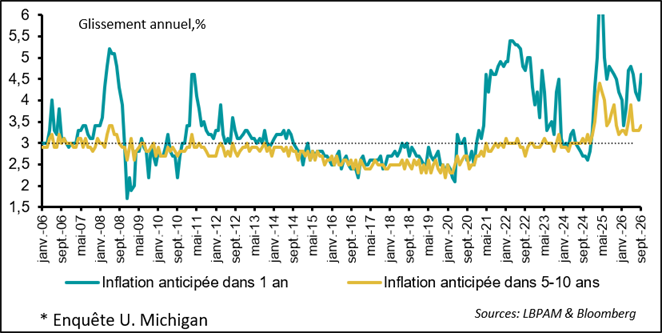
Inflation appears to be the factor weighing most heavily on consumer confidence. As energy prices rise, households’ inflation expectations are moving higher again, including medium-term expectations.
This is clearly not good news for the Fed.
Overall, inflation’s difficulty in re-establishing a clearly downward trend highlights the scale of the challenge that remains in bringing it back to the 2% target.
As a result, these figures are putting renewed pressure on K. Warsh. In his speech at Jackson Hole last month, he strongly emphasized his determination to bring inflation back to 2% as quickly as possible, arguing that it was unacceptable for inflation to have remained so far above target for such a prolonged period.
The Market Is Expecting an Aggressive Response from the Fed
The Market Is Expecting an Aggressive Response from the Fed
In light of these figures, markets have stepped up the pressure on the Fed, assigning a probability of over 90% to the start of a rate-hiking cycle as early as this Wednesday’s meeting.
Clearly, K. Warsh would likely have preferred not to act in the midst of the campaign for the upcoming midterm elections. However, he has put himself in a difficult position and will probably need to persuade a majority of the members of the Federal Open Market Committee to raise the Fed’s policy rate by 50 basis points. That is our base-case expectation.
At the same time, we believe that a second rate hike will be necessary to accelerate inflation’s return toward the 2% target. We expect this second move to take place in December, after the midterm elections. As a result of these two increases, policy rates would move above 4% and, in our view, enter restrictive territory. This should be sufficient to ease inflationary pressures, especially if, as we anticipate, tensions in energy markets ease significantly toward the end of the year, allowing for a gradual return to equilibrium.
Consequently, our outlook for the path of policy rates remains considerably less aggressive than that currently priced in by financial markets.

Sebastian Paris Horvitz
Head of of Researc