The Fed is also embarking on a series of rate hikes
Link
Rate hikes by the Fed and the Bank of Japan, a hold from the Bank of England, rising energy prices, and mounting pressure on bond markets... Xavier Chapard reviews the key takeaways from September's central bank meetings and their implications for financial markets.
Overview
► The Fed raised interest rates by 25 basis points for the first time in more than three years, a move that was widely anticipated. However, it signalled more clearly than expected that further rate hikes are likely during this tightening cycle. Indeed, the decision was unanimous, with no votes in favour of keeping rates unchanged. In addition, a large majority of committee members expect at least one more rate increase this year, while Warsh's remarks suggest he is prepared to go further in order to accelerate the return of inflation to target. This strengthens the Fed’s credibility in its fight against inflation, as well as its independence, at a time when the administration continues to press for lower interest rates.
►After an initial negative reaction, financial markets were ultimately little affected, with the notable exception of the US dollar, which remained up 0.5%. Equities recovered to trade above their pre-meeting levels, short-term yields were broadly unchanged as markets priced in slightly fewer than three additional rate hikes, and long-term yields edged back below the 5% threshold.
►Overall, we view Warsh's remarks with caution, and this meeting remains broadly in line with our baseline scenario, which calls for one additional rate hike in December. That said, the risk of a final rate increase in the first quarter of 2027 has risen, particularly if energy prices do not ease significantly by then. Nevertheless, we continue to believe that these rate hikes are more akin to a mid-cycle recalibration, involving two to three increases, rather than the start of a genuine monetary tightening cycle of more than one percentage point. As a result, we remain constructive on risk assets over the medium term.
►The Bank of Japan (BoJ) also raised its policy rate by 25 basis points, just three months after its previous increase, taking it above 1% for the first time in more than three decades. The central bank has also reiterated that it will continue to raise rates if the macroeconomic outlook remains favourable. We continue to expect the BoJ to deliver one further rate hike this year, followed by two additional increases next year. In Japan’s case, this therefore represents a genuine monetary tightening cycle. As a result, we remain bullish on the yen despite its recent rebound, particularly against the euro.
►By contrast, the Bank of England (BoE) has held its ground, remaining the only one of the four major central banks not to have raised interest rates this year. This wait-and-see approach is justified by the fact that its policy rate remains restrictive at 3.75%, the labour market is weak, and there is still no evidence of second-round effects from higher energy prices feeding through to domestic inflation. That said, the BoE is becoming increasingly concerned about both the magnitude and the persistence of the energy shock. As a result, while we continue to expect rates to remain unchanged this year, the risk of a precautionary rate hike has increased. However, we still believe that market expectations, which are pricing in four rate hikes by mid-next year, are excessive. Combined with the BoE’s slower pace of balance sheet reduction, this makes UK government bonds relatively attractive despite the significant fiscal risks that remain in the short term.
►Now that the September round of central bank meetings has come to an end, with most policymakers adopting a more hawkish tone while market expectations remain, in our view, overly aggressive, we believe bonds could regain some appeal after a challenging summer. However, fiscal and political risks are still likely to generate volatility in the near term.
►This would be all the more true if energy prices were to ease somewhat, given the emphasis central banks have placed on the duration of the shock in shaping their future policy decisions. Unusually, this week brought some encouraging news on that front: Saudi Arabia announced a faster-than-expected return of its exports, while China once again encouraged Iran and the United States to resume negotiations. As a result, oil prices fell back below USD 105 per barrel, while European natural gas prices dropped below EUR 80/MWh. Nevertheless, the situation remains highly uncertain, and more progress will be needed to materially reduce the risks surrounding our outlook.
To go further
Fed: A First Rate Hike, But Probably Not the Last
The Fed raised interest rates for the first time in three years, a move that had been widely anticipated following Warsh’s more hawkish remarks at Jackson Hole in late August and the economic data released over the past month, including a very strong labour market and core inflation that came in above expectations. Moreover, the resilience of the US economy continues to be confirmed by the latest figures published this week, notably robust retail sales growth in August and a further decline in initial jobless claims in early September. As President Warsh had advocated, the Fed refrained from providing explicit forward guidance on the future path of interest rates, both in its policy statement and during the press conference. However, as was the case with the ECB last week, this meeting suggests that the Fed has not yet completed the upward adjustment of its policy rates. First, this week's rate hike was approved unanimously, whereas several votes in favour of leaving rates unchanged could reasonably have been expected given recent public remarks and the pressure exerted by the White House to avoid higher interest rates, particularly from Waller, Bowman and even Warsh himself. This reinforces the Fed’s credibility in its fight against inflation, as well as its independence from political influence and from its new chair. It is also worth noting that the vote covers the policy statement itself, in which “elevated inflation” is now linked to “resilient domestic spending” rather than, as in June, to the energy shock. Strong demand provides a much stronger rationale for central bank intervention than a negative supply shock. The Fed also stated that this week's rate increase “will support a faster return to the 2% inflation target”, something that a one-off rate hike alone would be unlikely to achieve.
The Dot Plot Points to Another Rate Hike This Year and Suggests the Risk of Further Tightening Next Year
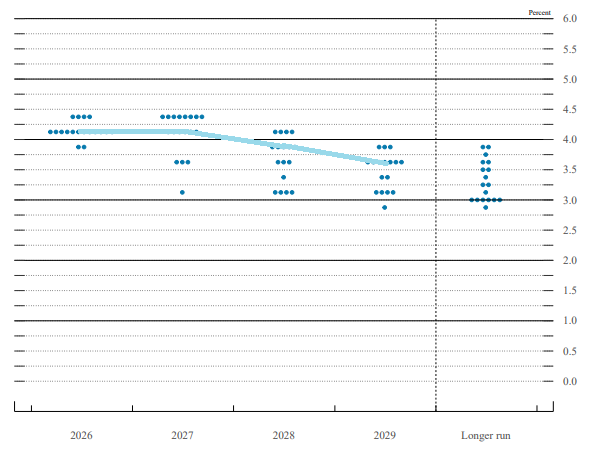
More importantly, the interest rate projections submitted by Fed policymakers, the well-known “dot plot” (in which Warsh still refuses to participate), show strong support for at least one additional rate hike by the end of the year, with 16 out of 18 members projecting further tightening. For next year, the median projection points to unchanged rates, albeit with a slight tightening bias, as eight members favour an additional rate hike compared with four who foresee a rate cut. This dot plot is more hawkish than the June edition, which indicated that a majority of Fed officials expected a single rate hike this year that would then be fully reversed the following year. It is also worth noting that Fed policymakers continue to raise their estimate of the long-term neutral rate, which has increased from 3.05% to 3.25%. However, this estimate remains below both our own assessment, which lies between 3.5% and 3.75%, and the roughly 4.5% level currently priced in by financial markets.
The Fed Expects the Economy to Remain at Full Employment Despite Inflation Taking Longer to Return to Target
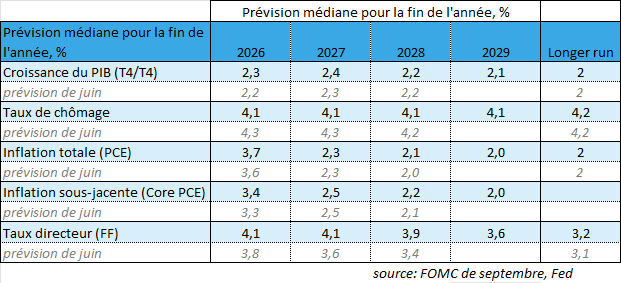
These higher interest rate projections reflect the updated economic forecasts published by Fed policymakers. Indeed, they have revised their growth expectations upwards, with economic activity expected to remain sustainably above its potential rate, while lowering their unemployment forecasts, with the jobless rate projected to remain slightly below its equilibrium level (4.1% versus 4.2%). At the same time, they have raised their core inflation forecasts, which are now expected to remain above the 2% target for an additional year, until 2029. An economy operating close to full employment, combined with inflation that remains too high over a two-year horizon, clearly justifies a more restrictive monetary policy stance. Finally, during a press conference that lasted less than thirty minutes, several remarks by Warsh strongly suggested that he is considering further rate increases. In addition to emphasising the strength of the US economy, he stated that this week's rate hike "removes some monetary accommodation" and "begins to show that we are serious" about bringing inflation back under control. These comments imply that, in his view, the Fed's monetary policy is not yet genuinely restrictive, despite the policy rate standing above the neutral rate. They also suggest that further rate hikes may be required to bring inflation sustainably back to target.
We Expect Fewer Rate Hikes Than the Market Despite the Fed’s Hawkish Tone
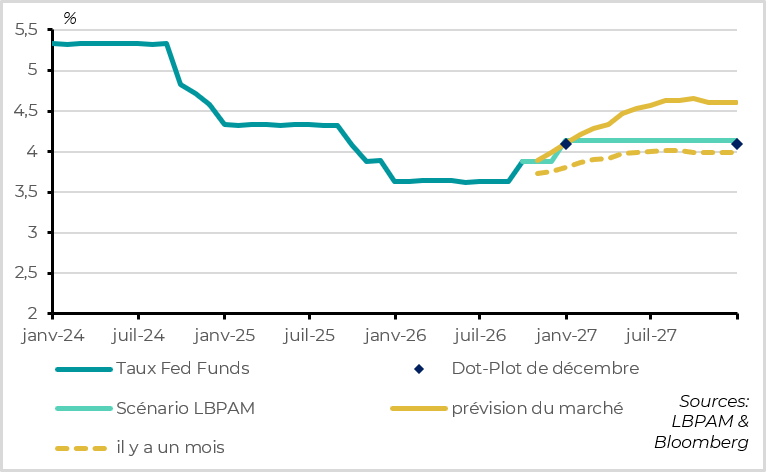
While it now seems clear that the Fed has not finished raising interest rates, the key question is whether this represents a mid-cycle adjustment aimed at ensuring inflation continues to converge towards its 2% target, implying two to three additional rate hikes, or the beginning of a new monetary tightening cycle involving more than 100 basis points of further increases to durably reduce inflationary pressures. Markets remain undecided and are currently pricing in nearly three additional rate hikes over the next twelve months. We remain in the mid-cycle adjustment camp and expect just one additional rate hike in December, with the risk of a final increase in the first quarter of 2027 if oil prices fail to ease by year-end and the economy continues to prove more resilient than expected. We also believe that this week's rate hike, combined with the Fed's enhanced credibility resulting from its current communication, should reduce the need for further rate increases next year.
Our Macroeconomic Forecasts Remain Slightly Less Optimistic Than the Fed’s
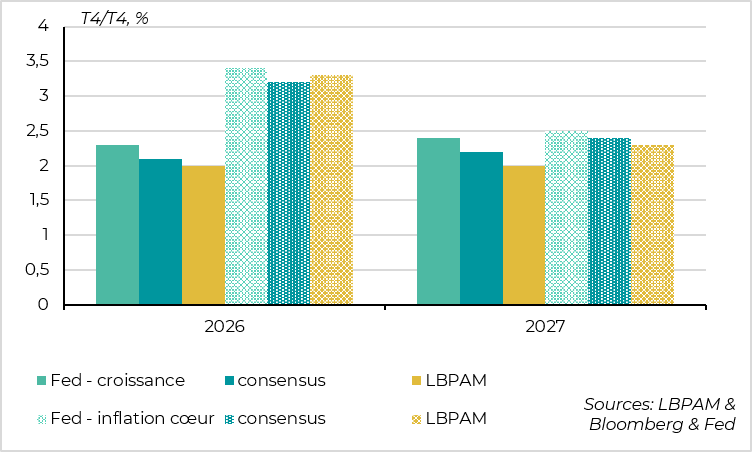
Our scenario is based on a slightly more cautious view of the growth and inflation outlook than that of the Fed and Warsh. Warsh explained that his support for this week's rate hike was driven by three factors: (1) the strength of the economy, (2) the absence of a clear downward trend in inflation, and (3) rising geopolitical risks, particularly on the energy front. However, we believe that economic growth could slow somewhat between the end of this year and early 2027, reflecting the increase in both short-term and long-term interest rates seen over the summer, as well as the negative impact of higher energy prices on household purchasing power. We also expect core inflation to moderate more rapidly next year than the Fed currently anticipates. Indeed, our analysis points to a slowdown in underlying inflation trends over the summer that is not yet fully captured by the Fed’s preferred inflation measure. Naturally, this scenario is based on a relatively favourable assumption for energy prices, namely that they will decline significantly from current levels by year-end. Should the conflict in the Middle East escalate or energy prices remain persistently at or above current levels, additional rate hikes would likely be required.
Bank of England: The Risk of Rate Hikes Is Increasing
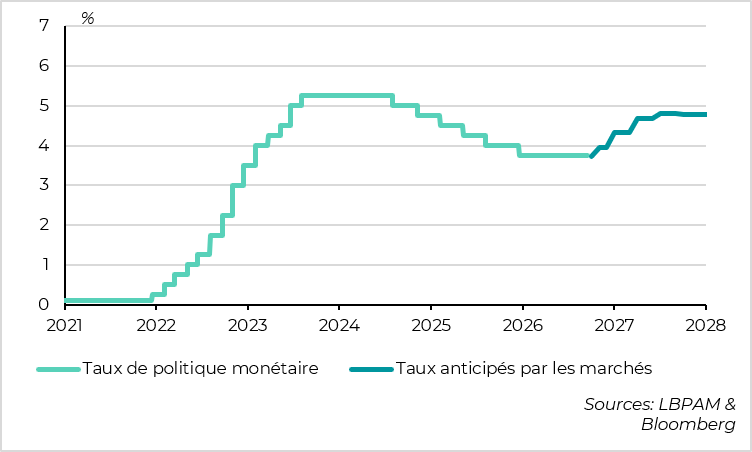
As expected, the Bank of England (BoE) left its policy rate unchanged at 3.75% yesterday, with a six-to-three vote in favour of keeping rates on hold. The three centrist members of the committee therefore did not support an immediate rate hike despite higher energy prices. Moreover, there was little reason to expect either the three most hawkish or the three most dovish members to change their positions. That said, both the policy statement and the comments made by the centrist members indicate that the risk of a rate hike in the coming months is increasing. This would be particularly likely if the energy shock remains as significant as it is today, as a prolonged period of elevated energy prices would increase the risk of indirect inflationary effects and second-round wage pressures. In such a scenario, a rate increase could become necessary. In its statement, the BoE noted that inflation is running higher than projected in its July forecasts and is expected to rise further until early 2027. The Bank also acknowledged that upside risks to inflation have increased since the previous meeting. Nevertheless, it justified its cautious stance by pointing to the uncertainty surrounding developments in the Middle East, which could ultimately evolve more favourably than currently anticipated. In addition, there is still no evidence of second-round inflation effects, while the labour market is not generating significant domestic inflationary pressures at this stage.
Inflation Accelerates on Higher Energy Prices, but Domestic Pressures Remain Stable
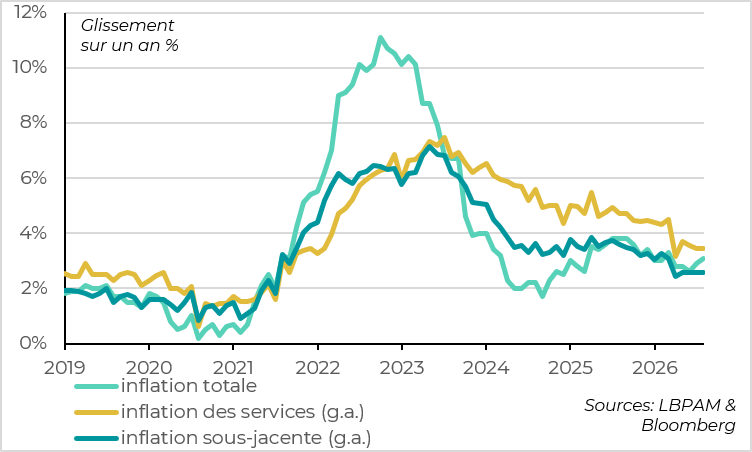
Indeed, the data released this week do not argue in favour of an urgent tightening of monetary policy. Inflation accelerated in August, rising from 2.9% to 3.1%, whereas the BoE was still forecasting inflation of 2.8% in its late-July projections. This development was nonetheless expected, as it was driven entirely by higher energy prices. Given current energy price levels, inflation is in fact expected to continue rising and could exceed 4% in January 2027, when regulated tariffs are next revised. The prospect of higher inflation persisting for a longer period helps explain why the BoE is becoming less patient. By contrast, core inflation remained stable at 2.6%, for both goods and services. This suggests that the pass-through of higher costs to domestic prices and wages remains limited, at least for now. Given the uncertainty surrounding the path of energy prices in the coming weeks, this situation still justifies a degree of patience on the part of the central bank.
The Unemployment Rate Remains Relatively High and Employment Is Declining Slightly
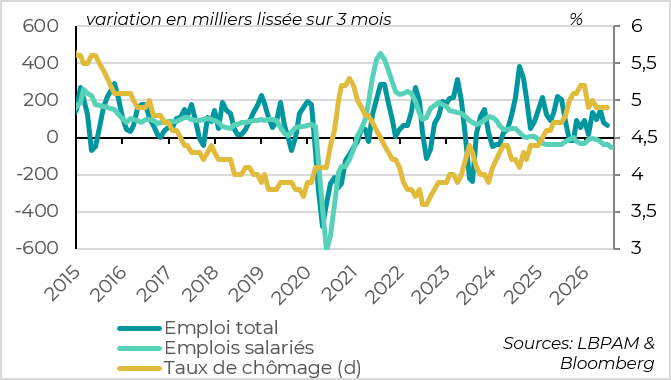
Beyond inflation, the labour market remains relatively weak. Despite stronger-than-expected growth since the beginning of the year, the unemployment rate remained stable at 4.9% in July, slightly above the BoE’s estimate of the equilibrium unemployment rate (4.75%). In August, the decline in payroll employment accelerated, with 25,000 jobs lost, while unemployment benefit claims increased at a faster pace than has been observed over the past two years. Under these circumstances, it is difficult to justify any further tightening of monetary policy.
Wage Pressures Continue to Ease Gradually
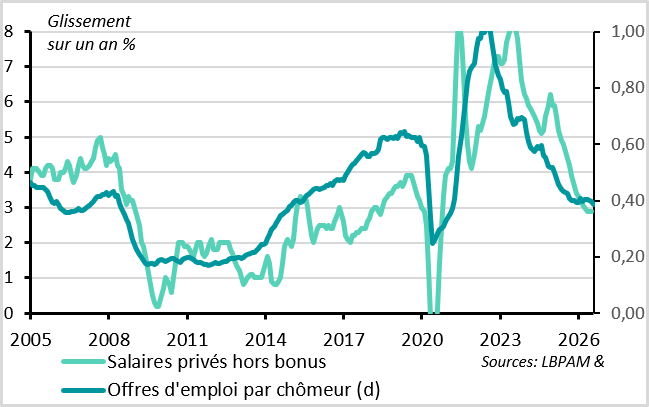
All the more so as the decline in the number of job vacancies per unemployed person suggests that wage pressures should remain contained. This would allow wage growth to continue moderating, even though it has stabilised over the past three months at a level that remains slightly too high relative to the BoE’s objectives (around 3%). Overall, the risk of a BoE rate hike has increased as a result of an energy shock that has proved larger and more persistent than anticipated in its July projections. Nevertheless, we continue to believe that the central bank may keep rates at their current, already mildly restrictive level if the situation in the Middle East and energy prices begin to ease ahead of the next meeting in November. More importantly, even if the BoE were ultimately to act, we believe it would deliver only a single rate hike given the persistent weakness of the labour market. As a result, the gap between what markets are currently pricing in (three rate hikes by summer 2027) and what we consider a reasonable baseline scenario remains, in our view, larger than for the other major central banks.
The BoE Slows Quantitative Tightening to Limit Pressure on Long-Term Yields
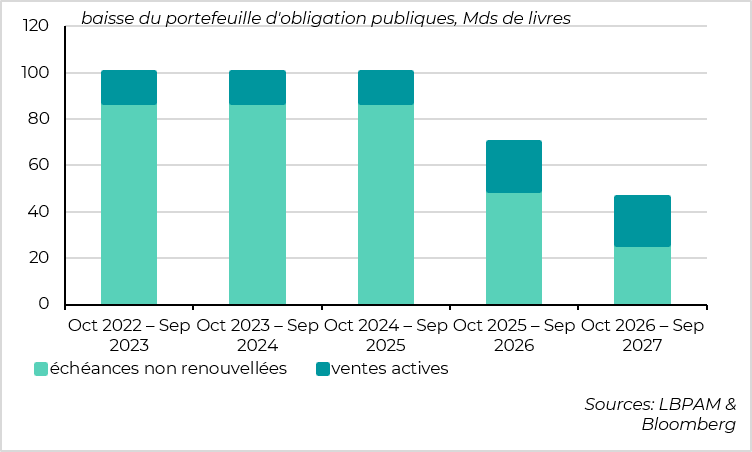
At the same time, the BoE unanimously approved an adjustment to its balance sheet reduction policy that should marginally ease the pressure on long-term yields. This decision is supportive of UK bonds, although its impact remains secondary compared with the fiscal measures that the new government is expected to announce from next month onward. More specifically, the BoE will permanently retain on its balance sheet the 25% of government bonds it still holds with the longest maturities, representing around GBP 120 billion. This already amounts to nearly 4% of the current stock of public debt that the market will not have to absorb. For the remainder of its portfolio, the Bank will slow the pace of reduction slightly more than expected, to GBP 46 billion per year compared with the GBP 50 billion anticipated by markets and GBP 70 billion this year. Nevertheless, the BoE remains the only major central bank actively selling government bonds. Others, such as the ECB, have stopped reinvesting maturing securities but are not conducting active bond sales.

Xavier Chapard
Deputy head of research