The German economy is gradually recovering
Link
What are the key takeaways from the market news on August 28, 2026? Sebastian Paris Horvitz provides some insights.
Overview
►News of a potential agreement between Oman and Iran on a transit corridor for oil tankers through the Strait of Hormuz has helped ease tensions somewhat in energy markets, both for oil and gas. Nevertheless, at this stage, there is no concrete evidence regarding the viability of this initiative. The Strait of Hormuz remains virtually closed, although some shipping-flow observers report a pickup in activity despite the risks. Brent crude oil prices have edged lower and are fluctuating around USD 87 per barrel, while European gas prices remain close to their highs at EUR 68 per MWh.
►The lack of normalization of this maritime route, which is essential to global energy markets, remains a constraint on the world economy and poses a risk to our growth recovery scenario, particularly in Europe.
►At the same time, despite the energy-related headwinds and the uncertainty they may generate, the cyclical recovery that regained momentum in July across many countries appears to remain firmly in place. Indeed, as previously noted, S&P Global’s preliminary PMIs for August showed that industrial activity, particularly in Europe, continues to hold up well.
►Industrial activity in Germany has regained strong momentum. The manufacturing PMI reached its highest level in more than four years. This improvement was also reflected in the Ifo survey for August, with the composite business climate index rising above its level of last February, before the outbreak of the war in Iran.
►However, this more supportive trend in industrial activity is failing to spill over to the rest of the economy. Consumer spending remains subdued, which may help explain the deterioration in services activity observed in August. That said, the GfK survey for September delivered a more encouraging signal, with consumer confidence continuing to improve. Naturally, caution is warranted when assessing the link between confidence and consumption. All the more so as the energy shock is still very much present and the political climate in the country does not necessarily support greater optimism. The regional elections due to take place in September in two eastern Länder, where the AfD (far-right party) could secure victories, provide a tangible indication of the discontent prevailing in the country.
►Detailed German GDP data for Q2 2026 show that consumption remained weak, while investment was even more subdued. A stronger recovery in domestic demand in Germany will be essential to consolidate the country’s economic recovery. Sustained fiscal stimulus will likely be needed for the recovery to broaden and spread more widely across the economy, including by providing greater support to Europe as a whole.
►In the United States, the second estimate of GDP growth for Q2 2026 left overall growth unchanged at an annualized rate of 1.5%. However, consumer spending growth was revised upward to an annualized 3.4%, compared with 3.2% previously, indicating that the energy shock, in particular, has not dampened consumers’ willingness to spend. Nevertheless, consumer spending data for July showed stagnation.
►Thus, in July, the persistence of elevated inflation appears to have weighed on consumer spending, as did concerns about the economic outlook, particularly with regard to employment. However, given the strong rebound in services activity in August, consumption may continue to surprise on the upside and regain momentum, especially since the labor market remains relatively resilient.
►At the same time, investment remains the other key driver of growth, making a substantial contribution to GDP expansion in Q2 2026 (1.2 percentage points). This primarily reflects the continued strength of investment in sectors linked to the development of artificial intelligence. Capital goods orders in July continued to expand at a robust pace. This trend is consistent with developments in equity markets, as investors continue to increase their exposure to companies benefiting from the build-out of AI-related infrastructure.
►Nevertheless, inflation, as measured by the Personal Consumption Expenditures (PCE) price index, the Federal Reserve’s preferred gauge, remained relatively elevated on a year-over-year basis, even though it increased at a moderate pace in July, in line with expectations. Headline inflation accelerated to 3.7%, while core inflation remained unchanged at 3.3%. It is worth noting that services inflation, although easing slightly, continues to hover around 3.9%.
►Despite remaining elevated, the fact that inflation has nevertheless moderated somewhat should rule out a policy rate hike in September. However, we still expect the Fed to raise rates later this year. K. Warsh’s speech at the Jackson Hole conference this evening could provide the market with some additional guidance. Yet his communication style and his reluctance to provide forward guidance on the future direction of monetary policy could disappoint investors and add to uncertainty.
Going Further
Germany: Industry Continues to Recover
An optimistic mood among German businesses
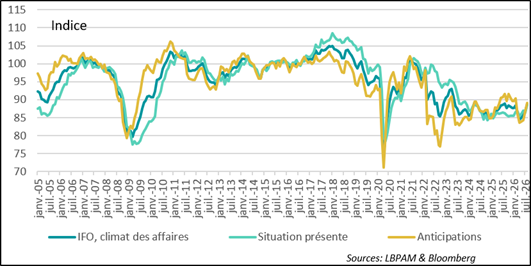
Numerous uncertainties continue to cloud the economic outlook, notably as the oil market remains heavily disrupted by the ongoing blockage of the Strait of Hormuz. Nevertheless, many economic indicators remain well oriented. In particular, the industrial cycle is proving resilient across many countries and, in some cases, continues to improve.
This industrial upturn is especially pronounced in Europe, particularly in Germany. Following another marked increase in S&P Global’s preliminary manufacturing PMI survey, the Ifo business survey confirmed this renewed optimism among German companies. The expectations index is now approaching the level it reached before the outbreak of the war in Iran.
It therefore appears that the large-scale public stimulus program, still underway and focused on infrastructure and defense, has helped strengthen the industrial recovery. Moreover, this improvement in the industrial cycle is a global phenomenon, generating a multiplier effect on demand for the sector.
External demand remains the strongest driver of growth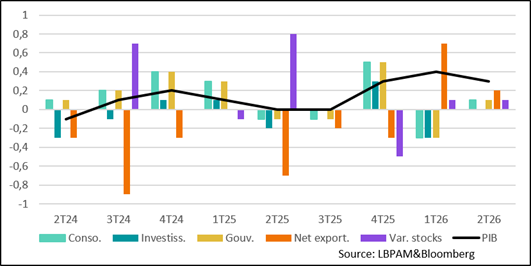
Indeed, the detailed breakdown of demand components contributing to GDP growth in Q2 2026 shows that the largest contribution once again came from the export sector. Domestic demand remained lagging behind.
In particular, investment is still struggling to gain momentum, while the rebound in consumption, although welcome, remains very modest.
Confidence continues its upward trajectory
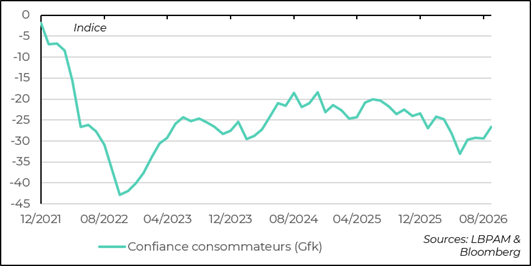
Providing a ray of hope for the outlook, the GfK survey of consumer confidence for September surprised on the upside. This improvement in confidence may be an early sign that the recovery in industry is beginning to spread to other parts of the economy. Nevertheless, caution is warranted given the more disappointing S&P survey on services activity in August.
Above all, the energy shock is not yet behind us in Europe, with gas prices in particular remaining very high. Moreover, the political climate remains tense and may further fuel anxiety. Two of the regional elections scheduled for September will take place in eastern German Länder, where the far right has made significant gains. In particular, in the state of Saxony-Anhalt, there is a strong possibility that the AfD could secure a majority. Such an outcome could further weaken the country's ruling coalition.
Be that as it may, we continue to expect this cyclical recovery in the euro area to persist, even though energy constraints remain a major source of uncertainty. In addition, the sharp rise in interest rates over the past month represents a new headwind to economic expansion. We still believe that the ECB will raise its key interest rates once more, but we remain skeptical about the need for a more aggressive monetary policy tightening. Nevertheless, this risk remains present, with market expectations continuing to be more hawkish than our own.
United States: Consumer Spending Remains the Main Driver of Growth
The contribution to growth was revised upward in Q2 2026
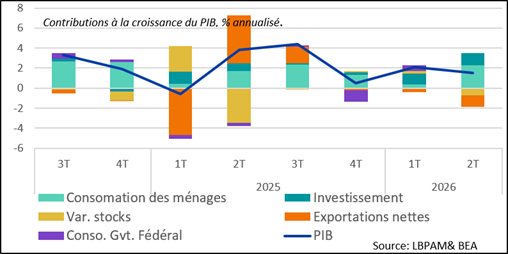
In the latest release of U.S. GDP data, the growth rate was left unchanged at an annualized 1.5%. However, the contribution of the various demand components was revised, with consumer spending making an even larger contribution to growth. Indeed, the contribution of consumption was revised up to 2.3%, making it by far the main driver of GDP growth in Q2 2026. This represents a strong rebound from Q1 2026 and is partly explained by government transfers at the beginning of the quarter. Nevertheless, the strength of consumer spending remains surprising given the magnitude of the energy shock.
At the same time, the resilience of activity in both manufacturing and services, which has allowed the labor market to remain relatively strong, may help explain this robustness. It should be noted that, particularly in manufacturing, although momentum has softened somewhat recently, the dynamism of sectors linked to artificial intelligence has remained a powerful driver of economic growth in the United States. This is one of the factors that continues to support gains in the U.S. equity market.
…but consumer spending stalled in July
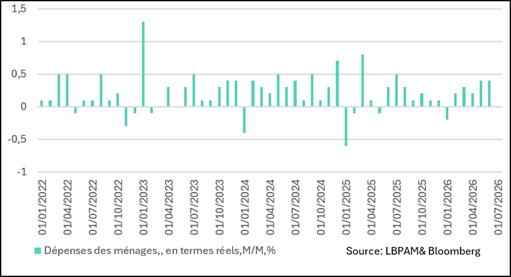
At the same time, July data on real household spending proved somewhat disappointing, with real consumer spending stagnating.
Nevertheless, it is difficult at this stage to foresee a significant adjustment in consumer spending. Not only did the services PMIs rebound strongly in August, but labor market data continue to show no signs of deterioration. In particular, jobless claims remain at relatively low levels, pointing to continued resilience in employment conditions.
However, we believe that consumer spending is likely to moderate in Q3 2026, primarily due to persistently high energy prices and tighter credit conditions resulting from higher interest rates.
Inflation Eases in August but Remains Elevated
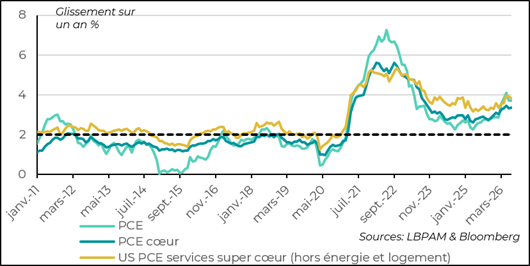
An important factor in the inflation outlook remains price developments, while wage growth has continued to moderate.
Inflation in July, as measured by the Personal Consumption Expenditures (PCE) price index, the Federal Reserve’s preferred inflation gauge, came in slightly higher than expected, although it moderated compared with the previous month.
Nevertheless, headline inflation remains elevated, rising by 3.7% year-on-year, while core inflation was unchanged at 3.3%.
At the same time, services inflation shows few signs of easing, with annual price growth still running at around 3.9%.
Indicators point to a very modest slowdown
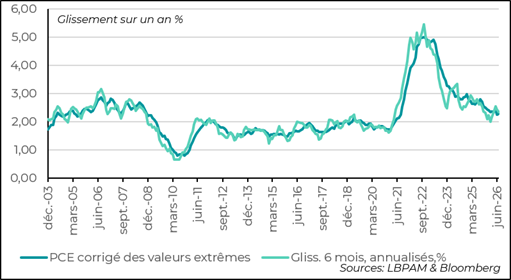
Trend indicators point to a continued moderation in inflationary pressures, albeit at a very gradual pace. This is notably the case for the Dallas Fed’s trimmed mean inflation measure, which excludes goods and services that experienced extreme price changes during the month.
While inflation remains too high and continues to weigh on household consumption, the latest data are likely to be viewed by the Federal Reserve as relatively reassuring. They are unlikely to settle the debate between the more hawkish members of the Federal Open Market Committee, who advocate further monetary tightening, and those who oppose it. However, they should support keeping policy rates unchanged at the September meeting.
Given the current level and trajectory of inflation, and especially in light of K. Warsh’s commitments, we continue to expect a rate hike before the end of the year.
Markets will be primarily focused this Friday on K. Warsh’s speech at the Jackson Hole conference, as investors look for clues about how the new Fed Chair interprets recent economic and financial developments and about the future direction of monetary policy. We believe that, while he is likely to reiterate his commitment to bringing inflation back to the 2% target, as he has done previously, his remarks will provide little concrete guidance on the outlook for monetary policy. A surprise would be for him to comment on Treasury Secretary S. Bessent’s recently announced bond market intervention measures.

Sebastian Paris Horvitz
Director of Research