Uncertainties surrounding the U.S. elections
Link

What should investors take away from market developments on November 03, 2026? Sebastian Paris Horvitz shares his analysis and insights.
Overview
► U.S. congressional elections will take place tomorrow. Polls currently show Democrats as the favorites to regain control of the House of Representatives. However, their ability to recapture a majority in the Senate remains more uncertain.
► For markets, whether the outcome is viewed positively or negatively will depend primarily on the degree of uncertainty it generates. A “blue wave”, resulting in Democratic control of Congress, could be interpreted favorably by investors. Despite tensions with the President, such an outcome would likely be seen as positive for public finances. Indeed, political opposition between the two parties would tend to restrain government spending. Conversely, Republicans retaining control of the Senate would represent a more mixed scenario, reminiscent of the configuration observed following the 2018 midterm elections.
► One scenario that could unsettle markets would be a challenge to the election results, particularly by the current administration. This possibility stems from numerous statements and initiatives aimed at casting doubt on the electoral process. In addition, a large Democratic victory could weigh on certain key sectors, notably artificial intelligence, given Democrats’ proposals to strengthen regulation of the industry.
► We remain relatively cautious on markets in the short term. However, the most likely scenario remains a more or less decisive Democratic victory, which would primarily result in a rebalancing of political power in the United States. Such an outcome would likely limit the adoption of extreme or overly divisive measures when the new Congress takes office on January 3, 2027.
► The evolution of the conflict with Iran remains the market’s primary concern. Over the weekend, President Trump sent mixed signals. Initially echoing calls from Israeli Prime Minister Benjamin Netanyahu, he raised the possibility of military strikes against Iran. He later softened his stance, stating that he would allow more time for diplomacy. These remarks were followed by statements from the Iranian government indicating that negotiations were underway, with the approval of Supreme Leader Ayatollah Ali Khamenei, with a view to reaching an agreement.
► The announcement of these discussions led to a decline in oil prices. Brent crude fell by more than $9 per barrel to $104, its lowest level in two weeks. European natural gas followed a similar path, falling back to €94/MWh. While these levels remain elevated, the speed of this adjustment highlights the significant downward impact that a normalization of oil flows through the Strait of Hormuz could have on energy prices.
► At this stage, Iranian authorities appear to have proposed a peace plan broadly similar to those discussed previously. The proposal would include a swift reopening of the Strait of Hormuz in exchange for the lifting of certain U.S. sanctions and the release of frozen financial assets. Shipping through the strait would then be jointly administered by Iran and Oman.
This initiative could also pave the way for renewed negotiations over Iran’s nuclear program. However, further adjustments may still be required to address the expectations of the U.S. administration. A positive announcement in the coming days would represent very good news for the global economy.
► At the same time, questions about the profitability of investments in artificial intelligence continue to persist. In equity markets, particularly in the United States, technology stocks and semiconductor companies remain under pressure. This debate is likely to continue given the uncertainty surrounding the market’s ability to absorb the sector’s still substantial financing needs. In this context, a significant decline in energy prices would help ease pressure on interest rates and reduce financing costs.
► We maintain a cautious stance in our asset allocation. Nevertheless, a faster-than-expected decline in energy prices would remove a significant headwind to economic growth and would be supportive of risk assets, particularly the more cyclical segments of the market.
► In the euro area, in an unscheduled announcement, ratings agency Fitch revised the outlook on French sovereign debt from “stable” to “negative”, while maintaining its A+ rating. This decision reflects a deterioration in growth prospects, higher financing costs, and a larger-than-expected public deficit compared with the assumptions underlying its most recent review in August 2026. While the decision did not come as a major surprise, it was announced earlier than expected. The spread between France and Germany remained broadly unchanged and even continued to narrow, supported by lower energy prices, although it remains at historically elevated levels.
► Contrary to market concerns, S&P’s final PMI surveys for October confirm the resilience of global manufacturing activity. Although the global index compiled by JPMorgan edged lower, it remains close to its highest levels since 2022.
► In the United States, S&P’s manufacturing PMI has followed a similar trajectory to the global index. The modest slowdown observed in October was mainly driven by softer growth in new orders and manufacturing output. Despite this moderation, activity remains sufficiently robust to support employment growth.
Meanwhile, the ISM Manufacturing Index has returned to its highest level since July, a level not seen since the spring of 2022. Investments linked to artificial intelligence, particularly in data centers, continue to provide strong support for the expansion of industrial activity.
However, some supply bottlenecks are beginning to re-emerge, with delivery times lengthening and cost pressures remaining elevated.
► In the euro area, S&P’s manufacturing PMI for October came in slightly above the preliminary estimate. The resilience of activity in Spain partly explains this upward revision. By contrast, some countries, including France and Italy, continue to experience a mild contraction, with PMI readings below 50, the threshold separating expansion from contraction in economic activity.
It is nonetheless worth emphasizing that, at the euro area level, manufacturing activity remains in expansionary territory despite the recent economic shocks.
► In China, the official PMIs for manufacturing and services, which primarily reflect the activity of large state-owned enterprises, disappointed by slipping slightly back into contraction territory. This development highlights the persistent weaknesses of the domestic economy and could justify further support measures from the authorities. Nevertheless, policymakers continue to rely on the resilience of external trade. By contrast, the private-sector manufacturing PMI, although slightly lower, remains in expansionary territory.
To go further
U.S. Elections: Democrats Close to Securing a Majority in Congress
The Senate remains the key uncertainty, although Democrats could also secure a majority there
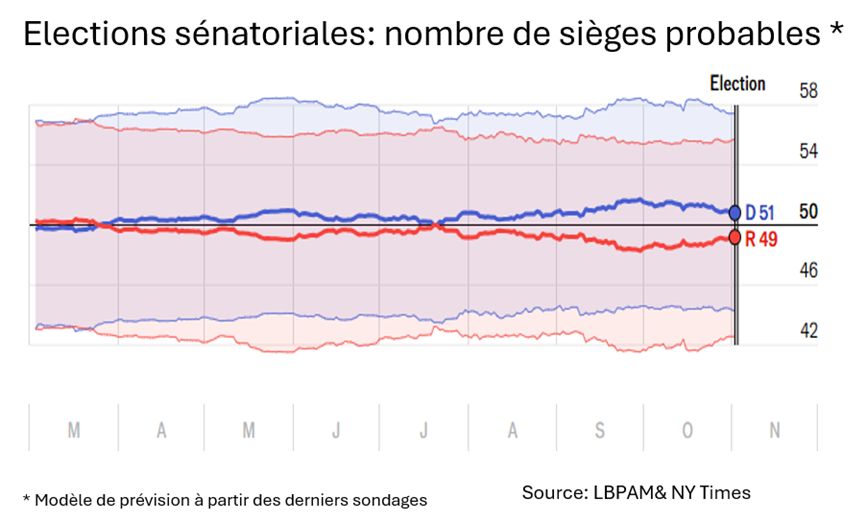
Polls and prediction markets, notably on platforms such as Kalshi and Polymarket, currently show Democrats as the clear favorites to win control of the House of Representatives. They are therefore expected to secure a majority in the chamber.
However, the outcome of the Senate race appears more uncertain. While Democrats also have a chance of regaining a majority there, their prospects seem more limited. Indeed, only one-third of Senate seats are contested at each election and, this year, many of the seats up for election are located in states that have traditionally leaned Republican.
As a result, polls assign Democrats only a relatively modest probability of taking control of the Senate. Even in the most favorable scenario, they would likely secure only a very narrow majority, with just a one-seat advantage.
Naturally, political polarization in the United States is now so intense that it remains difficult to make fully reliable forecasts. Consequently, despite the President’s high level of unpopularity and the central role of purchasing power in the electoral campaign, the outcome of the vote remains uncertain.
We could therefore see a configuration similar to that of the 2018 midterm elections during Donald Trump’s first term, with Democrats controlling the House of Representatives while Republicans retain their majority in the Senate.
The key difference this time is that several major promises made to Republican voters, particularly on purchasing power and foreign policy, including U.S. military interventions abroad, have not been fully delivered.
Prediction markets assign a higher probability to Democrats regaining control of the Senate
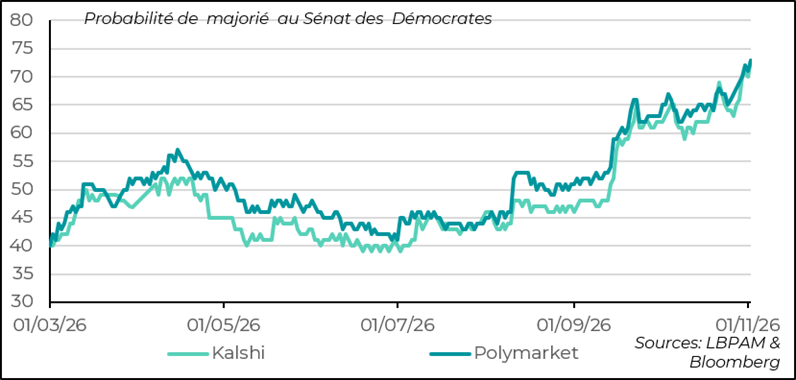
In prediction markets, opposition to the current administration appears to be a more dominant theme. As a result, the probability of a Democratic victory in the Senate has continued to rise over recent months and has now reached its highest level of the campaign, exceeding 70%.
Republicans benefited from substantial financial resources throughout the campaign
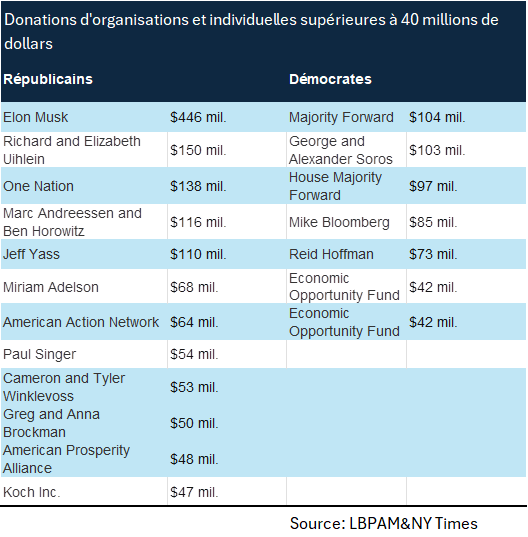
The outcome of these elections also remains highly uncertain given the considerable financial resources deployed throughout the campaign, particularly on the Republican side. Unprecedented sums have been spent in an effort to influence the outcome of the vote. Elon Musk alone is reported to have contributed nearly $450 million in support of Republican candidates, an exceptional amount for an individual donor.
In addition, the current administration has multiplied legal challenges aimed at contesting or invalidating certain election results pre-emptively, although none have been successful so far.
As recently as yesterday, the Supreme Court rejected a request to exclude nearly 20,000 ballots in California, after it had already been dismissed by lower courts.
Challenges to the election results or delays in their certification represent one of the main near-term risks for financial markets. Such a scenario would increase political uncertainty and could trigger a renewed bout of market volatility.
From an investor’s perspective, the most favorable outcome would likely be a divided government. Such a configuration would probably limit the expansion of public spending, as each party would be able to counterbalance the other’s fiscal and budgetary initiatives.
At a more sector-specific level, as concerns over the substantial financing needs of the artificial intelligence ecosystem continue to grow, a Democratic victory could also lead to increased pressure for tighter regulatory oversight of the sector.
Conversely, a Congress more actively involved in seeking a resolution to the conflict with Iran could contribute to a significant easing in energy prices. Such a development would support consumer purchasing power, improve global growth prospects and, consequently, encourage greater risk-taking in financial markets.
Global Manufacturing Activity: Slight Slowdown, but Growth Remains Robust
Despite the Turbulence, Global Manufacturing Activity Remains Resilient
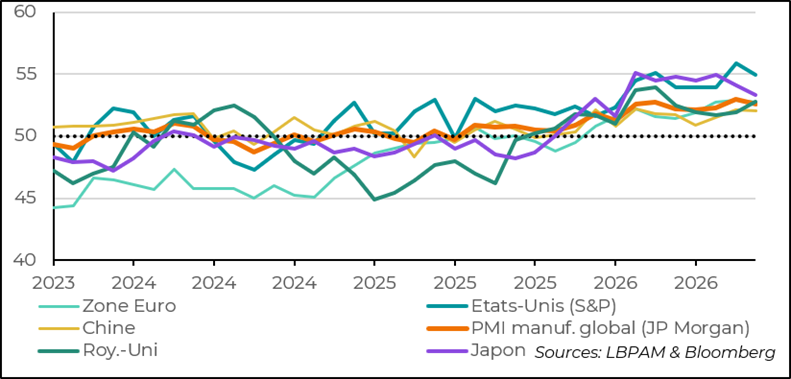
S&P’s final PMI survey confirms the resilience of global manufacturing activity, which continues to expand despite the slight slowdown observed in October. Manufacturing has once again demonstrated a strong ability to withstand recent economic shocks, including higher energy prices, tighter financial conditions and rising interest rates.
This resilience can largely be attributed, across many economies, to the strength of investment linked to the development of the artificial intelligence ecosystem.
Spending on digital infrastructure, data centers and semiconductors continues to provide significant support to manufacturing activity. This trend also helps explain why the United States continues to enjoy a more favorable industrial outlook than most other developed economies.
At the same time, cost pressures remain elevated globally, particularly due to high energy prices. In the United States, strong demand is also leading to the re-emergence of supply chain bottlenecks. These pressures are reflected in longer delivery times and are making it easier for companies to pass higher production costs on to customers through increased selling prices.
United States: Manufacturing Activity Remains Robust
United States: The ISM Manufacturing Survey Improves Again
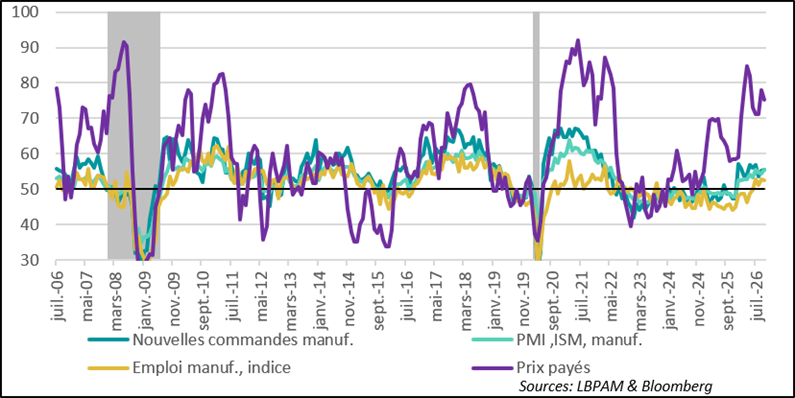
The ISM Manufacturing Survey, widely regarded as one of the most reliable indicators of U.S. industrial activity, once again pointed to an acceleration in activity. This improvement was driven primarily by strong order growth and faster production, highlighting continued strength in underlying demand.
However, this momentum is not without consequences. Robust demand is placing increasing pressure on production capacity and is generating new bottlenecks in certain industries. In this environment, manufacturers enjoy greater pricing power, enabling them to pass on rising costs, particularly energy-related costs, more easily to their customers.
In addition, strong demand and continued pressure on production capacity are supporting employment in the manufacturing sector.
The employment component of the survey remains in expansionary territory, confirming that manufacturers continue to hire in order to meet a still favorable business environment.
Wage Pressures: Signs of Contained Inflationary Pressures
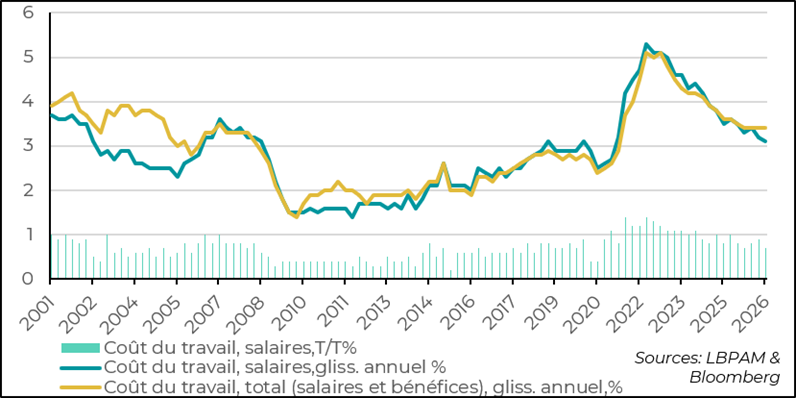
Despite a labor market that remains robust, as evidenced in particular by the ISM survey, wage pressures remain broadly contained. The Employment Cost Index (ECI) has remained stable, rising by 3.4% year-on-year. This increase is driven primarily by higher employee benefits, while wage growth continues to moderate, slowing to 3.1% in the third quarter of 2026.
This development is encouraging from an inflation perspective, as it suggests that labor market tightness is not translating into accelerating wage growth. In the absence of a wage-price spiral, domestically generated inflationary pressures should therefore remain relatively well contained.
Euro Area: Industrial Activity Holds Up, but Significant Differences Persist Across Countries
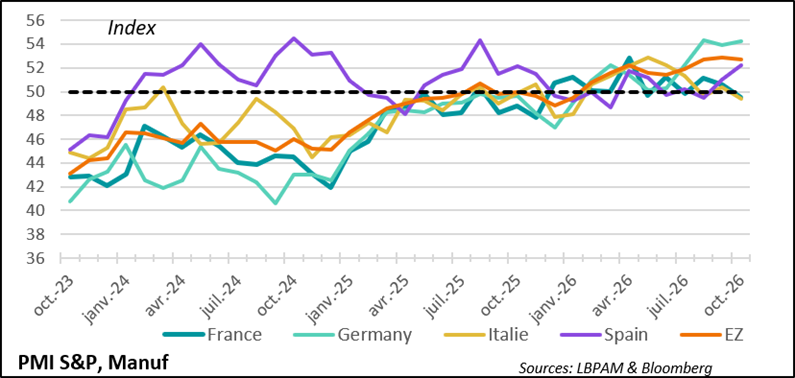
In the euro area, manufacturing activity has also demonstrated resilience, although significant disparities across countries in the region remain.
While activity remains well supported in Germany and Spain, conditions appear more challenging in France and Italy, even though the indicators came in somewhat stronger than the preliminary survey had suggested. Germany’s fiscal stimulus program continues to provide meaningful support to the country’s industrial sector, which is also benefiting from solid export performance. This combination has allowed Germany to maintain favorable manufacturing momentum despite an international environment that remains highly uncertain.
Overall, manufacturing activity in the euro area has slowed slightly but remains in expansionary territory, highlighting its resilience in the face of energy-related pressures, still-elevated interest rates and ongoing geopolitical uncertainties.
Euro Area GDP Continued to Expand in the Third Quarter of 2026
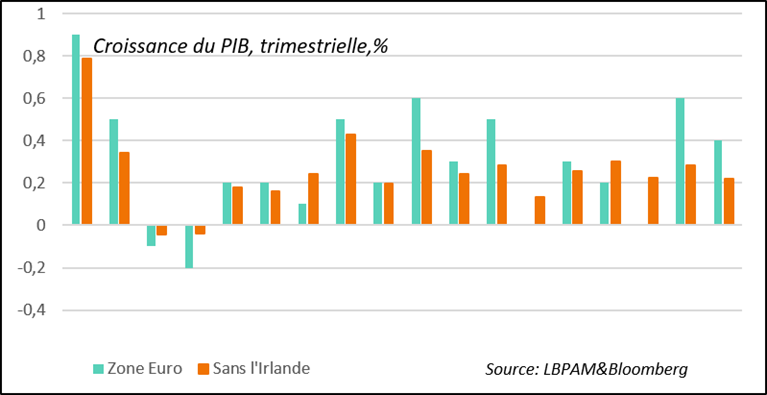
These activity indicators for the beginning of the final quarter of the year are consistent with the euro area’s ongoing growth momentum. Accordingly, the region’s GDP continued to expand in the third quarter of 2026, rising by 0.6%.
This performance was admittedly boosted by Ireland’s contribution, as Irish GDP is particularly volatile due to the tax optimization strategies of many multinational corporations and the significant fluctuations in the income flows they report there. Nevertheless, even excluding Ireland, the euro area economy continued to grow during the period, confirming the resilience of economic activity despite an economic and geopolitical environment that remains highly uncertain.
...but with significant disparities across countries
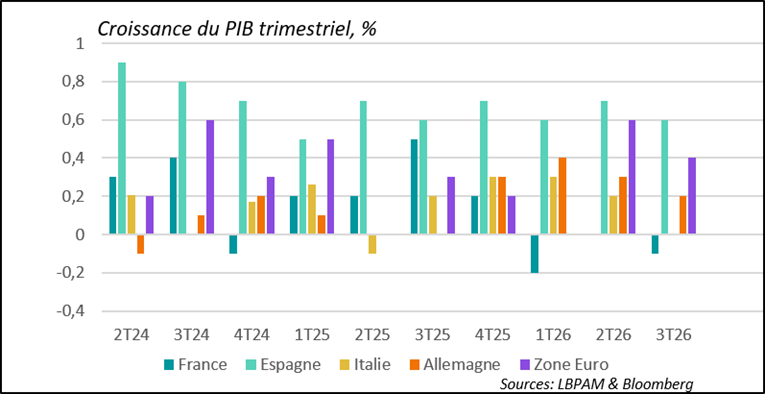
However, as with the activity indicators, significant disparities remain across the major euro area economies. Spain continues to be the strongest performer, while Italy and France are posting the weakest growth rates.
In France, the contraction in GDP was primarily driven by the negative contribution of net exports. Domestic demand, however, appears somewhat more resilient, helping to partially offset this weakness. Nevertheless, given the uncertain political environment, the ongoing energy shock and increasingly limited fiscal room for maneuver, it is difficult to envisage a meaningful rebound in the French economy in the near term.
China: Industrial Activity Remains Resilient, but Sectoral Disparities Persist
China: An Economy Still Moving at Two Speeds
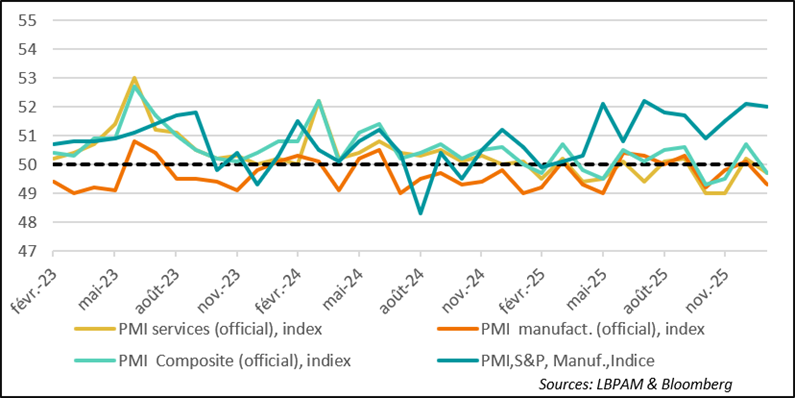
China’s official PMI survey for October disappointed, with the composite index (manufacturing and services) slipping back slightly into contraction territory. This development points to a renewed loss of momentum in domestic economic activity.
The official PMIs mainly reflect the performance of large state-owned enterprises, which are more exposed to domestic demand. As such, they highlight the persistent weaknesses of the Chinese economy. This situation could prompt policymakers to introduce additional targeted support measures in order to keep economic activity on a growth trajectory.
At the same time, S&P’s manufacturing PMI remained more encouraging. Although it pointed to a slight slowdown in October, it continues to signal solid expansion. This indicator is more representative of the private sector and export-oriented companies, which continue to benefit from resilient external demand.
China’s economy therefore remains characterized by a two-speed dynamic: on the one hand, a domestic economy that is struggling to regain meaningful growth momentum; on the other, an export sector that continues to support industrial activity and overall economic growth.

Sebastian Paris Horvitz
Head of of Researc