US employment confirms its solidity in August
Link

Between the resilience of global activity, the strength of US employment, and persistent tensions in energy markets, Sebastian Paris Horvitz, Director of Research, deciphers the main market drivers as we enter September.
Overview
► As the conflict between the United States and Iran enters its seventh month, exchanges of strikes continue to fuel tensions on energy markets. The Brent oil price remains close to $97 per barrel, while the price of gas in the Eurozone is at a multi-year high at $73 per MWh.
► It remains difficult to discern the US crisis exit strategy, which reinforces the scenario of a stalemate in the conflict. However, the flows already passing through the Strait of Hormuz, combined with still relatively moderate global demand, help avoid a more significant shock to energy prices.
► In addition, the Iranian authorities announced that an agreement with Oman aimed at regulating maritime traffic in the Strait of Hormuz is imminent. If this agreement were also accepted by the United States, trade flows could gradually return to a more normal state of operation, bringing relief to the energy markets. However, significant uncertainty remains at this stage.
► In the eurozone, the AfD's historic result in the regional elections in the German state of Saxony-Anhalt puts the party on the threshold of power. Despite nearly 44% of the vote, he is three seats short of obtaining a majority and taking the head of the Land. The leaders of the other political formations, however, reaffirmed their refusal to govern with the AfD.
► It remains to be seen whether an "anti-AfD" coalition can be formed to govern the region. One thing is certain: the German government emerges weakened from this election, with in particular a historic decline for the CDU, the party of Chancellor Friedrich Merz. For the rest of Europe, the signal also appears worrying, given the electoral weight reached by a Eurosceptic party favorable to a rapprochement with Russia.
► However, this political development should not jeopardise the implementation of the recovery plan currently underway, which is expected to continue supporting the German economy and, more broadly, the European economy.
► In this context, the latest economic data from the eurozone remain relatively well-oriented and continue to surprise analysts favorably. The zone's GDP was revised upwards, in particular, for the second quarter of 2026, to 0.6%.
► However, this revision mainly reflects the very strong growth recorded in Ireland (+10.2%), linked to a significant increase in the revenues of multinationals. Excluding Ireland, growth was 0.3% for the quarter, while the French economy stagnated.
► Meanwhile, the Sentix investor confidence index rebounded quite significantly in September, reaching its highest level since the beginning of 2022. This development is encouraging and even surprising in a context where the energy shock continues to weigh on the eurozone. However, the cyclical recovery dynamic remains favorable.
► In the United States, the August employment report was much stronger than expected. According to the business survey, job creations reached 162,000 over the month, while previous month figures were revised upwards.
► In addition, the unemployment rate remained stable at 4.1%. The participation rate even rebounded slightly, ending the downward trend observed since the beginning of the year.
► Wages also increased at a slightly faster pace than the previous month, although their year-on-year growth remains the lowest seen since May 2021.
► The strong labor market thus supports the main concern of the members of the Fed's monetary policy committee, namely inflation. We continue to expect a rate status quo at next week's meeting. The decision will largely depend, however, on the inflation figures to be published at the end of the week.
► These data should also be decisive for interest rate developments, which remain under pressure in an environment marked by persistently high energy prices.
► Finally, China's foreign trade statistics for August confirmed the major role played by exports in the country's growth. Exports, expressed in dollars, increased by 25% year on year.
► This increase is largely due to the rise in exports of technological products related to the development of artificial intelligence. At the same time, imports also increased significantly, by 28.2% year-on-year.
► However, it should be noted that the increase in prices of these technological goods, both for exports and imports, masks less spectacular volume increases. Despite this, the contribution of net exports to Chinese GDP growth remains particularly significant.
To go further
Eurozone: growth holds up well in the second quarter
Economic data continues to surprise on the upside
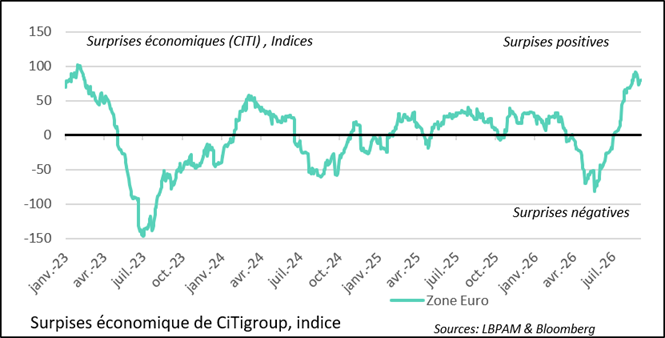
It is clear that the energy shock caused by the war in Iran remains a major constraint on European growth, particularly with a gas price at historically high levels. Nevertheless, recent data show that the Eurozone has shown a certain resilience so far, although significant differences persist between countries. In fact, economic data continued to surprise positively during the summer.
This situation largely reflects the cyclical recovery of the industrial sector, a global phenomenon that is currently supporting growth. In Europe, this recovery is also driven by continued public spending in Germany.
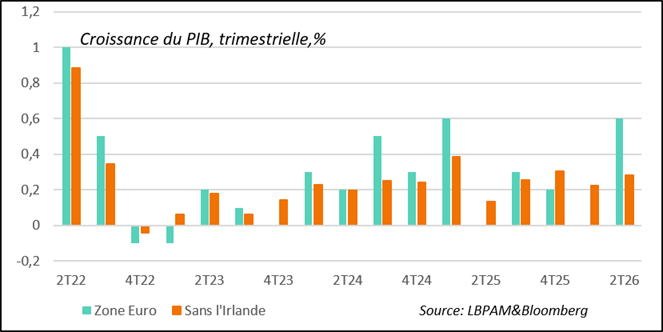
The GDP figures for the second quarter of 2026 confirmed this resilience, even though the recent upward revision somewhat exaggerates the real dynamics of the Eurozone. Indeed, the 0.6% growth over the quarter is largely explained by Ireland, whose GDP soared by 10.2%. This figure mainly reflects a sharp increase in the revenues of multinational corporations located in the country for tax reasons, which explains the strong volatility of Irish GDP.
Excluding Ireland, which represents approximately 3 % of eurozone GDP, growth was 0.3 % for the quarter. This pace nevertheless remains a sign of relatively favorable economic momentum.
As we have already pointed out, growth was mainly driven by Germany and the southern European countries, while France continues to lag behind. The French GDP indeed stagnated over the period.
Investors remain optimistic about the outlook
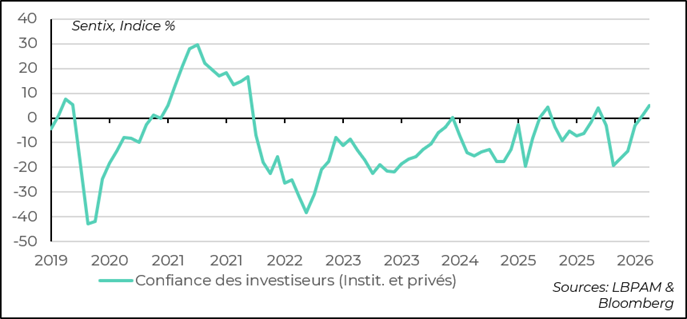
For now, the positive dynamics of the industrial cycle and the German recovery plan continue to support investor confidence. Thus, the Sentix indicator continued to rebound to reach its highest level since 2022.
Of course, persistent tensions in energy markets remain a drag on the region's expansion, much like rising interest rates. Against this background, the ECB will have to be careful, in our view, in the conduct of its monetary tightening so as not to excessively weigh on growth.
Therefore, after the expected increase this week, we anticipate only one further increase in key interest rates by the end of the year.
United States: employment is in good health in August
The US economy remains close to full employment
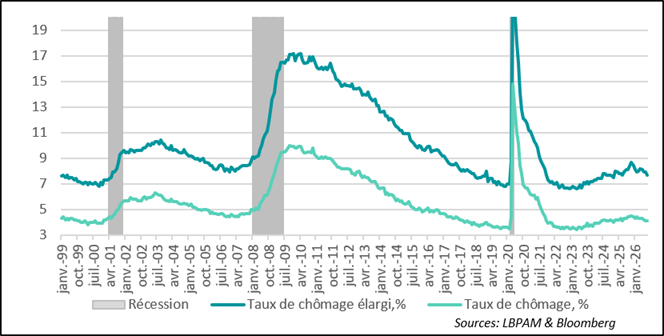
In the United States, the employment report for August was better than expected. It shows that the US economy remains near full employment, with an unemployment rate stable at 4.1%.
The participation rate stops decreasing
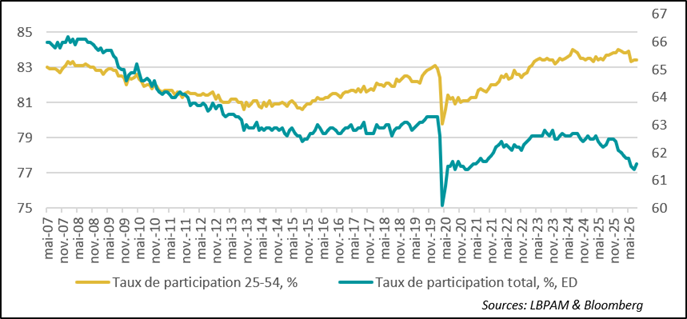
The stability of the unemployment rate resulted in particular from a labor market that remained dynamic throughout the month, with strong job creations, even as the participation rate increased, ending several months of decline.
Robust job creations
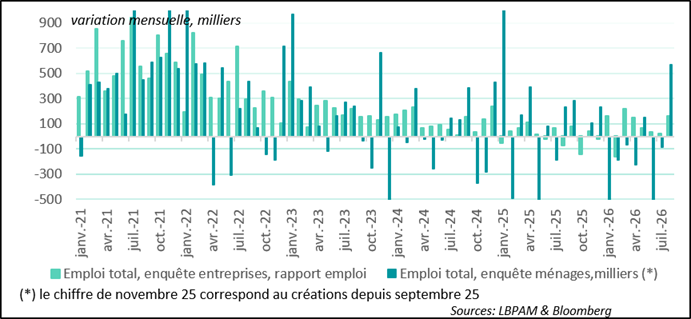
Job creations were also particularly strong. The business survey reports 162,000 job creations, almost three times more than consensus expectations. In addition, the figures for previous months were revised upwards by 55,000 additional jobs.
The health and leisure sectors remain among the main job creators. Activities related to the development of infrastructure necessary for artificial intelligence also contributed to this good performance of the labor market.
The household survey delivers a similar message, with more than 500,000 job creations recorded during the month.
Wages are gradually slowing down
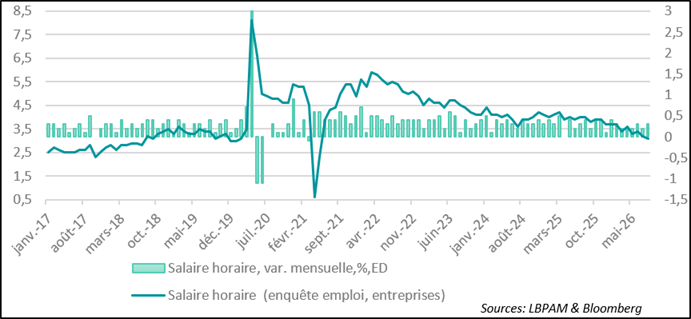
At the same time, wage growth remained moderate. These increased by 0.3% over the month, while their year-on-year growth continued to slow down to 3.1%, its lowest level in several years.
These data support the analysis of the members of the Fed's monetary policy committee, who believe that the labor market remains strong and consistent with their goal of maintaining full employment.
The next decisions of the Fed will therefore depend mainly on the evolution of inflation. Therefore, the publication of the CPI index scheduled for Friday will play an important role in next week's decision.
We continue to believe that key interest rates should remain unchanged, even though pressure is growing on K. Warsh to act in order to be consistent with his commitment to quickly bring inflation back to the 2% target.
China: exports remain a growth driver
Foreign trade continues to support activity
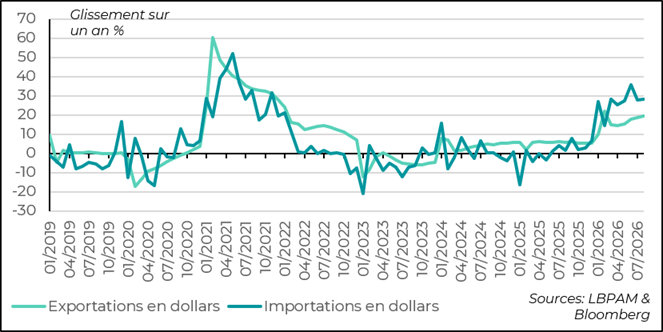
Chinese trade figures confirmed that exports remain a significant driver of growth. Exports expressed in dollars thus increased by 25% year on year.
The largest contribution once again comes from the technology sectors, benefiting from strong global demand for equipment related to the development of artificial intelligence.
Imports also continued to grow strongly. Again, purchases of technological equipment, particularly semi-conductors, made a significant contribution to this increase.
Of course, price effects, which remain very significant both at imports and exports, greatly amplify the observed increase in trade flows.
Therefore, in volume terms, the increase in net exports seems less spectacular, but it should still continue to make a significant contribution to GDP growth in the third quarter of 2026.
Exports to the United States continue to grow despite customs tariffs
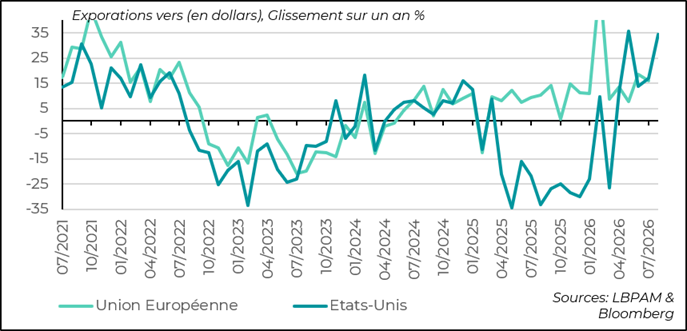
It should be noted that, despite the trade restrictions imposed by the United States, Chinese exports to the US market continue to grow strongly, with an increase of over 34% year on year.

Sebastian Paris Horvitz
Head of of Researc